Willsboro in Essex County, New York — The American Northeast (Mid-Atlantic)
Bouquet River
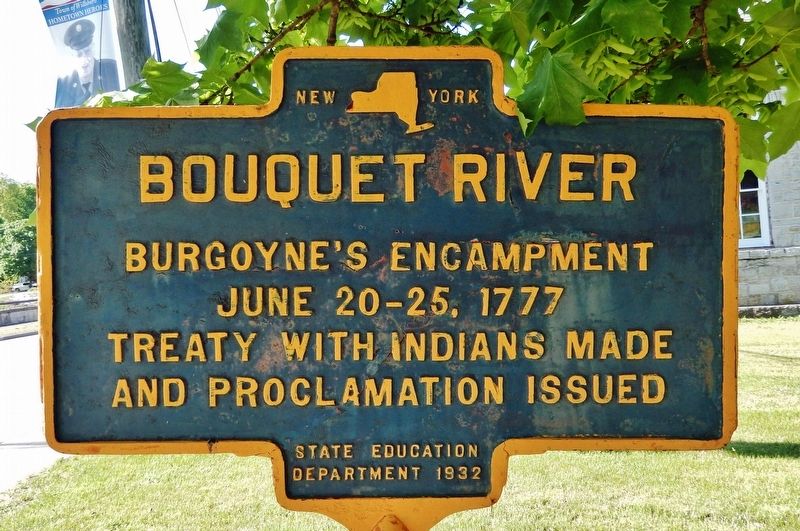
Photographed by Cosmos Mariner, May 18, 2024
1. Bouquet River Marker
Treaty with Indians made and proclamation issued
Erected 1932 by State Education Department.
Topics. This historical marker is listed in these topic lists: Indigenous Peoples and Communities • War, US Revolutionary • Waterways & Vessels. A significant historical date for this entry is June 20, 1777.
Location. 44° 21.849′ N, 73° 23.417′ W. Marker is in Willsboro, New York, in Essex County. It is on Gilliland Lane just north of Main Street (New York State Route 22), on the right when traveling north. The marker is located in front of the Paine Memorial Library. Touch for map. Marker is at or near this postal address: 2 Gilliland Lane, Willsboro NY 12996, United States of America. Touch for directions.

Regionally, this marker is in Upstate New York, in the Adirondacks & North Country, and in the Champlain Valley. It is also in the American Northeast and in the Mid-Atlantic. Globally, it is in North America, the Great North Woods, the Western Hemisphere, the Western World, and the Anglosphere. Historically, it finds itself in what was once the Viceroyalty of New France,
this page online
Other nearby markers. At least 8 other markers are within 4 miles of this marker, measured as the crow flies: Willsboro (approx. 0.2 miles away); a different marker also named Willsboro (approx. 0.2 miles away); Memorial Cemetery (approx. one mile away); Masonic Hall (approx. 2 miles away); Lakeview Cemetery (approx. 2.6 miles away); Site of Willsborough Blockhouse (approx. 3.7 miles away); Willsborough Block House (approx. 3.7 miles away); The Adsit Cabin (approx. 4 miles away). Touch for a list and map of all markers in Willsboro.
Also see . . .
1. General Burgoyne’s Proclamation (teachingamericanhistory.org). Excerpt:
...I have but to give stretch to the Indian Forces under my direction, and they amount to Thousands, to overtake the harden’d Enemies of Great Britain and America, (I consider them the same) wherever they may lurk. If notwithstanding these endeavours, and sincere inclinations to effect them, the phrenzy of hostility shou’d remain, I trust I shall stand acquitted in the Eyes of God & Men in denouncing and executing the vengeance of the state against the wilful outcasts...(Submitted on July 29, 2024, by Cosmos Mariner of Cape Canaveral, Florida.)
JohnBurgoyne, Camp at Bouquet Ferry, June 20th, 1777Photographed by Cosmos Mariner, May 18, 20242. Bouquet River MarkerLooking south; Paine Memorial Library is in the left background; Gilliland Lane is on the right.

2. General John Burgoyne (Wikipedia). Excerpt:
A British general, dramatist and politician who sat in the House of Commons from 1761 to 1792, Burgoyne is best known for his role in the American Revolutionary War. He designed an invasion scheme and was appointed to command a force moving south from Canada to split away New England and end the rebellion. Burgoyne advanced from Canada but his slow movement allowed the Americans to concentrate their forces. Burgoyne fought two small battles near Saratoga but was surrounded by American forces and, with no relief in sight, surrendered his entire army of 6,200 men on 17 October 1777.(Submitted on July 29, 2024, by Cosmos Mariner of Cape Canaveral, Florida.)
3. Burgoyne Campaign of 1777 (US History.com). Excerpt:
In early 1777, American military leaders and members of Congress were aware that Major General John Burgoyne maintained a considerable force in Canada, but assumed that when those forces were readied for action it would be in an offensive(Submitted on July 29, 2024, by Cosmos Mariner of Cape Canaveral, Florida.)against Philadelphia, the American capital city. Few colonists believed that the British would again try an assault southward down Lake Champlain, as they had done unsuccessfully in the early stages of the war. Despite the American assumption, Burgoyne had received the consent of Lord Germain and George III for the southward move. On June 17, British forces departed from St. John’s in a huge procession of more than 8,000 men, extensive artillery and dozens of baggage wagons. By the end of the month, the army had reached the first important rebel strongholds and commenced a series of encounters...Photographed by Cosmos Mariner, May 18, 20243. Bouquet River MarkerLooking north; Willsboro Heritage Center is in the right background; Gilliland Lane is on the left.

Credits. This page was last revised on July 29, 2024. It was originally submitted on July 29, 2024, by Cosmos Mariner of Cape Canaveral, Florida. This page has been viewed 269 times since then and 48 times this year. Photos: 1, 2, 3. submitted on July 29, 2024, by Cosmos Mariner of Cape Canaveral, Florida.
