Fulton in Callaway County, Missouri — The American Midwest (Upper Plains)
Jeff Davis Comes to the Kingdom
| — | Missouri's Civil War | — |

Photographed by Duane and Tracy Marsteller, July 1, 2024
1. Jeff Davis Comes to the Kingdom Marker
He arrived in Fulton by train on the afternoon of Sept. 10, 1875, after an address at DeSoto, Missouri. He was welcomed here at this gracious Italianate home of Missouri's attorney general, John A. Hockaday. In a spirit of fellowship and reconciliation, Davis was honored with a reception and sumptuous dinner including both Southern and former Union political leaders.
Davis came to speak on behalf of an English venture, the Mississippi Valley Association, seeking to foster agricultural trade with, and perhaps emigration to, this farming region. While Davis accepted three offers from Missouri, an Illinois invitation was withdrawn due to threats. Much of the North continued to harbor resentment toward the “arch traitor” Davis.
However, “[I]n many respects the train ride from St. Charles to the capital of the 'Kingdom of Callaway' was one long triumphal procession
this page online
Fatigue forced the ailing Davis, accompanied by his son Jeff Jr., to forego a grand tour of the fair, but after the evening's dinner here, a crowd gathered on the front lawn with a local band to serenade him. Davis responded briefly but graciously. Missouri's newly elected U.S. senator, former Confederate general Francis M. Cockrell, also spoke.
When the next day Davis' carriage arrived for his speech at the fairground – now Westminster College's Priest Field – he was greeted by the roar of an estimated 10,000-12,000 people. The Fulton Telegraph offered: “There is no man living whom our people were more anxious to meet, representing as he does the cause that had enlisted their warmest sympathies, and in defense of which they had lost and suffered so much.”
In his address Davis extolled the economic sense of agriculture as well as urged developing local manufacture as an alternative to exporting natural resources. He endorsed the “joint interest” of the upper and lower Mississippi valleys in expanding
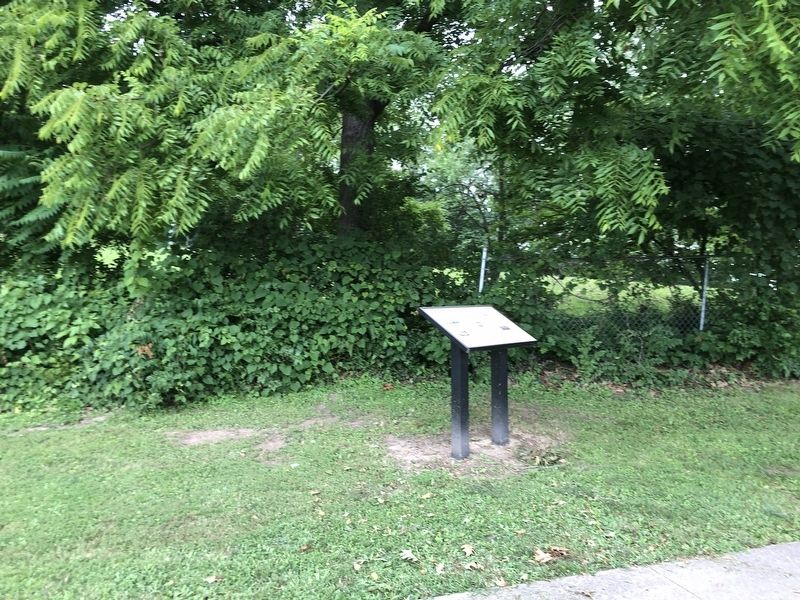
Photographed by Duane and Tracy Marsteller, July 1, 2024
2. Jeff Davis Comes to the Kingdom Marker
Davis was visibly moved by his reception and the warmth of locals he met after his address. During his speech he made a point of observing that in Callaway County the people were “King” and while he had been a Jeffersonian “republican” all his life, “if I ever move to a kingdom it shall be to the Kingdom of Callaway.” Frequently interrupted by applause, now he was roundly cheered.
Sharing the platform was Missouri Governor Charles Hardin, with whom Davis would debark later by train to enjoy the hospitality of the Governor's Mansion in Jefferson City before traveling to his final appearance in Kansas City. Hardin rose at the end of Davis' address to speak some words on his behalf, but stood aside while Davis acknowledged a thunderous ovation and the band struck up “Dixie.”
[Left column]
Antebellum Architecture in Fulton
Fulton's rich heritage housing stock manifests early 19th century origins as well as noteworthy Victorian and post-Victorian architectural designs. Some remaining antebellum homes reflect early “Little Dixie” settlers' roots in the upper South; these Greek Revival style houses have Civil War tales to tell as well.
Robnett-Payne House, 5th and N. Bluff Sts. (1857-58). Originally located west of Westminster College, this two-story white clapboard home with added lacework porch has been moved and painstakingly restored. According to the great-grandson of original owner James Robnett, during the July 17, 1861, running fight extending to Overton Run on the outskirts of Fulton, spent bullets passed through clothes on a line near the house. Also, perhaps in 1864; the widower and his children sheltered an early-hours visitor seeking refuge from Union troops – teenaged guerrilla Jesse James, who with a compatriot had stolen federal ammunition.
Dr. George M. Willing Home, 211 Jefferson St. (ca. 1850). This two-story structure featuring magnificent red brick work was built on the end-chimney “I” plan with a central hall. Kentucky-born Willing operated a general store here by 1854. A known Confederate sympathizer, when Fulton was occupied by Union troops he was arrested and imprisoned in Jefferson City, where according to lore his wife, Mary, rode on horseback accompanied by a slave and successfully appealed for her husband's release by a Union officer because both men were Masons. Fearing re-arrest, Willing barely missed local Federals while hiding in a cornfield before escaping to St. Louis on a borrowed mule.
Judge Thomas B. Nesbit Mansion, 530 Old Jefferson City Road (ca. 1840). Little is known about its construction, but this two-story red brick home with two-story portico is a fine example of some “Southern mansions” in Nesbit's native Kentucky. Thirty-nine years of age at war's onset, Nesbit successfully walked the line as a Union man in a strongly Southern county, elected circuit court clerk and recorder in 1860, remaining the latter until 1867. This household witnessed passage of the first Union troops to occupy Fulton, U.S. Reserve Corps (German Home Guards) soldiers after the fight at Overton's Run.
[Top right column] Born in Kentucky, Jefferson Davis was educated at Transylvania University and the U.S. Military Academy. As a young officer, he was posted to Jefferson Barracks (St. Louis), where he escorted Chief Black Hawk after his capture in 1832. Davis served with distinction as a colonel of volunteers in the Mexican War (where he was wounded). A Mississippi planter, he also served as a U.S. Congressman, Senator and Secretary of War.
From 1861-1865 he was the first and only president of the Confederate States of America. Demonized in the North as a traitor, after the Civil War he was imprisoned at Fortress Monroe for two years before being released on bond. In 1868 a charge of treason was dropped, but he refused to take a loyalty oath because he believed he had done nothing wrong or illegal. His full citizenship was posthumously restored by Congress in 1978.
Erected by Missouri's Civil War Heritage Foundation, Inc.
Topics and series. This historical marker is listed in these topic lists: Notable Events • War, US Civil. In addition, it is included in the Missouri’s Civil War series list. A significant historical date for this entry is July 17, 1861.
Location. 38° 50.555′ N, 91° 56.865′ W. Marker is in Fulton, Missouri, in Callaway County. It can be reached from Hockaday Avenue west of South Ravine Street, on the right when traveling west. Marker is on a path by the playground in Hockaday Park. Touch for map. Marker is at or near this postal address: 102 Hockaday Ave, Fulton MO 65251, United States of America. Touch for directions.

Regionally, this marker is in Little Dixie and in the Missouri River Corridor. It is also in the American Midwest, in the Lewis & Clark Corridor, and in the Corn Belt. Globally, it is in North America, the Western Hemisphere, the Western World, and the Anglosphere. Historically, it finds itself in what was once the territory of the Mississippian Culture, the Louisiana Purchase, and the Antebellum South.
Other nearby markers. At least 8 other markers are within walking distance of this marker: War Memorial (about 700 feet away, measured in a direct line); Memorial Park (about 700 feet away); Fulton - 1824 (approx. 0.3 miles away); Captain James Callaway (approx. 0.3 miles away); Boone's Rock (approx. 0.3 miles away); a different marker also named War Memorial (approx. 0.3 miles away); Callaway County Men at War (approx. 0.3 miles away); War Comes to Westminster College (approx. half a mile away). Touch for a list and map of all markers in Fulton.
Credits. This page was last revised on November 21, 2024. It was originally submitted on July 29, 2024, by Duane and Tracy Marsteller of Murfreesboro, Tennessee. This page has been viewed 573 times since then and 79 times this year. Photos: 1, 2. submitted on July 29, 2024, by Duane and Tracy Marsteller of Murfreesboro, Tennessee.
