Hermann in Gasconade County, Missouri — The American Midwest (Upper Plains)
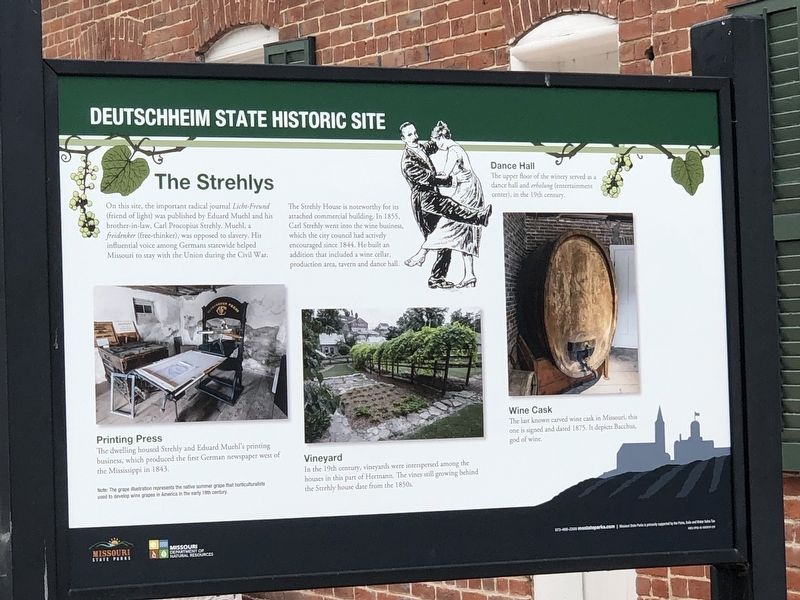
The Strehlys
⎯⎯⎯
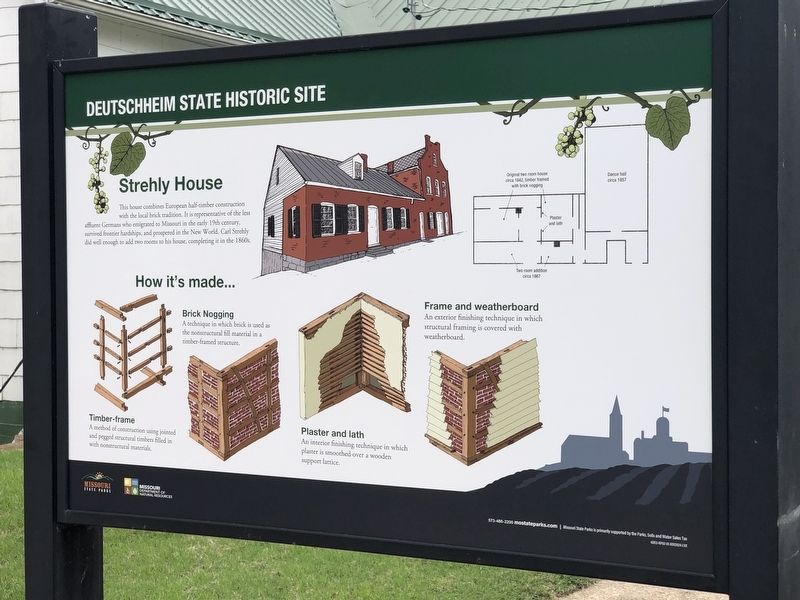
Strehly House
| — | Deutschheim State Historic Site | — |
Photographed by Duane and Tracy Marsteller, July 1, 2024
1. The Strehlys side of marker
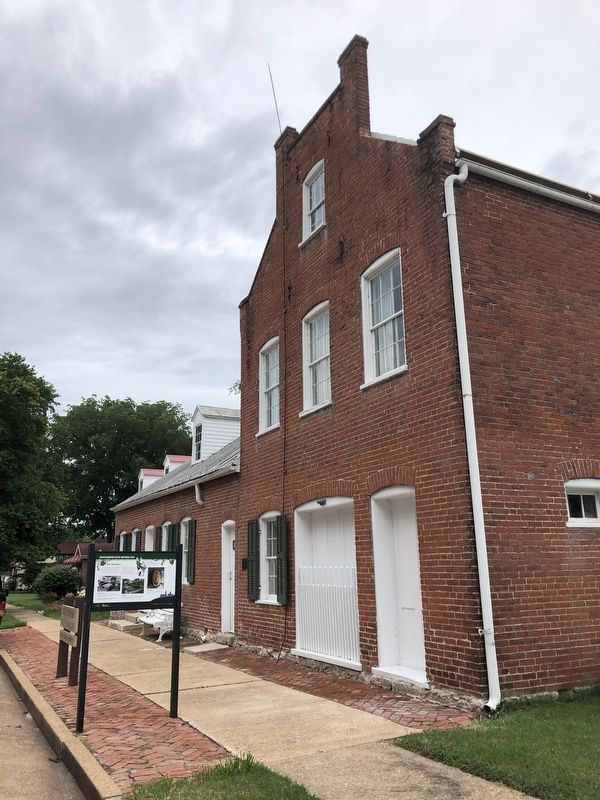
The Strehly House is noteworthy for its attached commercial building. In 1855, Carl Strehly went into the wine business, which the city council had actively encouraged since 1844. He built an addition that included a wine cellar, production area, tavern and dance hall.
Dance Hall The upper floor of the winery served as a dance hall and erholung (entertainment center), in the 19th century.
Printing Press The dwelling housed Strehly and Eduard Muehl's printing business, which produced the first German newspaper west of the Mississippi in 1843.
Vineyard In the 19th century, vineyards were interspersed among the houses in this part of Hermann. The vines still growing behind the Strehly house date from the 1850s.
Wine Cask The last known carved wine cask in Missouri, this one is signed
this page online
Note: The grape illustration represents the native summer grape that horticulturalists used to develop wine grapes in America in the early 19th century.
Strehly House This house combines European half timber construction with the local brick tradition. It is representative of the less-affluent Germans who emigrated to Missouri in the early 19th century, survived frontier hardships, and prospered in the New World. Carl Strehly did well enough to add two rooms to his house, completing it in the 1860s.
How it's made …
• Timber-frame A method of construction using jointed and pegged structural timbers filled in with nonstructural materials.
• Brick Nogging A technique in which brick is used as the nonstructural fill material in a timber-framed structure.
• Plaster and lath An interior finishing technique in which plaster is smoothed over a wooden support lattice.
• Frame and weatherboard An exterior finishing technique in which structural framing is covered with weatherboard.
Erected by Missouri State Parks.
Topics and series. This historical marker is listed in
Photographed by Duane and Tracy Marsteller, July 1, 2024
2. Strehly House side of marker
Location. 38° 42.371′ N, 91° 26.375′ W. Marker is in Hermann, Missouri, in Gasconade County. It is on West 2nd Street east of Mozart Street, on the right when traveling east. Touch for map. Marker is at or near this postal address: 130 W 2nd St, Hermann MO 65041, United States of America. Touch for directions.

Regionally, this marker is in the Missouri River Corridor. It is also in the American Ozarks, in the Lewis & Clark Corridor, and in the Corn Belt. Globally, it is in North America, the Western Hemisphere, the Western World, and the Anglosphere. Historically, it finds itself in what was once the territory of the Mississippian Culture, the Louisiana Purchase, and the Antebellum South.
Other nearby markers. At least 8 other markers are within walking distance of this marker: Conrad Schuch Home (within shouting distance of this marker); The Pommers & Gentners (about 500 feet
Photographed by Duane and Tracy Marsteller, July 1, 2024
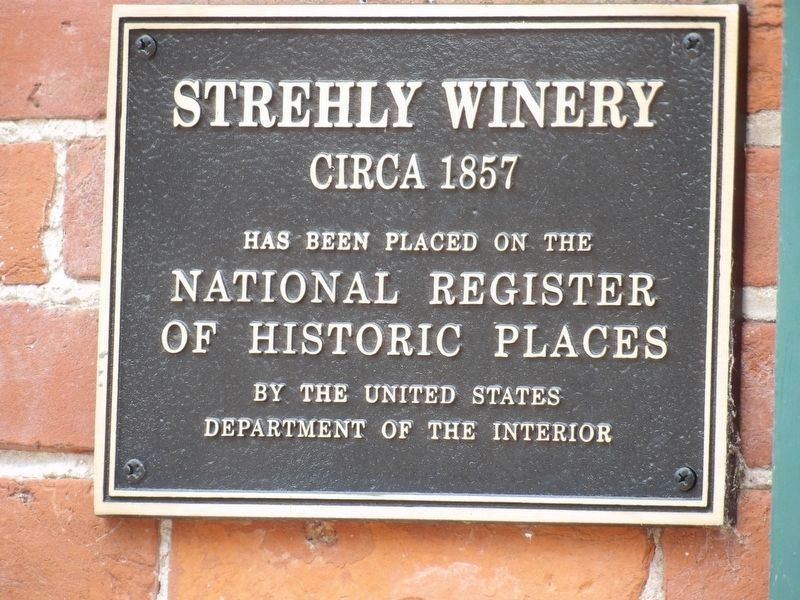
3. National Register of Historic Places Plaque
Other markers no longer nearby. Strehly House / The Strehlys (was here, next to this marker but has been replaced with another marker now near it); Hermann Honor Roll WWII (was about 500 feet away but has been replaced with another marker now near it).
Also see . . .
1. The Lichtfreund Press: German-American Newspaper Publishing on the Missouri Frontier, 1843-55. On 21 July 1843, Eduard Mühl, accompanied by his wife, baby, and brother-in-law, Karl Strehly, stepped off a Missouri River boat onto the wharf at the small frontier town of Hermann, Missouri. (Siegmar Muehl, Yearbook of German-American Studies, vol. 26 (1991), Society for German-American Studies; via journals@KU, University of Kansas Libraries) (Submitted on July 31, 2024, by Duane and Tracy Marsteller of Murfreesboro, Tennessee.)
2. Wine Cask | Deutschheim State Historic Site.
Photographed by Duane and Tracy Marsteller, July 1, 2024
4. The Strehlys / Strehly House Marker
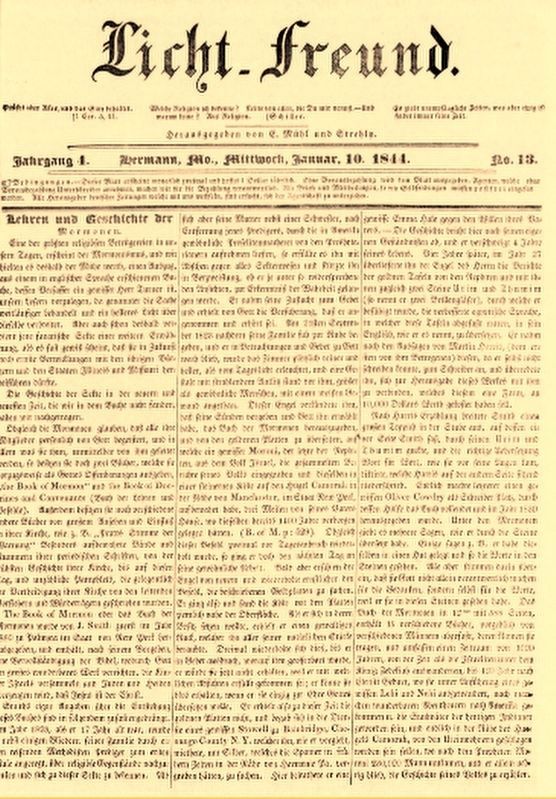
via Newspapers.com (cropped, tinted) (Public Domain), January 10, 1844
5. Licht-freund Front Page
The lead article on the newspaper's Jan. 10, 1844 front page is about Mormons. The weekly newspaper was published in Cincinnati from 1840 to August 1843, when it moved to Hermann.
Credits. This page was last revised on August 4, 2024. It was originally submitted on July 31, 2024, by Duane and Tracy Marsteller of Murfreesboro, Tennessee. This page has been viewed 157 times since then and 15 times this year. Photos: 1, 2, 3, 4, 5. submitted on July 31, 2024, by Duane and Tracy Marsteller of Murfreesboro, Tennessee.
