Billings in Yellowstone County, Montana — The American West (Mountains)
The Place Where the White Horse Went Down
Photographed by Cosmos Mariner, July 4, 2024
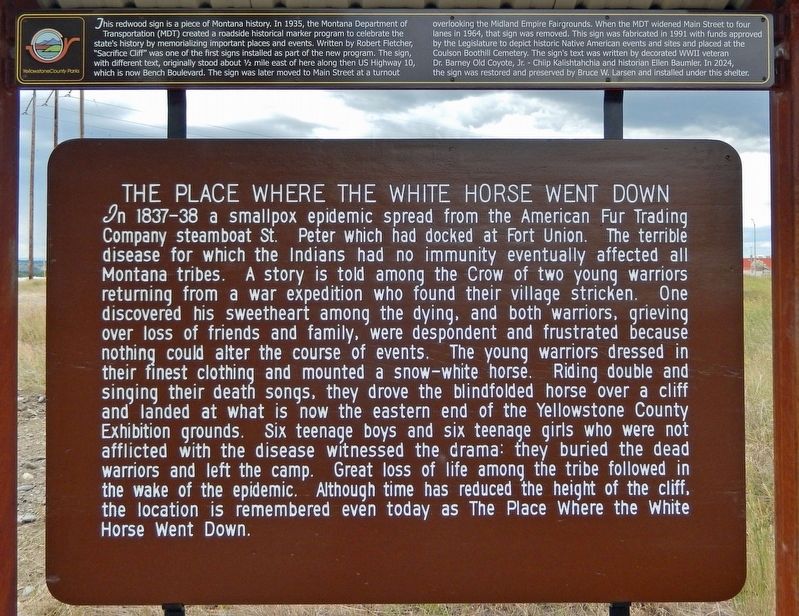
1. The Place Where the White Horse Went Down Marker
In 1837-38 a smallpox epidemic spread from the American Fur Trading Company steamboat St. Peter which had docked at Fort Union. The terrible disease for which the Indians had no immunity eventually affected all Montana tribes. A story is told among the Crow of two young warriors returning from a war expedition who found their village stricken. One discovered his sweetheart among the dying, and both warriors, grieving over loss of friends and family, were despondent and frustrated because nothing could alter the course of events. The young warriors dressed in their finest clothing and mounted a snow-white horse. Riding double and singing their death songs, they drove the blindfolded horse over a cliff and landed at what is now the eastern end of the Yellowstone County Exhibition grounds. Six teenage boys and six teenage girls who were not afflicted with the disease witnessed the drama: they buried the dead warriors and left the camp. Great loss of life among the tribe followed in the wake of the epidemic. Although time has reduced the height of the cliff, the location is remembered even today as The Place Where the White
this page online
This redwood sign is a piece of Montana history. In 1935, the Montana Department of Transportation (MDT) created a roadside historical marker program to celebrate the state’s history by memorializing important places and events. Written by Robert Fletcher, "Sacrifice Cliff" was one of the first signs installed as part of the new program. The sign, with different text, originally stood about ½ mile east of here along then US Highway 10, which is now Bench Boulevard. The sign was later moved to Main Street at a turnout overlooking the Midland Empire Fairgrounds. When the MDT widened Main Street to four lanes in 1964, that sign was removed. This sign was fabricated in 1991 with funds approved by the Legislature to depict historic Native American events and sites and placed at the Coulson Boothill Cemetery. The sign's text was written by decorated WWII veteran Dr. Barney Old Coyote, Jr. - Chiip Kalishtahchia and historian Ellen Baumler. In 2024, the sign was restored and preserved by Bruce W. Larsen and installed under this shelter.
Erected 2024 by Yellowstone County Parks and Bruce W. Larsen.
Topics and series.
Photographed by Cosmos Mariner, July 4, 2024
2. The Place Where the White Horse Went Down Marker
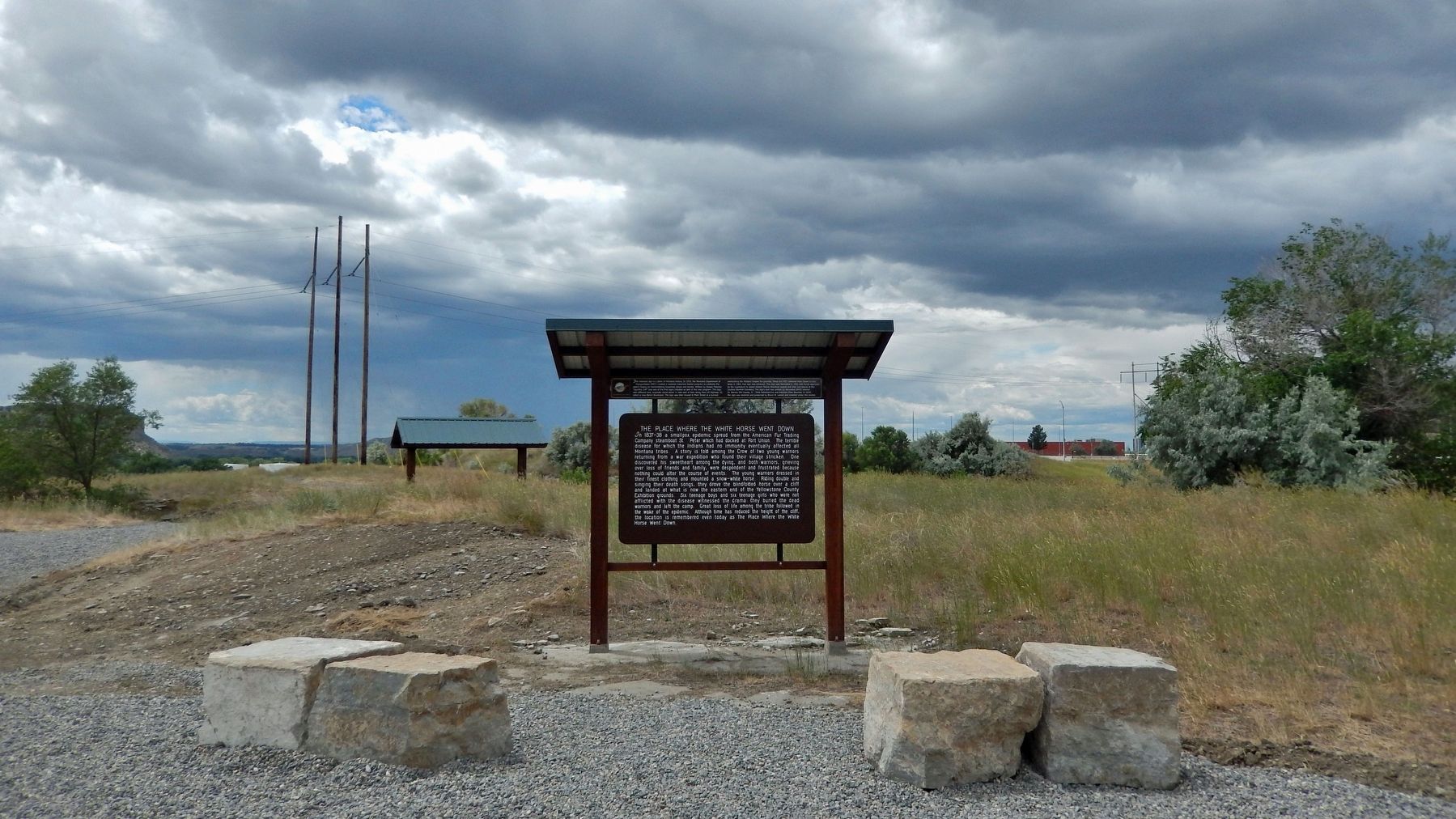
Looking west from the Jim Dutcher Trail, on the west side of Earl Guss Park.
Location. 45° 48.189′ N, 108° 28.314′ W. Marker is in Billings, Montana, in Yellowstone County. It can be reached from the intersection of Bench Boulevard and Lake Elmo Drive, on the right when traveling east. The marker is located along the Jim Dutcher Trail, on the west side of Earl Guss Park. Touch for map. Marker is at or near this postal address: 215 Bench Boulevard, Billings MT 59105, United States of America. Touch for directions.

Regionally, this marker is in Montana’s Yellowstone Country. It is also in the American Mountain West and in the Lewis & Clark Corridor. Globally, it is in North America, the Western Hemisphere, the Western World, and the Anglosphere. Historically, it finds itself in what was once Rupert’s Land and also the Louisiana Purchase.
Other nearby markers. At least 8 other markers are within walking distance of this marker: Lewis and Clark Yellowstone River Journey (approx. 0.4 miles away); Boothill Cemetery (approx. 0.4 miles away); Skeleton Cliff (approx. 0.6 miles away); Where the River Meets the Rims (approx. 0.8 miles away); The Nomadic Experience (approx. 0.9 miles away); Luther Sage "Yellowstone" Kelly (approx. 0.9 miles away); Yellowstone Kelly's Grave (approx. 0.9 miles away); Surely this spot was meant for Yellowstone Kelley (approx. 0.9 miles away). Touch for a list and map of all markers in Billings.
Another marker is no longer nearby. The Place Where the White Horse Went Down (was approx. 0.4 miles away but has been permanently removed).
Also see . . .
1. Restored sign featured at Billings Heights park. Excerpt:
The sign details the well-known story of "The Place Where The White Horse Went Down," where two Native American warriors came back from a battle to a tribe infested with small pox. Instead of letting them suffer, they blindfolded their horses and led them off a cliff. That cliff is known as Sacrifice Cliff. While no one knows exactly which cliff in the area was the sight of the horses' demise, it's believed to have happened in the area south of the Yellowstone River in Billings. Earl Guss Park is located in that area.(Submitted on August 1, 2024, by Cosmos Mariner of Cape Canaveral, Florida.)
2. The Legend Of Sacrifice Cliff In Montana May Send Chills Down Your Spine. Excerpt:
According to the legend, the cliff was once a place of meditation for young boys and men in the Crow tribe. They would make the trip over from wherever they lived and spend some time on the rocks in silence. One day, two teen Crow boys returned to their tribe to discover that nearly everyone had been wiped out by smallpox. In most versions of the tale, the victims included both of the boys' sweethearts as well as their immediate family members. The boys were so distraught over the loss of their loved ones, they couldn't bear to go on living. So they returned to Sacrifice Cliff with their horses, blindfolded the horses, and rode off the cliffs to their deaths so they could join their tribe on the other side. No one knows for certain if the tale is true or not, but sadly, it isn't impossible. The smallpox epidemic was extremely dangerous for Native Americans in the 1800s. The disease was extremely lethal, killing around 90 percent of the Native American people who became sick with it.(Submitted on August 1, 2024, by Cosmos Mariner of Cape Canaveral, Florida.)
Credits. This page was last revised on March 5, 2026. It was originally submitted on August 1, 2024, by Cosmos Mariner of Cape Canaveral, Florida. This page has been viewed 628 times since then and 99 times this year. Photos: 1, 2. submitted on August 1, 2024, by Cosmos Mariner of Cape Canaveral, Florida.
