Elizabethtown in Hardin County, Kentucky — The American South (East South Central)
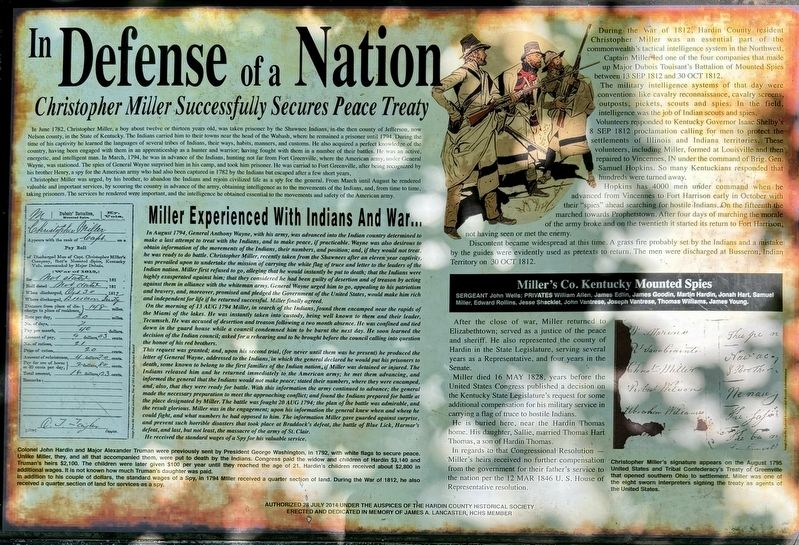
In Defense of a Nation
Photographed by Brandon D Cross
1. In Defense of a Nation Marker
Christopher Miller Successfully Secures Peace Treaty
In June 1782, Christopher Miller, a boy about twelve or thirteen years old, was taken prisoner by the Shawnee Indians, in the then county of Jefferson, now Nelson county, in the State of Kentucky. The Indians carried him to their towns near the head of the Wabash, where he remained a prisoner until 1794. During the time of his captivity he learned the languages of several tribes of Indians, their ways, habits, manners, and customs. He also acquired a perfect knowledge of the country, having been engaged with them in an apprenticeship as a hunter and warrior; having fought with them in a number of battles. He was an active, energetic, and intelligent man. In March, 1794, he was in advance of the Indians, hunting not far from Fort Greenville, where the American army, under General Wayne, was stationed. The spies of General Wayne surprised him in his camp, and took him prisoner. He was carried to Fort Greenville, after being recognized by his brother Henry, a spy for the American army who had also been captured in 1782 by the Indians but escaped after a few short
this page online
Christopher Miller was urged, by his brother, to abandon the Indians and rejoin civilized life as a spy for the general. From March until August he rendered valuable and important services, by scouring the country in advance of the army, obtaining intelligence as to the movements of the Indians, and, from time to time, taking prisoners. The services he rendered were important, and the intelligence he obtained essential to the movements and safety of the American army.
Miller Experienced With Indians And War
In August 1794, General Anthony Wayne, with his army, was advanced into the Indian country determined to make a last attempt to treat with the Indians, and to make peace, if practicable. Wayne was also desirous to obtain information of movements of the Indians, the numbers, and position; and if they would not treat, he was ready to do battle. Christopher Miller, recently taken from the Shawnee after an eleven year captivity, was prevailed upon to undertake the mission of carrying the white flag of truce and letter to the leaders of the Indian nation. Miller first refused to go, alleging he would instantly be

Photographed by Brandon D Cross
2. In Defense of a Nation Marker
On the morning of 13 AUG 1794 Miller, in search of the Indians, found them encamped near the rapids of the Miami of the lakes. He was instantly taken into custody, being well known to them and their leader, Tecumseh. He was accused of desertion and treason following a two month absence. He was confined and tied down in the guard house while a council condemned him to be burnt the next day. He soon learned the decision of the Indian council; asked for a rehearing and to be brought before the council calling into question the honor of his red brothers.
This request was granted; and, upon his second trial, (for never until then was he present) he produced the letter of General Wayne, addressed to the Indians, in which the general declared he would put his prisoners to death, some known to belong to the first families, of the Indian nation, if Miller was detained or injured. The Indians, released him and he returned immediately to the American army; he met them advancing and informed the general that the Indians would not make peace; stated their numbers, where they were encamped, and also, that they were ready for battle. With this information the army continued to advance; the General made the necessary preparation to meet the approaching conflict; and found the Indians prepared for battle at the place designated by Miller. The battle was fought 20 AUG 1794; the plan of battle was admirable, and the result glorious. Miller was in the engagement; upon his information the general knew when and where he could fight, and what numbers he had opposed to him. The information Miller gave guarded against surprise, and prevent such horrible disasters that took place at Braddock’s defeat, the Battle of Blue Lick, Harmar’s defeat, and last, but not least, the massacre of the army of St. Clair.
He received the standard wages of a Spy for his valuable service.
During the War of 1812, Hardin County resident Christopher Miller was an essential part of the commonwealth's tactical intelligence system in the Northwest.
Captain Miller led one of the four companies that made up Major Dubois Touisant's Battalion of Mounted Spies between 13 SEP 1812 and 30 OCT 1812.
The military intelligence systems of that day were conventions like cavalry reconnaissance, cavalry screens, outposts, pickets, scouts and spies. Volunteers responded to Kentucky Governor Isaac Shelby’s 8 SEP 1812 proclamation calling for men to protect the settlements of Illinois and Indiana territories. These volunteers, including Miller, formed at Louisville and then repaired to Vincennes, IN under the command of Brig. Gen. Samuel Hopkins. So many Kentuckians responded that hundreds were turned away.
Hopkins has 4000 men under command when he advanced from Vincennes to Fort Harrison early in October with their “spies” ahead searching for hostile lndians. On the fifteenth they marched towards Prophetstown. After four days of marching the morale of the army broke and on the twentieth it started its return to Fort Harrison, not having seen or met the enemy.
Discontent became widespread at this time. A grass fire probably set by the Indians and a mistake by the guides were evidently used as pretexts to return. The men were discharged at Busseron, Indian Territory on 30 Oct 1812.
After the close of war, Miller returned to Elizabethtown; served as a justice of the peace and sheriff. He also represented the county of Hardin in the State Legislature, serving several years as a Representative, and four years in the Senate.
Miller died 16 MAY 1828, years before the United States Congress published a decision on the Kentucky State Legislature's request for some additional compensation for his military service in carrying a flag of truce to hostile Indians.
He is buried here, near the Hardin Thomas home. His daughter, Sallie, married Thomas Hart Thomas, a son of Hardin Thomas.
In regards to that Congressional Resolution Miller's heirs received no further compensation from the government for their father's service to the nation per the 12 Mar 1846 U.S. House of Representative resolution.
(Sidebar)
(captions)
Colonel John Hardin and Major Alexander Truman were previously sent by President George Washington, in 1792, with white flags to secure peace. Unlike Miller, they, and all that accompanied them, were put to death by the Indians. Congress paid the widow and children of Hardin $3,140 and Truman's heirs $2,100. The children were later given $100 per year until they reached the age of 21. Hardin's children received about $2,800 in additional wages. It is not known how much Truman's daughter was paid.
In addition to his couple of dollars, the standard wages of a Spy, in 1794 Miller received a quarter section of land. During the War received a quarter section of land for services as a spy.
Christopher Miller's signature appears on the August 1795 United States and Tribal Confederacy's Treaty of Greenville that opened southern Ohio to settlement. Miller was one of the eight sworn interpreters signing the treaty as agents of the United States.
Authorized 28 July 2014 under the auspices of the Hardin County Historical Society
Erected and dedicated in memory of James A. Lancaster, HCHS Member.
Erected by Hardin County Historical Society.
Topics. This historical marker is listed in these topic lists: Colonial Era • Indigenous Peoples and Communities • Patriots & Patriotism • War of 1812. A significant historical year for this entry is 1794.
Location. 37° 43.237′ N, 85° 52.435′ W. Marker is in Elizabethtown, Kentucky, in Hardin County. It can be reached from the intersection of Freeman Lake Park Road and City Street-1197-20, on the left when traveling east. The marker is located within Freeman Lake Park near boat rentals. Touch for map. Marker is in this post office area: Elizabethtown KY 42701, United States of America. Touch for directions.

Regionally, this marker is in the American South and specifically in the Upper South. Globally, it is in North America, the Western Hemisphere, the Western World, and the Anglosphere. Historically, it finds itself in what was once the territory of the Mississippian Culture and also the Antebellum South.
Other nearby markers. At least 8 other markers are within 2 miles of this marker, measured as the crow flies: Sarah Bush Johnston Lincoln (within shouting distance of this marker); Remembering Sarah Her Old Kentucky Home (within shouting distance of this marker); Lincoln Heritage House (about 500 feet away, measured in a direct line); The Helms - First Family of Hardin County (approx. 0.8 miles away); Men of Distinction (approx. 0.8 miles away); Helm Cemetery (approx. 0.9 miles away); John Larue Helm, 1802-1867 (approx. 0.9 miles away); John Young Brown (1835-1904) (approx. 1.2 miles away). Touch for a list and map of all markers in Elizabethtown.
Also see . . . Christopher Bryan Miller. (Submitted on August 1, 2024, by Brandon D Cross of Flagler Beach, Florida.)
Credits. This page was last revised on August 2, 2024. It was originally submitted on August 1, 2024, by Brandon D Cross of Flagler Beach, Florida. This page has been viewed 490 times since then and 53 times this year. Photos: 1, 2. submitted on August 1, 2024, by Brandon D Cross of Flagler Beach, Florida. • James Hulse was the editor who published this page.
