Columbus in Stillwater County, Montana — The American West (Mountains)
Itch-ke-pe and Clark's Canoe Camp
Clark's Yellowstone River Camps
| — | Clark Down the Yellowstone | — |
Photographed by Cosmos Mariner, July 5, 2024
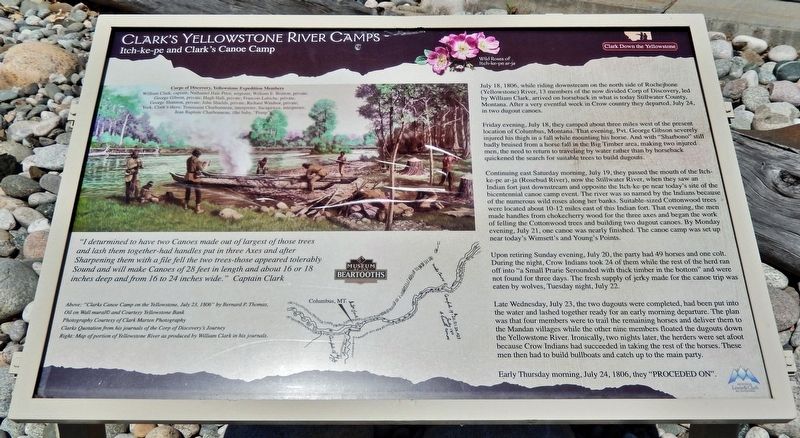
1. Itch-ke-pe and Clark's Canoe Camp Marker
”I deturmined to have two Canoes made out of largest of those trees and lash them together — had handles put in three Axes and after Sharpening them with a file fell the two trees — those appeared tolerably Sound and will make Canoes of 28 feet in length and about 16 or 18 inches deep and from 16 to 24 inches wide.” Captain Clark, from his journals of the Corp of Discovery's Journey
July 18, 1806, while riding downstream on the north side of Rochejhone (Yellowstone) River, 13 members of the now divided Corp of Discovery, led by William Clark, arrived on horseback in what is today Stillwater County, Montana. After a very eventful week in Crow country they departed, July 24, in two dugout canoes.
Friday evening, July 18, they camped about three miles west of the present location of Columbus, Montana. That evening, Pvt. George Gibson severely injured his thigh in a fall while mounting his horse. And with “Sharbono” still badly bruised from a horse fall in the Big Timber area, making two injured men, the need to return to traveling by water rather than by horseback quickened the search for suitable trees to build dugouts.
Continuing
this page online
Upon retiring Sunday evening, July 20, the party had 49 horses and one colt. During the night, Crow Indians took 24 of them while the rest of the herd ran off into “a Small Prarie Serounded with thick timber in the bottom” and were not found for three days. The fresh supply of jerky made for the canoe trip was eaten by wolves, Tuesday night, July 22.
Late Wednesday, July 23, the two dugouts were completed, had been put into the water
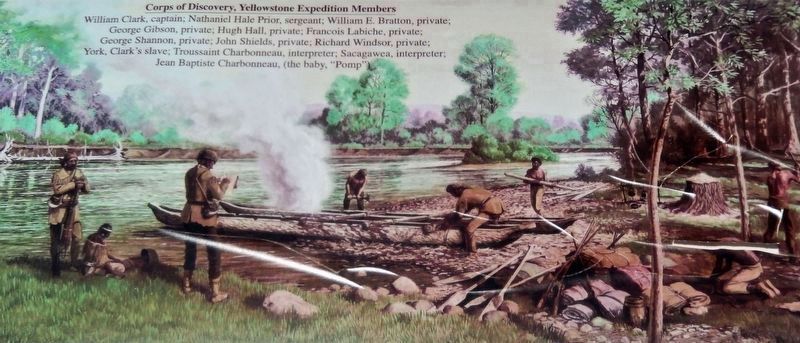
2. Marker detail: "Clarks Canoe Camp on the Yellowstone, July 23, 1806"
by Bernard P. Thomas, Oil on Wall mural© and Courtesy Yellowstone Bank
Photography Courtesy of Clark Marten Photography
Photography Courtesy of Clark Marten Photography
Early Thursday morning, July 24, 1806, they "PROCEDED ON".
Corps of Discovery, Yellowstone Expedition Members
William Clark, captain; Nathaniel Hale Prior, sergeant; William E. Bratton, private; George Gibson, private; Hugh Hall, private; Francois Labiche, private; George Shannon, private; John Shields, private; Richard Windsor, private; York, Clark's slave; Troussaint Charbonneau, interpreter; Sacagawea, interpreter; Jean Baptiste Charbonneau, (the baby, "Pomp")
Topics and series. This historical marker is listed in these topic lists: Exploration • Indigenous Peoples and Communities • Waterways & Vessels. In addition, it is included in the Lewis & Clark Expedition series list. A significant historical date for this entry is July 18, 1806.
Location. 45° 38.535′ N,

3. Marker detail: Wild Roses of Itch-ke-pe ar-ja

Regionally, this marker is in Yellowstone Country and in Greater Billings. It is also in the American Mountain West and in the Lewis & Clark Corridor. Globally, it is in North America, the Rocky Mountains, the Western Hemisphere, the Western World, and the Anglosphere. Historically, it finds itself in what was once Rupert’s Land and also the Louisiana Purchase.
Other nearby markers. At least 8 other markers are within 10 miles of this marker, measured as the crow flies: Jacobs House (approx. 0.4 miles away); Columbus (approx. 9.4 miles away); Bozeman Trail (approx. 9.4 miles away); The Great Inland Seaway (approx. 9.4 miles away); The March of the Montana Column (approx. 9.4 miles away); a different
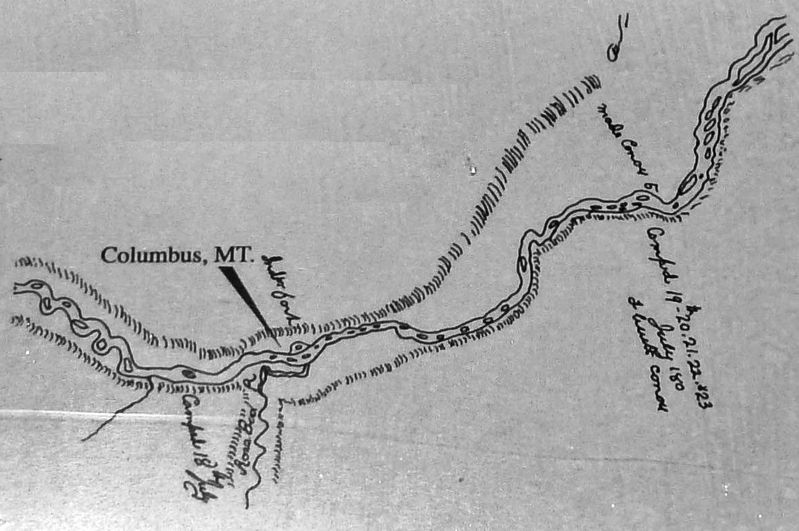
4. Marker detail: Map of portion of Yellowstone River as produced by William Clark in his journals
Also see . . .
1. Journals of the Lewis & Clark Expedition, July 19, 1806. Excerpt:
[Clark] I rose early and dressed Gibsons wound. he Slept but very little last night and complains of great pain in his Knee and hip as well as his thy. there being no timber on this part of the Rochjhone sufficintly large for a Canoe and time is pracious as it is our wish to get to the U States this Season, conclude to take Gibson in a little if he is not able to ride on down the river untill I can find a tree Sufficently large for my purpose.(Submitted on August 1, 2024, by Cosmos Mariner of Cape Canaveral, Florida.)
2. Journals of the Lewis & Clark Expedition, July 20, 1806. Excerpt:
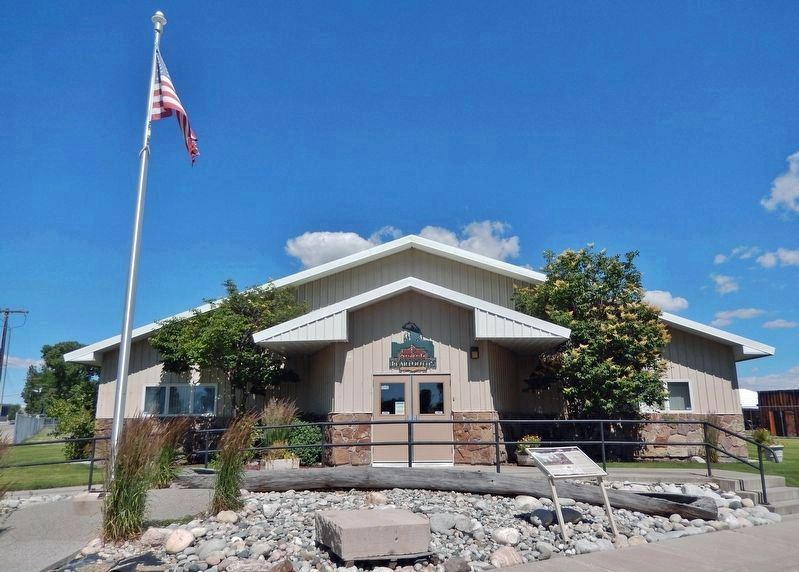
[Clark] I directed Sergt. Pryor and Shields each of them good judges of timber to proceed on down the river Six or 8 miles and examine the bottoms if any larger trees than those near which we are encamped(Submitted on August 1, 2024, by Cosmos Mariner of Cape Canaveral, Florida.)can be found and return before twelve oClock. they Set out at daylight.Photographed by Cosmos Mariner, July 5, 20245. Itch-ke-pe and Clark's Canoe Camp MarkerThe marker (beside sidewalk on the right) is located directly in front of the Museum of the Beartooths.
3. Journals of the Lewis & Clark Expedition, July 21, 1806. Excerpt:
[Clark] This morning I was informed that Half of our horses were absent. Sent out Shannon Bratten, and Shabono to hunt them. Gibsons wound is beginning to heal. I am in great hope that it will get well in time for him to accompany Sgt. Pryor with the horses to the Mandans.(Submitted on August 1, 2024, by Cosmos Mariner of Cape Canaveral, Florida.)
4. Journals of the Lewis & Clark Expedition, July 22, 1806. Excerpt:
[Clark] I Sent Sergt. Pryor and Shabono in Serch of the horses with directions to proceed up the river as far as the 1st narrows and examine particularly for their tracks. they Serched for tracks all the evening without finding which Course the horses had taken, the plains being so remarkably hard and dry as to render it impossible to See a track of a horse passing through the hard parts of them. being to Suspect that they are taken by the Indians and taken over the hard plains to prevent our following them. my Suspicions is grounded on the improbibility of the horses leaveing the grass and rushes of the river bottoms of which they are very fond, and takeing imediately out into the open dry plains where the grass is but Short and dry.(Submitted on August 1, 2024, by Cosmos Mariner of Cape Canaveral, Florida.)
5. Journals of the Lewis & Clark Expedition, July 23, 1806. Excerpt:
[Clark] last night the wolves or dogs came into our Camp and eat most of our dryed meat which was on a scaffold. Indian Signs is Conclusive with me that they have taken the 24 horses which we lost on the night of the 20th instant, and that those who were about last night were in Serch of the ballance of our horses which they could not find. the men finished both Canoes by 12 oClock to day, and I sent them to make Oars & get poles after which I sent Shields and Labeech to kill a fat Buffalow out of a gangue which has been in a fiew miles of us all day.(Submitted on August 1, 2024, by Cosmos Mariner of Cape Canaveral, Florida.)
6. Journals of the Lewis & Clark Expedition, July 24, 1806. Excerpt:
[Clark] had all our baggage put on board of the two Small Canoes which when lashed together is very Study. at 8 A M. we Set out and proceeded on very well to a riffle about 1 mile above the enterance of Clarks fork or big horn river.(Submitted on August 1, 2024, by Cosmos Mariner of Cape Canaveral, Florida.)
Credits. This page was last revised on August 1, 2024. It was originally submitted on August 1, 2024, by Cosmos Mariner of Cape Canaveral, Florida. This page has been viewed 365 times since then and 48 times this year. Photos: 1, 2, 3, 4, 5. submitted on August 1, 2024, by Cosmos Mariner of Cape Canaveral, Florida.
