
Near La Plume in Lackawanna County, Pennsylvania — The American Northeast (Mid-Atlantic)
Station 17: Maple Sugaring
Photographed by William Fischer, Jr., July 26, 2024
1. Station 17: Maple Sugaring Marker
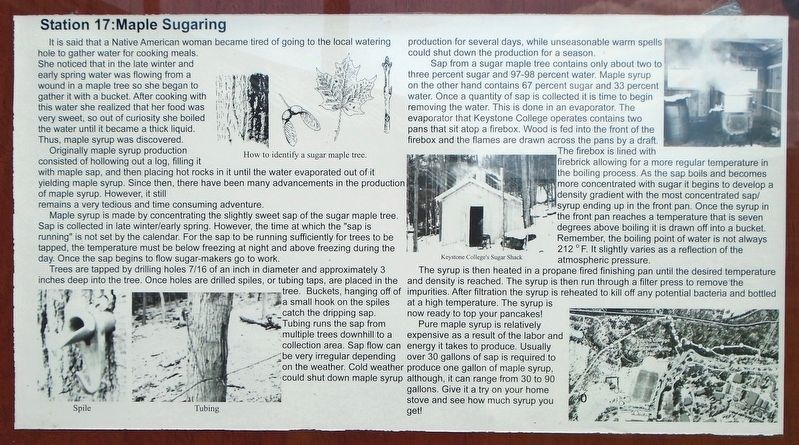
It is said that a Native American woman became tired of going to the local watering hole to gather water for cooking meals. She noticed that in the late winter and early spring water was flowing from a wound in a maple tree so she began to gather it with a bucket. After cooking with this water she realized that her food was very sweet, so out of curiosity she boiled the water until it became a thick liquid. Thus, maple syrup was discovered.
Originally maple syrup production consisted of hollowing out a log, filling it with maple sap, and then placing hot rocks in it until the water evaporated out of it yielding maple syrup. Since then, there have been many advancements in the production of maple syrup. However, it still remains a very tedious and time consuming adventure.
Maple syrup is made by concentrating the slightly sweet sap of the sugar maple tree. Sap is collected in late winter/early spring. However, the time at which the "sap is running" is not set by the calendar. For the sap to be running sufficiently for trees to be tapped, the temperature must be below freezing at night and above freezing during the day.
this page online
Trees are tapped by drilling holes 7/16 of an inch in diameter and approximately 3 inches deep into the tree. Once holes are drilled spiles, or tubing taps, are placed in the tree. Buckets, hanging off of a small hook on the spiles catch the dripping sap. Tubing runs the sap from multiple trees downhill to a collection area. Sap flow can be very irregular depending on the weather. Cold weather could shut down maple syrup production for several days, while unseasonable warm spells could shut down the production for a season.
Sap from a sugar maple tree contains only about two to three percent sugar and 97-98 percent water. Maple syrup on the other hand contains 67 percent sugar and 33 percent water. Once a quantity of sap is collected it is time to begin removing the water. This is done in an evaporator. The evaporator that Keystone College operates contains two pans that sit atop a firebox. Wood is fed into the front of the firebox and the flames are drawn across the pans by a draft. The firebox is lined with firebrick allowing for a more regular temperature in the boiling process.

Photographed by William Fischer, Jr., July 26, 2024
2. Sugar Shack and Station 17: Maple Sugaring Marker
The syrup is then heated in a propane fired finishing pan until the desired temperature and density is reached. The syrup is then run through a filter press to remove the impurities. After filtration the syrup is reheated to kill off any potential bacteria and bottled at a high temperature. The syrup is now ready to top your pancakes!
Pure maple syrup is relatively expensive as a result of the labor and energy it takes to produce. Usually over 30 gallons of sap is required to produce one gallon of maple syrup, although, it can range from 30 to 90 gallons. Give it a try on your home stove and see how much syrup you get!
Erected by Keystone College.
Topics. This historical marker is listed in these topic lists: Environment • Indigenous Peoples and Communities • Industry & Commerce.
Location. 41° 33.521′ N, 75° 46.098′ W. Marker is near La Plume, Pennsylvania, in Lackawanna County. It can be reached from Nokomis Forest Stewardship Trail. Marker is on Keystone College's Sugar Shack, part of the Howard Jennings Nature Preserve, and just east of the athletic stadium. Touch for map. Marker is in this post office area: La Plume PA 18440, United States of America. Touch for directions.

Regionally, this marker is in the Wyoming Valley and in Greater Scranton and Wilkes-Barre. It is also in the American Northeast, in the Mid-Atlantic, in Appalachia, and specifically in Northern Appalachia. Globally, it is in North America, the Western Hemisphere, the Western World, and the Anglosphere. Historically, it finds itself in what was once the Haudenosaunee (Iroquois) Confederacy and also one of the original Thirteen Colonies.
Other nearby markers. At least 8 other markers are within walking distance of this marker: Professor Howard D. Jennings (here, next to this marker); From Sap to Syrup: The Making of Maple Sugar (here, next to this marker); History of Maple Syrup (a few steps from this marker); Fun Maple Syrup Facts (a few steps from this marker); Keystone College Sugar Shack (a few steps from this marker); a different marker also named Professor Howard D. Jennings (within shouting distance of this marker); Slowing the Flow (about 600 feet away, measured in a direct line); The Northern Electric Interurban Trolley (approx. 0.2 miles away). Touch for a list and map of all markers in La Plume.
Regarding Station 17: Maple Sugaring. Although primarily informational, the marker provides some historical (folklore?) information.
Credits. This page was last revised on August 5, 2024. It was originally submitted on August 1, 2024, by William Fischer, Jr. of Reynoldsburg, Ohio. This page has been viewed 179 times since then and 17 times this year. Photos: 1, 2. submitted on August 1, 2024, by William Fischer, Jr. of Reynoldsburg, Ohio.
