
Leavenworth in Leavenworth County, Kansas — The American Midwest (Upper Plains)
Frontier Military Historic Byway
Beginning Your Byway Tour
Photographed by Mark Hilton, July 11, 2024
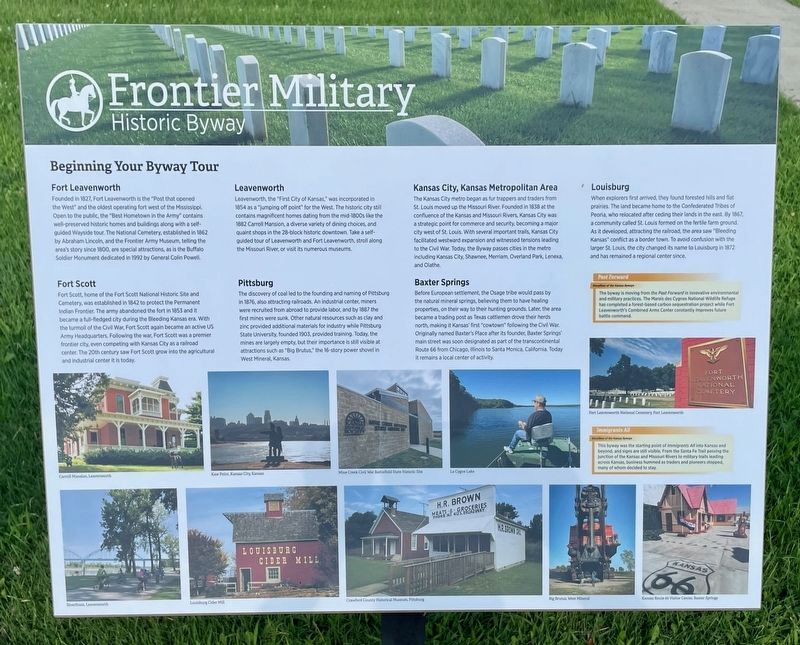
1. Frontier Military Historic Byway Marker
Fort Leavenworth
Founded in 1827, Fort Leavenworth is the "Post that opened the West" and the oldest operating fort west of the Mississippi. Open to the public, the "Best Hometown in the Army" contains well-preserved historic homes and buildings along with a self-guided Wayside tour. The National Cemetery, established in 1862 by Abraham Lincoln, and the Frontier Army Museum, telling the area's story since 1800, are special attractions, as is the Buffalo Soldier Monument dedicated in 1992 by General Colin Powell.
Fort Scott
Fort Scott, home of the Fort Scott National Historic Site and Cemetery, was established in 1842 to protect the Permanent Indian Frontier. The army abandoned the fort in 1853 and it became a full-fledged city during the Bleeding Kansas era. With the turmoil of the Civil War, Fort Scott again became an active US Army Headquarters. Following the war, Fort Scott was a premier frontier city, even competing with Kansas City as a railroad center. The 20th century saw Fort Scott grow into the agricultural and industrial center it is today.
Leavenworth
Leavenworth, the "First City of Kansas," was
this page online
Pittsburg
The discovery of coal led to the founding and naming of Pittsburg in 1876, also attracting railroads. An industrial center, miners were recruited from abroad to provide labor, and by 1887 the first mines were sunk. Other natural resources such as clay and zinc provided additional materials for industry while Pittsburg State University, founded 1903, provided training. Today, the mines are largely empty, but their importance is still visible at attractions such as "Big Brutus," the 16-story power shovel in West Mineral, Kansas.
Kansas City, Kansas Metropolitan Area
The Kansas City metro began as fur trappers and traders from St. Louis moved up the Missouri River. Founded in 1838 at the confluence of the Kansas and Missouri Rivers, Kansas
Photographed by Mark Hilton, July 11, 2024
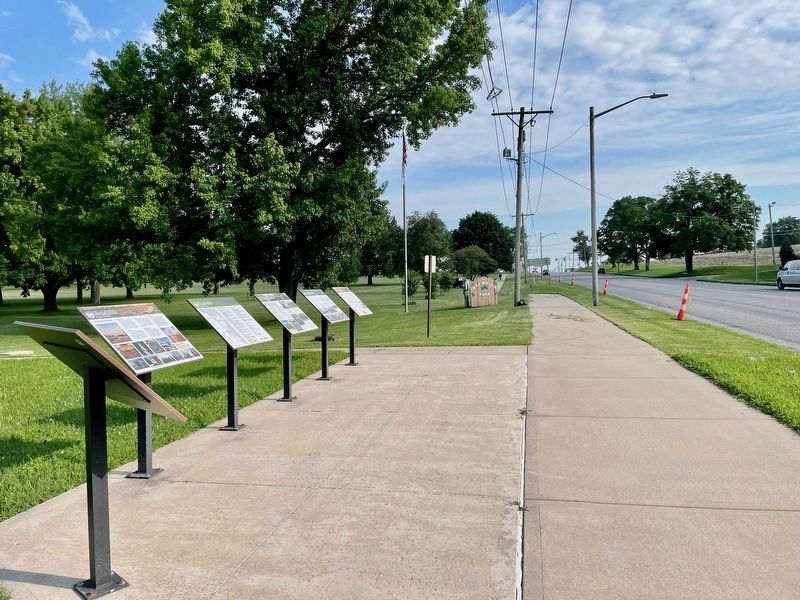
2. Frontier Military Historic Byway Marker (second from far end).
Baxter Springs
Before European settlement, the Osage tribe would pass by the natural mineral springs, believing them to have healing properties, on their way to their hunting grounds. Later, the area became a trading post as Texas cattlemen drove their herds north, making it Kansas' first "cowtown" following the Civil War. Originally named Baxter's Place after its founder, Baxter Springs' main street was soon designated as part of the transcontinental Route 66 from Chicago, Illinois to Santa Monica, California. Today it remains a local center of activity.
Louisburg
When explorers first arrived, they found forested hills and flat prairies. The land became home to the Confederated Tribes of Peoria, who relocated after ceding their lands in the east. By 1867, a community called St. Louis formed on the fertile farm ground. As it developed, attracting the railroad, the area saw "Bleeding Kansas" conflict as a border town. To avoid confusion with the larger St. Louis, the city changed its name to Louisburg in 1872 and has remained a regional center since.
Past Forward
Storylines of the Kansas Byways
The byway is moving from the Past Forward in innovative environmental and military practices. The Marais des Cygnes National Wildlife Refuge has completed a forest-based carbon sequestration project while Fort Leavenworth's Combined Arms Center constantly improves future battle command.
Immigrants All
Storylines of the Kansas Byways
This byway was the starting point of Immigrants All into Kansas and beyond, and signs are still visible. From the Santa Fe Trail passing the junction of the Kansas and Missouri Rivers to military trails leading across Kansas, business hummed as traders and pioneers stopped, many of whom decided to stay.
Erected by Kansas Tourism, Kansas Department of Transportation.
Topics. This historical marker is listed in these topic lists: Forts and Castles • Indigenous Peoples and Communities • War, US Civil. A significant historical year for this entry is 1827.
Location. 39° 16.612′ N, 94° 53.974′ W. Marker is in Leavenworth, Kansas, in Leavenworth County. It is at the intersection of South 4th Street (U.S. 73) and Home Place when traveling north on South 4th Street. Located in Ray Miller Park. Touch for map. Marker is at or near this postal address: 4103 S 4th St, Leavenworth KS 66048, United States of America. Touch for directions.

Regionally, this marker is in Eastern Kansas and specifically in Greater Kansas City. It is also in the American Midwest, in the Lewis & Clark Corridor, in the Corn Belt, on the prairies, and on the Southern Plains. Globally, it is in North America, the Western Hemisphere, the Western World, and the Anglosphere. Historically, it finds itself in what was once the Louisiana Purchase.
Other nearby markers. At least 8 other markers are within walking distance of this marker: A different marker also named Frontier Military Historic Byway (here, next to this marker); Glacial Hills Scenic Byway (here, next to this marker); a different marker also named Glacial Hills Scenic Byway (here, next to this marker); Veterans Administration Center (within shouting distance of this marker); Jeremy Lee Drexler (about 400 feet away, measured in a direct line); Jeremy A. Katzenberger (about 400 feet away); Patrick C. Hawkins (about 400 feet away); Veterans Memorial (about 400 feet away). Touch for a list and map of all markers in Leavenworth.
Also see . . . Frontier Military Historic Byway - Leavenworth, Kansas. (Submitted on August 3, 2024, by Mark Hilton of Montgomery, Alabama.)
Credits. This page was last revised on August 3, 2024. It was originally submitted on August 3, 2024, by Mark Hilton of Montgomery, Alabama. This page has been viewed 187 times since then and 37 times this year. Photos: 1, 2. submitted on August 3, 2024, by Mark Hilton of Montgomery, Alabama.
