Near St. George in Tucker County, West Virginia — The American South (Appalachia)
St. George
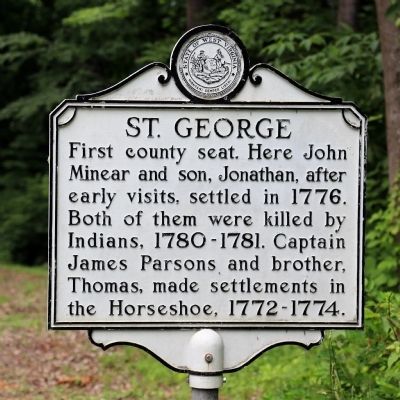
Photographed by J. J. Prats, June 22, 2014
1. St. George Marker
Topics and series. This historical marker is listed in these topic lists: Colonial Era • Indigenous Peoples and Communities • Political Subdivisions • Settlements & Settlers. In addition, it is included in the West Virginia Archives and History series list. A significant historical year for this entry is 1776.
Location. 39° 9.716′ N, 79° 42.244′ W. Marker is near St. George, West Virginia, in Tucker County. It is on Cheat Valley Highway (West Virginia Route 72) east of Mountaineer Highway ( Route 28), on the right when traveling west. Touch for map. Marker is at or near this postal address: 5405 Cheat Valley Highway, Parsons WV 26287, United States of America. Touch for directions.

Regionally, this marker is in the Potomac Highlands. It is also in the American South, specifically in the Upper South, in Appalachia, and specifically in Northern Appalachia. Globally, it is in North
this page online
Other nearby markers. At least 8 other markers are within 5 miles of this marker, measured as the crow flies: Capture of St. George / Imboden’s Expedition (approx. 0.3 miles away); Saint George Academy (approx. 0.3 miles away); Jonathan Minear (approx. 2 miles away); Flood of November 4-5, 1985 Memorial (approx. 4.7 miles away); Tucker County Courthouse (approx. 4.7 miles away); Tucker County Bank Building (approx. 4.7 miles away); Corrick's Ford Battle (approx. 4.7 miles away); Tucker County Jail (approx. 4.7 miles away). Touch for a list and map of all markers in St. George.
Another marker is no longer nearby. First County Seat / Fort Minear (was approx. 0.3 miles away but has been confirmed missing).
More about this marker. The marker stands across the river from St. George, although the foliage obscures the view of the town.
Also see . . . Wikipedia Entry. Originally known as Fort Minear and then as Westernford, St. George was settled in
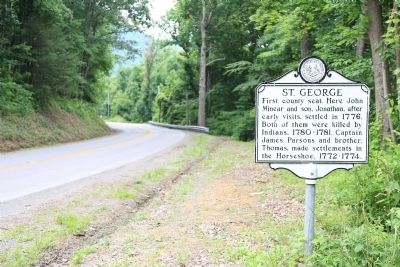
Photographed by J. J. Prats, June 22, 2014
2. St. George Marker
During the Tucker County Seat War, on the evening of August 1, 1893, vigilantes from Parsons seeking to move the county seat broke into the courthouse and stole the county records and the courthouse bell, moving the government of Tucker County to Parsons, where it has remained to this day. (Submitted on June 29, 2014.)
Credits. This page was last revised on August 6, 2024. It was originally submitted on June 29, 2014, by J. J. Prats of Powell, Ohio. This page has been viewed 1,493 times since then and 103 times this year. Last updated on August 4, 2024, by Carl Gordon Moore Jr. of North East, Maryland. Photos: 1, 2. submitted on June 29, 2014, by J. J. Prats of Powell, Ohio. • Devry Becker Jones was the editor who published this page.
Editor’s want-list for this marker. Photos of the town and of St. George Academy. • Can you help?
