Near San Antonio in Socorro County, New Mexico — The American Mountains (Southwest)
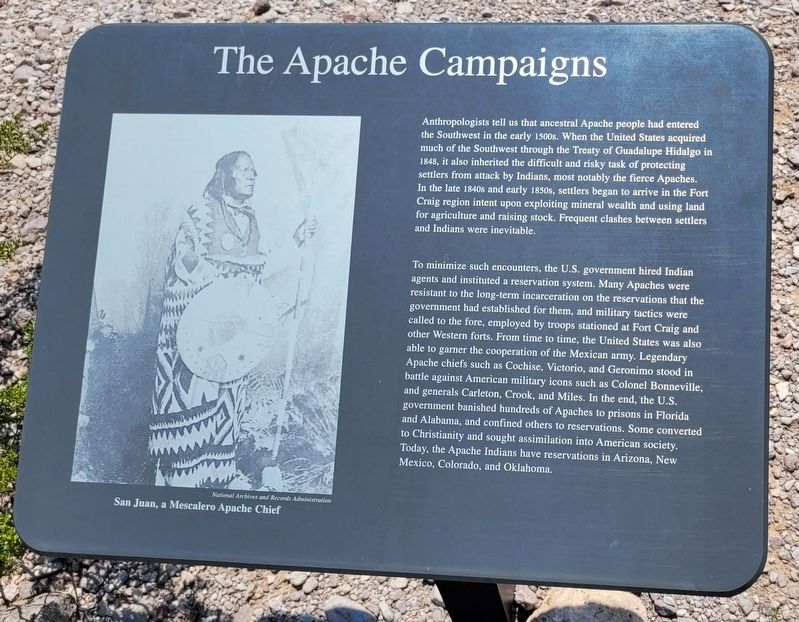
The Apache Campaigns
Photographed by James Hulse, July 23, 2024
1. The Apache Campaigns Marker
Anthropologists tell us that ancestral Apache people had entered the Southwest in the early 1500s. When the United States acquired much of the Southwest through the Treaty of Guadalupe Hidalgo in 1848, it also inherited the difficult and risky task of protecting settlers from attack by Indians, most notably the fierce Apaches. In the late 1840s and early 1850s, settlers began to arrive in the Fort Craig region intent upon exploiting mineral wealth and using land for agriculture and raising stock. Frequent clashes between settlers and Indians were inevitable
To minimize such encounters, the U.S. government hired Indian agents and instituted a reservation system. Many Apaches were resistant to the long-term incarceration on the reservations that the government had established for them, and military tactics were called to the fore, employed by troops stationed at Fort Craig and other Western forts. From time to time, the United States was also able to garner the cooperation of the Mexican army. Legendary Apache chiefs such as Cochise, Victorio, and Geronimo stood in battle against American military icons such as Colonel
this page online
Captions
San Juan, a Mescalero Apache Chief
National Archives and Records Administration
Topics. This historical marker is listed in these topic lists: Forts and Castles • Indigenous Peoples and Communities • Wars, US Indian. A significant historical year for this entry is 1848.
Location. 33° 38.026′ N, 107° 0.902′ W. Marker is near San Antonio, New Mexico, in Socorro County. It is on Fort Craig Road 4½ miles south of Old US Hwy 85 (New Mexico Highway 1). The marker is located at the Fort Craig Historic Site along the visitor trail. Touch for map. Marker is at or near this postal address: 457 Ft Craig Rd, Socorro NM 87801, United States of America. Touch for directions.

Regionally, this marker is in Southwest New Mexico and in the Rio Grande Valley. It is also in the

Photographed by James Hulse, July 23, 2024
2. The Apache Campaigns Marker (left side)
Other nearby markers. At least 8 other markers are within walking distance of this marker: The Navajo Campaigns (here, next to this marker); Defensive Bastions (here, next to this marker); The Indian Wars (here, next to this marker); Store Houses (about 300 feet away, measured in a direct line); Battle of Valverde (about 500 feet away); Fort Craig (about 500 feet away); El Camino Real (about 500 feet away); Prehistoric Peoples (about 500 feet away). Touch for a list and map of all markers in San Antonio.
More about this marker. At Fort Craig Historic Site, an ADA accessible, self-guided interpretive trail is open seven days a week, from 8:00 a.m. to one-hour before sunset. The visitor’s center is open Thursday through Monday from 8:00 a.m. to 5:00 p.m.
Also see . . .
1. Fort Craig Historic Site. blm.gov
Fort Craig, established in 1854, was one of the largest and most important frontier forts in the West.(Submitted on August 5, 2024, by James Hulse of Medina, Texas.)Set in the rugged beauty of Socorro County, N.M., it was one of the eight forts situated along the primary north-south road in the Rio Grande Valley. Fort Craig played a crucial role in Indian campaigns and the Civil War.Photographed by James Hulse, July 23, 20243. The Apache Campaigns Marker (left marker)

2. Apache. Wikipedia
The Apache are several Southern Athabaskan language–speaking peoples of the Southwest, the Southern Plains and Northern Mexico. They are linguistically related to the Navajo. They migrated from the Athabascan homelands in the north into the Southwest between 1000 and 1500 CE.(Submitted on August 6, 2024, by James Hulse of Medina, Texas.)
Credits. This page was last revised on March 11, 2026. It was originally submitted on August 4, 2024, by James Hulse of Medina, Texas. This page has been viewed 160 times since then and 18 times this year. Photos: 1, 2. submitted on August 5, 2024, by James Hulse of Medina, Texas. 3. submitted on August 6, 2024, by James Hulse of Medina, Texas.
