Susquehanna Township near Harrisburg in Dauphin County, Pennsylvania — The American Northeast (Mid-Atlantic)
United States Slavery
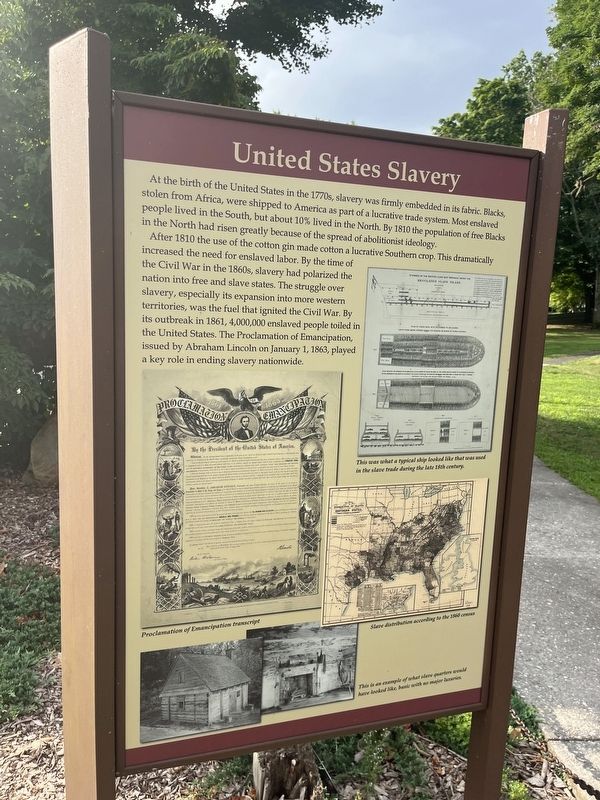
At the birth of the United States in the 1770s, slavery was firmly embedded in its fabric. Blacks stolen from Africa were shipped to America as part of a lucrative trade system. Most enslaved people lived in the South, but about 10% lived in the North. By 1810 the population of free Blacks in the North had risen greatly because of the spread of abolitionist ideology.
After 1810 the use of the cotton gin made cotton a lucrative Southern crop. This dramatically increased the need for enslaved labor. By the time of the Civil War in the 1860s, slavery had polarized the nation into free and slave states. The struggle over slavery, especially its expansion into more western territories, was the fuel that ignited the Civil War. By its outbreak in 1861, 4,000,000 enslaved people toiled in the United States. The Proclamation of Emancipation, issued by Abraham Lincoln on January 1, 1863, played a key role in ending slavery nationwide.
[Captions:]
Proclamation of Emancipation transcript
This is an example of what slave quarters would have looked like, basic with no major luxuries.
This was what a typical ship looked like that was used in the slave trade during the 18th century.
Slave distribution according to the 1860 census.
Erected by Dauphin
this page online
Topics. This historical marker is listed in these topic lists: Abolition & Underground RR • African Americans • Industry & Commerce • War, US Civil. A significant historical date for this entry is January 1, 1863.
Location. 40° 20.536′ N, 76° 54.516′ W. Marker is near Harrisburg, Pennsylvania, in Dauphin County. It is in Susquehanna Township. It can be reached from North Front Street 0.2 miles south of Fort Hunter Road, on the right when traveling north. Touch for map. Marker is at or near this postal address: 107 Fort Hunter Rd, Harrisburg PA 17110, United States of America. Touch for directions.

Regionally, this marker is in South-Central Pennsylvania, specifically in Pennsylvania Dutch Country, and in the Susquehanna Valley. It is also in the American Northeast and in the Mid-Atlantic. Globally, it is in North America, the Western Hemisphere, the Western World, and the Anglosphere. Historically, it finds itself in what was once the Haudenosaunee (Iroquois) Confederacy and also one of the original Thirteen Colonies.
Other nearby markers. At least 8 other markers are within walking distance

Credits. This page was last revised on August 4, 2024. It was originally submitted on August 4, 2024, by Devry Becker Jones of Washington, District of Columbia. This page has been viewed 119 times since then and 13 times this year. Photos: 1, 2. submitted on August 4, 2024, by Devry Becker Jones of Washington, District of Columbia.
