Maplewood in Ramsey County, Minnesota — The American Midwest (Upper Plains)
Restoring Gladstone Savanna
Photographed by McGhiever, August 9, 2019
1. Restoring Gladstone Savanna Marker
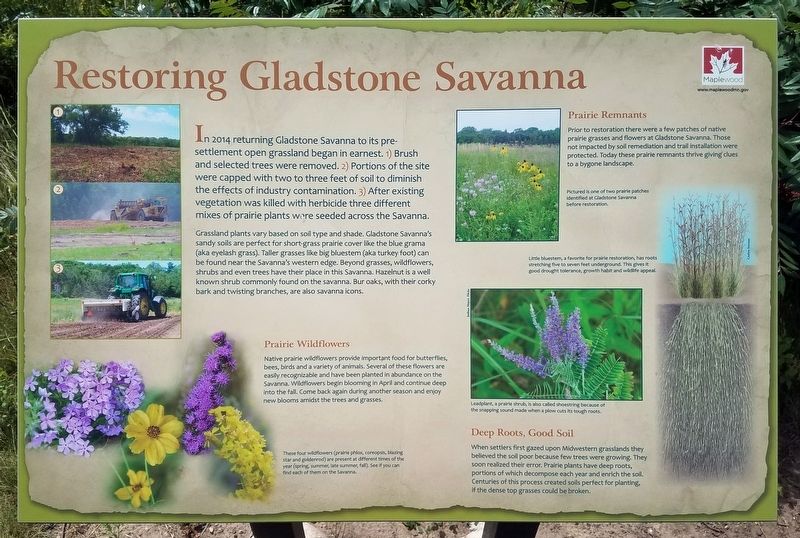
In 2014 returning Gladstone Savanna to its pre-settlement open grassland began in earnest. 1) Brush and selected trees were removed. 2) Portions of the site were capped with two to three feet of soil to diminish the effects of industry contamination. 3) After existing vegetation was killed with herbicide three different mixes of prairie plants were seeded across the Savanna.
Grassland plants vary based on soil type and shade. Gladstone Savanna's sandy soils are perfect for short-grass prairie cover like the blue grama (aka eyelash grass). Taller grasses like big bluestem (aka turkey foot) can be found near the Savanna's western edge. Beyond grasses, wildflowers, shrubs and even trees have their place in this Savanna. Hazelnut is a well known shrub commonly found on the savanna. Bur oaks, with their corky bark and twisting branches, are also savanna icons.
Prairie Wildflowers
Native prairie wildflowers provide important food for butterflies, bees, birds and a variety of animals. Several of these flowers are easily recognizable and have been planted in abundance on the Savanna. Wildflowers begin blooming in April
this page online
These four wildflowers (prairie phlox, coreopsis, blazing star and goldenrod) are present at different times of the year (spring, summer, late summer, fall). See if you can find each of them on the Savanna.
Prairie Remnants
Prior to restoration there were a few patches of native prairie grasses and flowers at Gladstone Savanna. Those not impacted by soil remediation and trail installation were protected. Today thee prairie remnants thrive giving clues to a bygone landscape.
Pictured is one of two prairie patches identified at Gladstone Savanna before restoration.
Little bluestem, a favorite for prairie restoration, has roots stretching five to seven feet underground. This gives it good drought tolerance, growth habit and wildlife appeal.
Leadplant, a prairie shrub, is also called shoestring because of the snapping sound made when a plow cuts its tough roots.
Deep Roots, Good Soil
When settlers first gazed upon Midwestern grasslands they believed the soil poor because few trees were growing. They
Photographed by McGhiever, August 9, 2019
2. Restoring Gladstone Savanna Marker in Gladstone Savanna
Erected by City of Maplewood.
Topics. This historical marker is listed in these topic lists: Environment • Parks & Recreational Areas. A significant historical year for this entry is 2014.
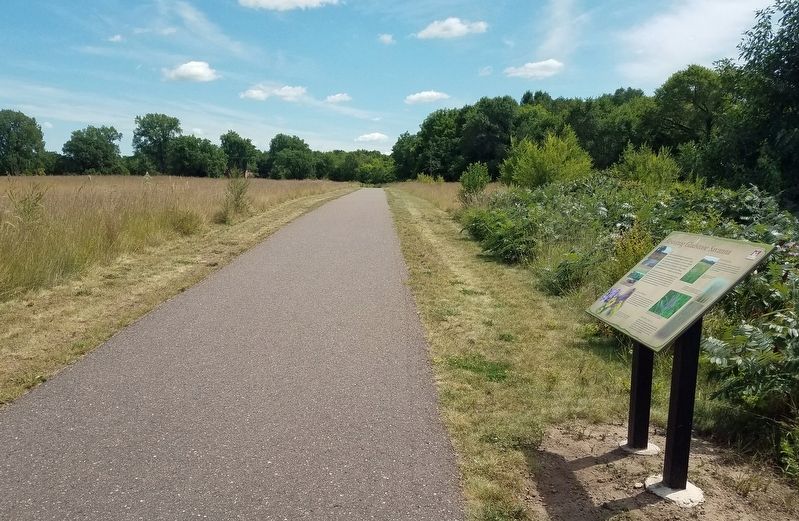
Location. 44° 59.848′ N, 93° 2.967′ W. Marker is in Maplewood, Minnesota, in Ramsey County. It can be reached from the intersection of Frisbie Avenue and Frank Street. The marker is in Gladstone Savanna, near the southwest corner of the footpath circling the middle of the park. Touch for map. Marker is in this post office area: Saint Paul MN 55109, United States of America. Touch for directions.

Regionally, this marker is in the Twin Cities Metropolitan Area. It is also in the American Midwest, in the Corn Belt, and in the Great River Road Region. Globally, it is in North America, the Western Hemisphere, the Western World, and the Anglosphere. Historically, it finds itself in what was once Rupert’s Land, the territory of the Mississippian Culture, and the Louisiana Purchase.
Other nearby markers. At least 8 other markers are within walking distance of this marker: The Shops at Gladstone (about 400 feet away, measured in a direct line); Stormwater: Problem or Asset? (about 500 feet away); Water: A Well Needed Resource (about 500 feet away); History in Depth (about 500 feet away); A History of Change (about 600 feet away); Gladstone Savanna's Natural History (approx. 0.2 miles away); Building the "Skally" (approx. 0.2 miles away); Destination Lake Phalen (approx. half a mile away). Touch for a list and map of all markers in Maplewood.
Credits. This page was last revised on August 6, 2024. It was originally submitted on August 6, 2024, by McGhiever of Minneapolis, Minnesota. This page has been viewed 194 times since then and 31 times this year. Photos: 1, 2. submitted on August 6, 2024, by McGhiever of Minneapolis, Minnesota.
