
Maplewood in Ramsey County, Minnesota — The American Midwest (Upper Plains)
Stormwater: Problem or Asset?
Photographed by McGhiever, August 9, 2019
1. Stormwater: Problem or Asset? Marker
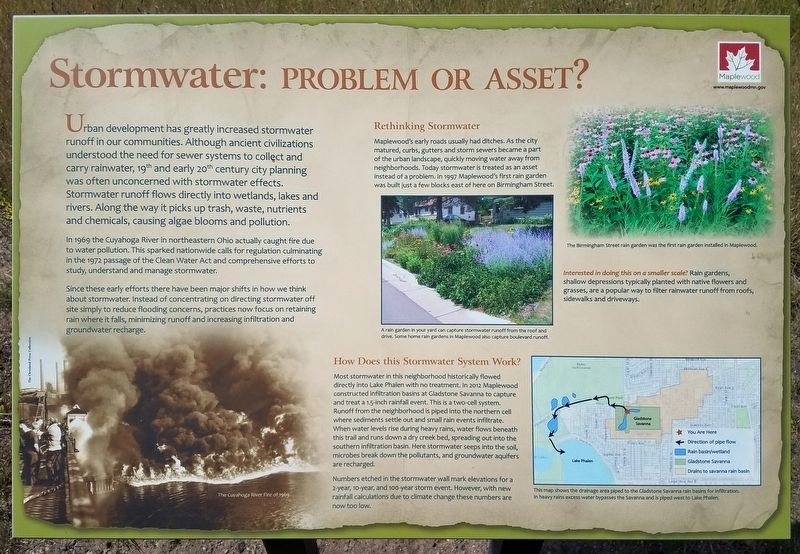
Urban development has greatly increased stormwater runoff in our communities. Although ancient civilizations understood the need for sewer systems to collect and carry rainwater, 19th and early 20th century city planning was often unconcerned with stormwater effects. Stormwater runoff flows directly into wetlands, lakes and rivers. Along the way it picks up trash, waste, nutrients and chemicals, causing algae blooms and pollution.
In 1969 the Cuyahoga River in northeastern Ohio actually caught fire due to water pollution. This sparked nationwide calls for regulation culminating in the 1972 passage of the Clean Water Act and comprehensive efforts to study, understand and manage stormwater.
Since these early efforts there have been major shifts in how we think about stormwater. Instead of concentrating on directing stormwater off site simply to reduce flooding concerns, practices now focus on retaining rain where it falls, minimizing runoff and increasing infiltration and groundwater recharge.
The Cuyahoga River fire of 1969.
Rethinking Stormwater
Maplewood's early roads usually had ditches. As the city matured,
this page online
A rain garden in your yard can capture stormwater runoff from the roof and drive. Some home rain gardens in Maplewood also capture boulevard runoff.
The Birmingham Street rain garden was the first rain garden installed in Maplewood
Interested in doing this on a smaller scale? Rain gardens, shallow depressions typically planted with native flowers and grasses, are a popular way to filter rainwater runoff from roofs, sidewalks and driveways.
How Does this Stormwater System Work?
Most stormwater in this neighborhood historically flowed directly into Lake Phalen with no treatment. In 2012 Maplewood constructed infiltration basins at Gladstone Savanna to capture and treat a 1.5-inch rainfall event. This is a two-cell system. Runoff from the neighborhood is piped into the northern cell where sediments settle out and small rain events infiltrate. When water
Photographed by McGhiever, August 9, 2019
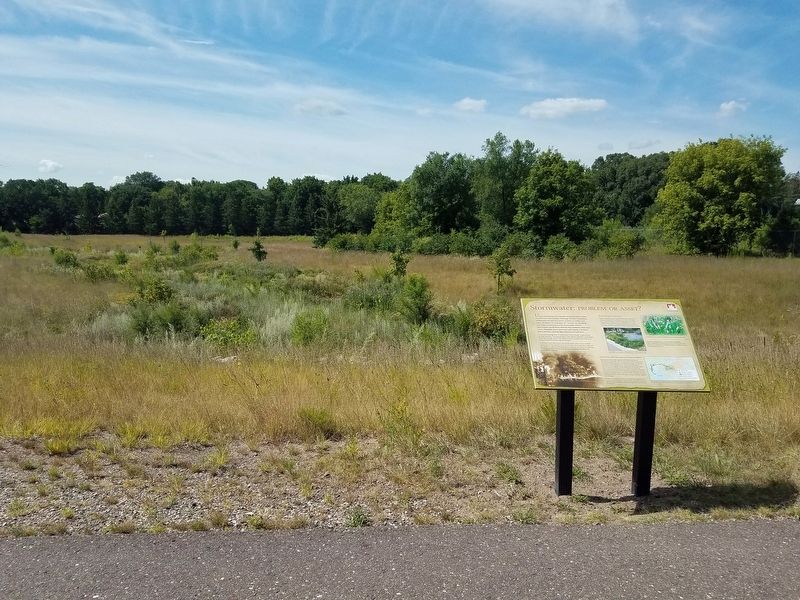
2. Stormwater Marker overlooking the southern infiltration basin in Gladstone Savanna
Numbers etched in the stormwater wall mark elevations for a 2-year, 10-year, and 100-year storm event. However, with new rainfall calculations due to climate change these numbers are now too low.
This map shows the drainage area piped to the Gladstone Savanna rain basins for infiltration. In heavy rains excess water bypasses the Savanna and is piped west to Lake Phalen.
Erected by City of Maplewood.
Topics. This historical marker is listed in these topic lists: Disasters • Environment • Waterways & Vessels. A significant historical year for this entry is 1997.
Location. 44° 59.918′ N, 93° 3.016′ W. Marker is in Maplewood, Minnesota, in Ramsey County. It can be reached from Frost Avenue east of Edward Street N., on the right when traveling east. The marker is in Gladstone Savanna, on the footpath northwest of the playground. Touch for map. Marker is at or near this postal address: 1186 Frost Avenue, Saint Paul MN 55109, United States of America. Touch for directions.

Regionally, this marker is in the Twin Cities Metropolitan Area. It is also in the American Midwest, in the Corn Belt, and in the Great River Road Region. Globally, it is in North America, the Western Hemisphere, the Western World, and the Anglosphere. Historically, it finds itself in what was once Rupert’s Land, the territory of the Mississippian Culture, and the Louisiana Purchase.
Other nearby markers. At least 8 other markers are within walking distance of this marker: Restoring Gladstone Savanna (about 500 feet away, measured in a direct line); A History of Change (about 500 feet away); Water: A Well Needed Resource (about 700 feet away); History in Depth (about 700 feet away); The Shops at Gladstone (about 800 feet away); Building the "Skally" (approx. 0.2 miles away); Gladstone Savanna's Natural History (approx. 0.2 miles away); Destination Lake Phalen (approx. half a mile away). Touch for a list and map of all markers in Maplewood.
Credits. This page was last revised on August 7, 2024. It was originally submitted on August 7, 2024, by McGhiever of Minneapolis, Minnesota. This page has been viewed 205 times since then and 26 times this year. Photos: 1, 2. submitted on August 7, 2024, by McGhiever of Minneapolis, Minnesota.
