Miracle Mile in Los Angeles in Los Angeles County, California — The American West (Pacific Coastal)
La Brea Tar Pits
Lake Pit
Photographed by Craig Baker
1. La Brea Tar Pits Marker
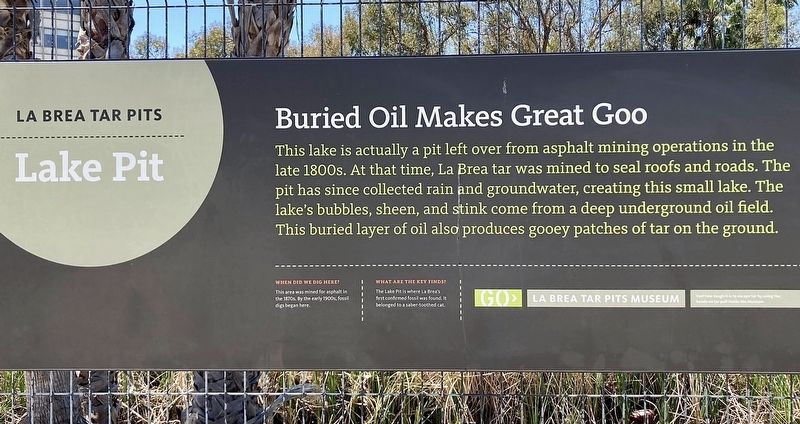
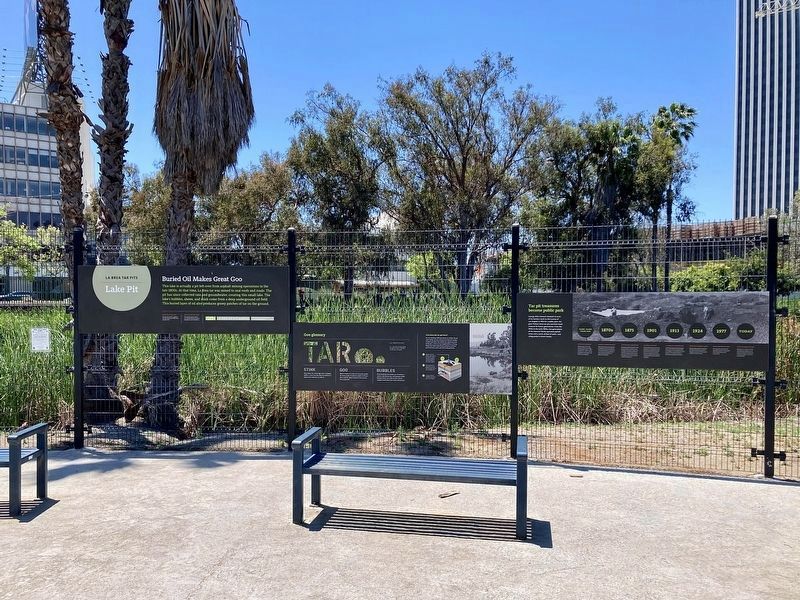
Buried Oil Makes Great Goo
This lake is actually a pit left over from asphalt mining operations in the late 1800s. At that time, La Brea tar was mined to seal roofs and roads. The pit has since collected rain and groundwater, creating this small lake. The lake's bubbles, sheen, and stink come from a deep underground oil field. This buried layer of oil also produces gooey patches of tar on the ground.
This area was mined for asphalt in the 1870s. By the early 1900s, fossil digs began here.
The Lake Pit is where La Brea’s first confirmed fossil was found. It belongs to a saber-toothed cat.
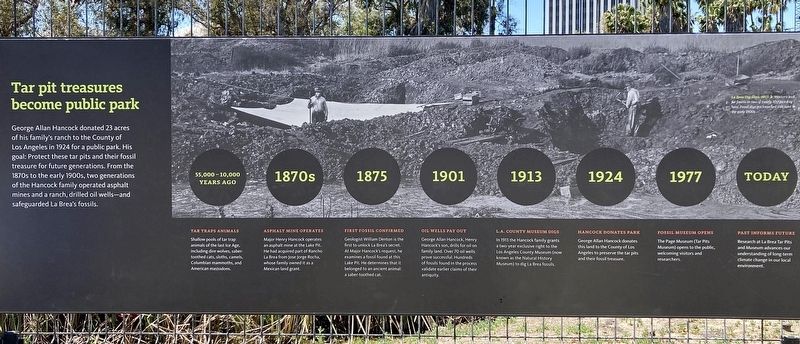
Tar pit treasures become public park
George Allan Hancock donated 23 acres of his family's ranch to the County of Los Angeles in 1924 for a public park. His goal: Protect these tar pits and their fossil treasure for future generations. From the 1870s to the early 1900s, two generations of the Hancock family operated asphalt mines and a ranch, drilled oil wells - and safeguarded La Brea's fossils.
55,000-10,000 Years Ago - Tar Traps Animals
Shallow pools of tar trap animals of
this page online
1870s - Asphalt Mine Operations
Major Henry Hancock operates an asphalt mine at the Lake Pit. He had acquired part of Rancho La Brea from Jose Jorge Rocha, whose family owned it as a Mexican land grant.
1875 - First Fossil Confirmed
Geologist William Denton is the first to unlock La Brea's secret. At Major Hancock's request, he examines a fossil found at this Lake Pit. He determines that it belonged to an ancient animal: a saber-toothed cat.
1901 - Oil Wells Pay Out
George Allan Hancock, Henry Hancock's son, drills for oil on family land. Over 70 oil wells prove successful. Hundreds of fossils found in the process validate earlier claims of their antiquity.
1913 - L.A. County Museum Digs
In 1913 the Hancock family grants a two-year exclusive right to the Los Angeles County Museum (now known as the Natural History Museum) to dig La Brea fossils.
1924 - Hancock Donates Park
George Allan Hancock donates this land to the County of Los Angeles to preserve the
Photographed by Craig Baker, May 6, 2024
2. La Brea Tar Pits Marker
1977 - Fossil Museum Opens
The Page Museum (Tar Pits Museum) opens to the public, welcoming visitors and researchers.
Today - Past Informs Future
Research at La Brea Tar Pits and Museum advances our understanding of long-term climate change in our local environment.
Topics. This historical marker is listed in these topic lists: Anthropology & Archaeology • Paleontology • Parks & Recreational Areas. A significant historical year for this entry is 1924.
Location. 34° 3.789′ N, 118° 21.336′ W. Marker is in Los Angeles, California, in Los Angeles County. It is in Miracle Mile. It is at the intersection of Wilshire Boulevard and Curson Avenue, on the right when traveling west on Wilshire Boulevard. Touch for map. Marker is at or near this postal address: 5801 Wilshire Blvd, Los Angeles CA 90036, United States of America. Touch for directions.

Regionally, this marker is in the Transverse Ranges. It is also on the American Pacific Coast. Globally, it is in North America, on the Ring of Fire, on the Pacific Rim, in the Western Hemisphere, in the Western World, and
Photographed by Craig Baker, May 6, 2024
3. La Brea Tar Pits Marker
Other nearby markers. At least 8 other markers are within walking distance of this marker: Hancock Park (a few steps from this marker); Imagining Ice Age L.A. (a few steps from this marker); When Mammoths Walked on Wilshire (within shouting distance of this marker); Rancho La Brea (within shouting distance of this marker); Different Types of Fossils (within shouting distance of this marker); Chester Stock Ph.D. (about 400 feet away, measured in a direct line); Pits 3, 4, 61/67 (about 500 feet away); Tar seeps form Ice Age time capsules (about 500 feet away). Touch for a list and map of all markers in Los Angeles.
Photographed by Craig Baker, May 6, 2024
4. La Brea Tar Pits
Credits. This page was last revised on August 26, 2026. It was originally submitted on August 8, 2024, by Craig Baker of Sylmar, California. This page has been viewed 350 times since then and 63 times this year. Photos: 1, 2, 3. submitted on August 8, 2024, by Craig Baker of Sylmar, California. 4. submitted on May 7, 2024, by Craig Baker of Sylmar, California.
