Nags Head in Dare County, North Carolina — The American South (South Atlantic)
Francis & Gertrude Rogallo
Inventors of the Flexible Wing
Photographed by Brandon D Cross
1. Francis & Gertrude Rogallo Marker (panel 1)
(Panel 1)
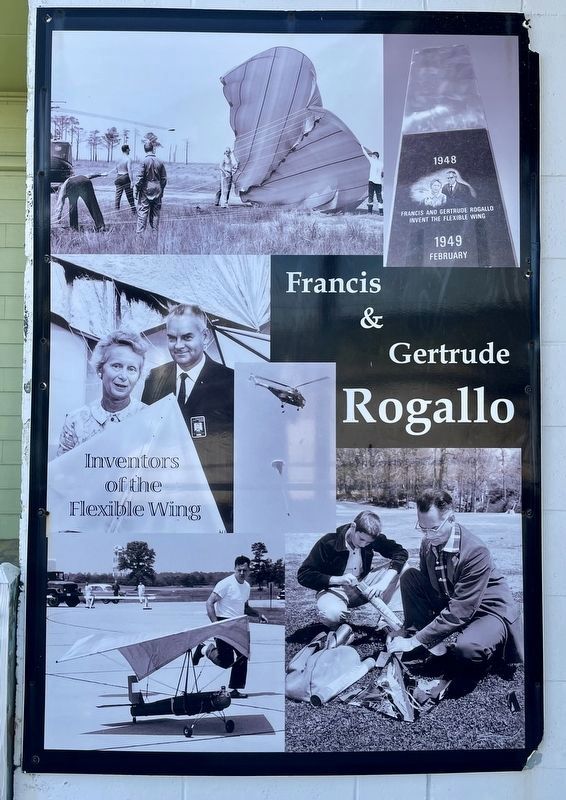
Francis & Gertrude Rogallo
Inventors of the Flexible Wing
(caption) Francis & Gertrude Rogallo invent the flexible wing
1948 • 1949 February
(Panel 2)
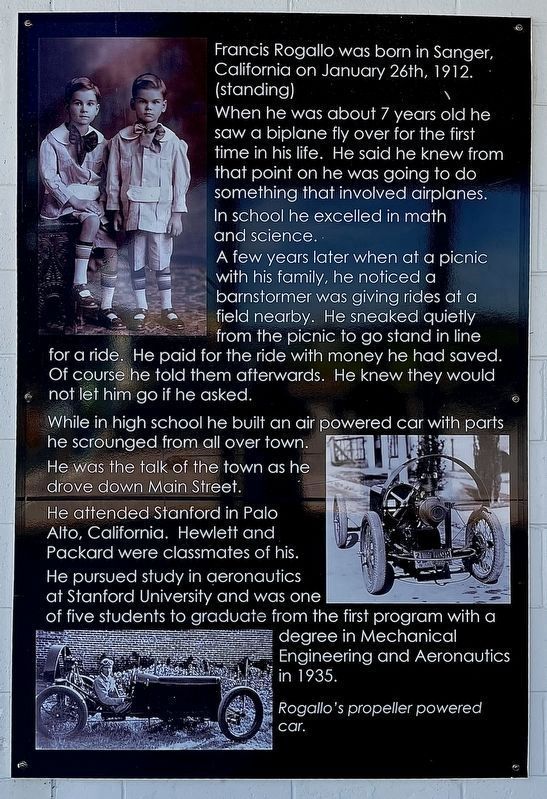
Francis Rogallo was born in Sanger, California on January 26th, 1912. (standing)
When he was about 7 years old he saw a biplane fly over for the first time in his life. He said he knew from that point on he was going to do something that involved airplanes. In school he excelled in math and science.
A few years later when at a picnic with his family, he noticed a barnstormer was giving rides at a field nearby. He sneaked quietly from the picnic to go stand in line for a ride. He paid for the ride with money he had saved. Of course he told them afterwards. He knew they would not let him go if he asked.
While in high school he built an air powered car with parts he scrounged from all over town. He was the talk of the town as he drove down Main Street.
He attended Stanford in Palo Alto, California. Hewlett and Packard were classmates of his. He pursued study in aeronautics at Stanford University and was one of five students to graduate from
this page online
(caption) Rogallo's propeller powered car.
(Panel 3)
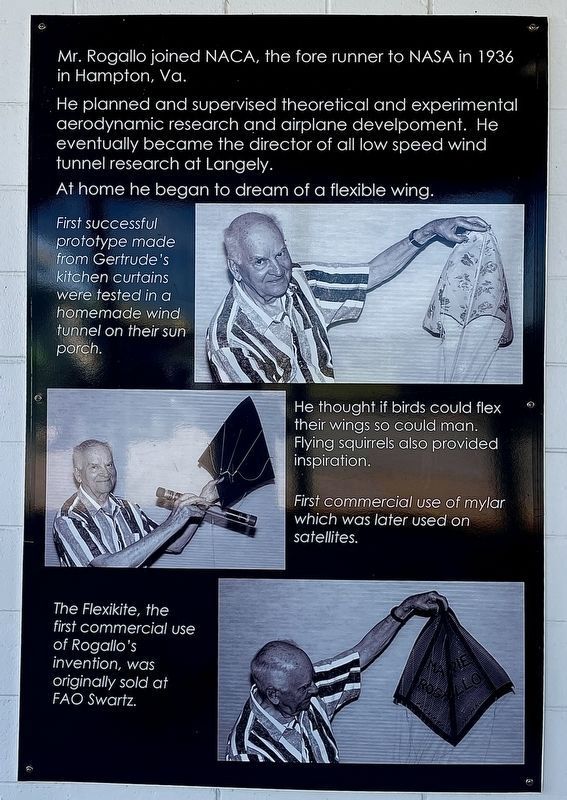
Mr. Rogallo joined NACA, the fore runner to NASA in 1936 in Hampton, Va.
He planned and supervised theoretical and experimental aerodynamic research and airplane development. He eventually became the director of all low speed wind tunnel research at Langley.
At home he began to dream of a flexible wing.
(captions)
First successful prototype made from Gertrude's Kitchen curtains were tested in a homemade wind tunnel on their sun porch.
He thought if birds could flex their wings so could man. Flying squirrels also provided inspiration.
First commercial use of mylar was later used on satellites.
The Flexikite, the first commercial use of Rogallo's invention, was originally sold at FAO Swartz.
(Panel 4)
(captions)
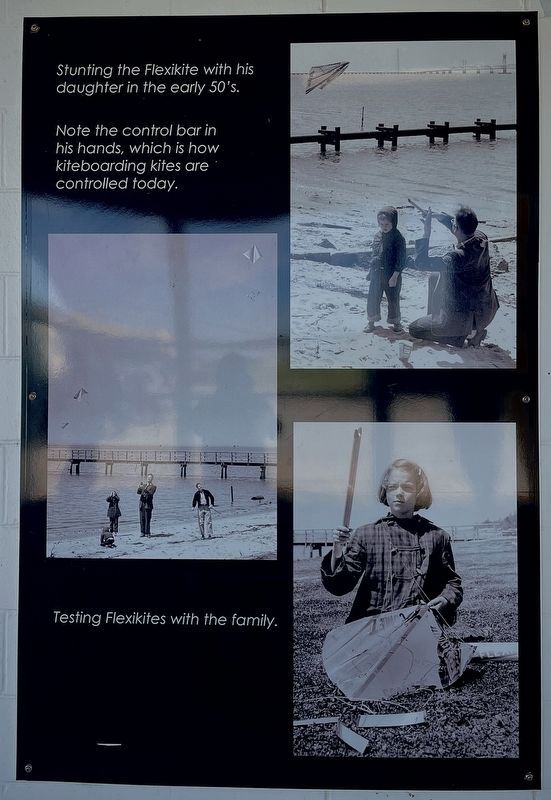
Stunting the Flexikite with his daughter in the early 50's.
Note the control bar in his hands, which is how kiteboarding kites are controlled today.
Testing Flexkites with the family.
(Panel 5)
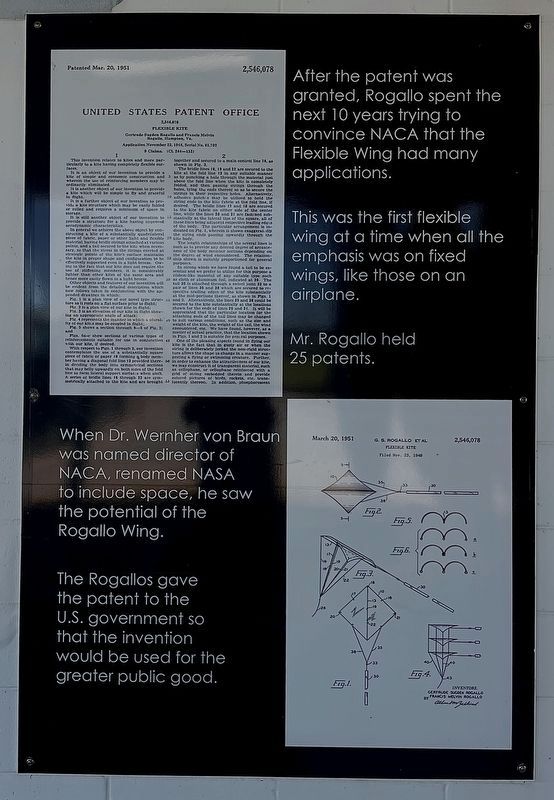
After the patent was granted, Rogallo spent the next 10 years
Photographed by Brandon D Cross
2. Francis & Gertrude Rogallo Marker (Panel 2)
This was the first flexible wing at a time when all the emphasis was on fixed wings, like those on an airplane.
Mr. Rogallo held 25 patents.
When Dr. Wernher von Braun was named director of NACA, renamed NASA to include space, he saw the potential of the Rogallo Wing.
The Rogallos gave the patent to the U.S. government so that the invention would be used for the greater public good.
(Panel 6)
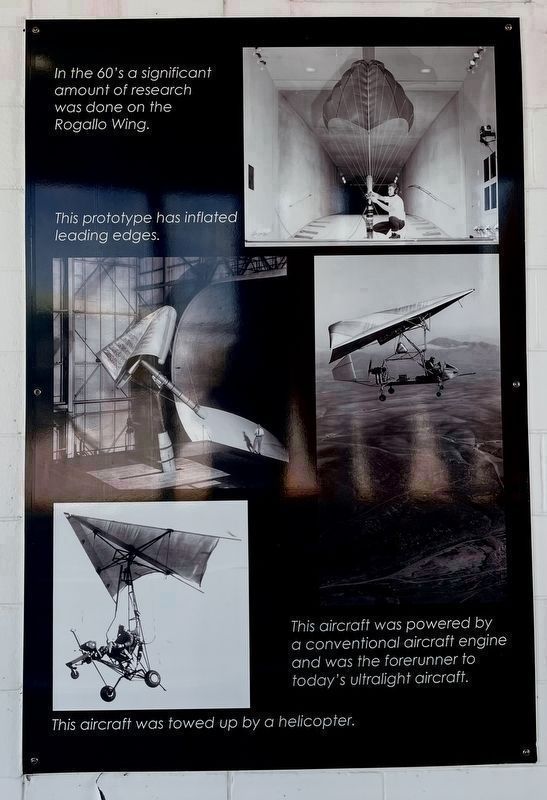
In the 60's a significant amount of research was done on the Rogallo Wing.
(captions)
This prototype has inflated leading edges.
This aircraft was powered by a conventional aircraft engine and was the forerunner to today's ultralight aircraft.
This aircraft was towed up by a helicopter.
(Panel 7)
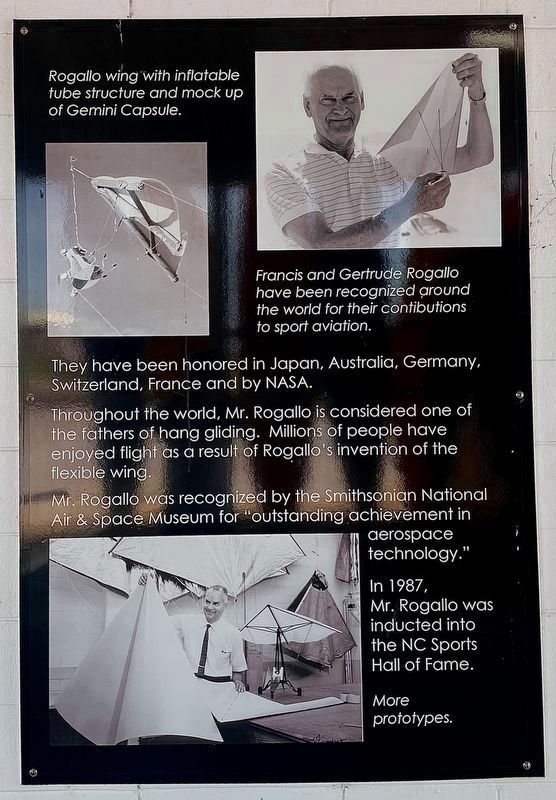
Francis and Gertrude Rogallo have been recognized around the world for their contributions to sport aviation.
They have been honored in Japan, Australia, Germany, Switzerland, France and by NASA.
Throughout the world, Mr. Rogallo is considered one of the fathers of hang gliding. Millions of people have enjoyed flight as a result of Rogallo's invention
Photographed by Brandon D Cross
3. Francis & Gertrude Rogallo Marker (Panel 3)
Mr. Rogallo was recognized by the Smithsonian National Air & Space Museum for "outstanding achievement in aerospace technology.”
In 1987, Mr. Rogallo was inducted into the NC Sports Hall of Fame.
(captions)
Rogallo wing with inflatable tube structure and mock up of Gemini Capsule.
More prototypes.
(Panel 8)
(captions)
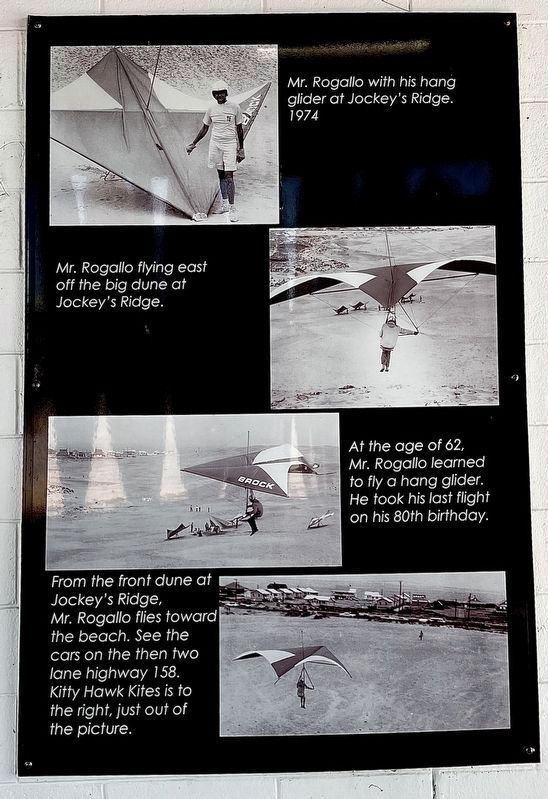
Mr. Rogallo with his hang glider at Jockey's Ridge in 1974.
Mr. Rogallo flying east off the big dune at Jockey's Ridge.
At the age of 62, Mr. Rogallo learned to fly a hang glider. He took his last flight on his 80th birthday.
From the front dune at Jockey's Ridge, Mr. Rogallo flies toward the beach. See the cars on the then two lane highway 158. Kitty Hawk Kites is to the right, just out of the picture.
(Panel 9)
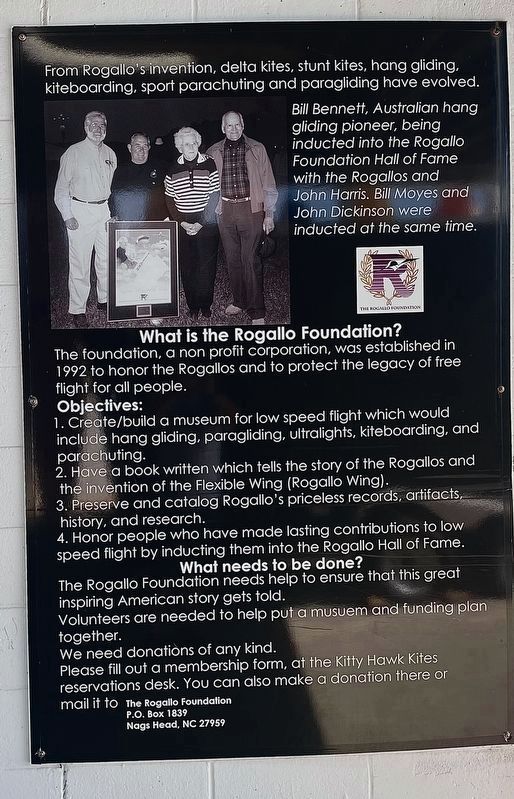
From Rogallo's invention, delta kites, stunt kites, hang gliding, kiteboarding, sport parachuting and paragliding have evolved.
Objectives:
1. Create/build a museum for low speed
Photographed by Brandon D Cross
4. Francis & Gertrude Rogallo Marker (Panel 4)
2. Have a book written which tells the story of the Rogallos and the invention of the Flexible Wing (Rogallo Wing).
3. Preserve and catalog Rogallo's priceless records, artifacts history, and research.
4. Honor people who have made lasting contributions to low speed flight by inducting them into the Rogallo Hall of Fame.
Volunteers are needed to help put a museum and funding plan together.
We need donations of any kind. Please fill out a membership form, at the Kitty Hawk Kites reservations desk. You can also make a idonation there or or mail it to
The Rogallo Foundation
P.O. Box 1839
Nags Head, NC 27959
(caption) Bill Bennett, Australian hang gliding pioneer, being inducted into the Rogallo Foundation Hall of Fame with the Rogallos and John Harris. Bill Moyes and John Dickinson were inducted at the same time.
Erected by The Rogallo Foundation.
Topics. This historical marker is listed in these
Photographed by Brandon D Cross
5. Francis & Gertrude Rogallo Marker (Panel 5)
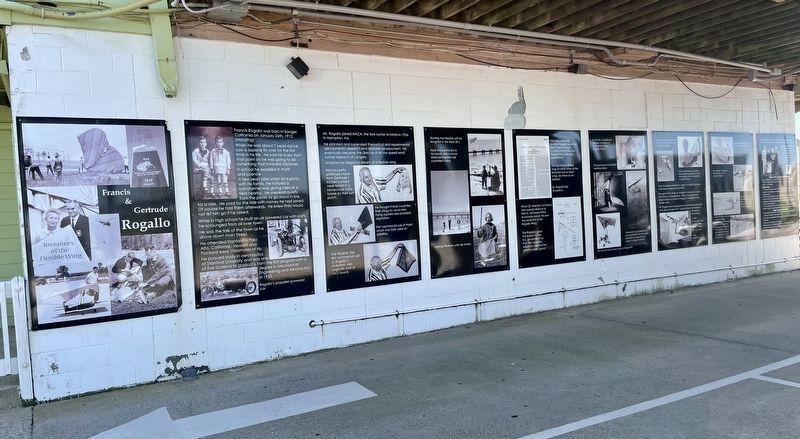
Location. 35° 57.535′ N, 75° 37.535′ W. Marker is in Nags Head, North Carolina, in Dare County. It can be reached from South Croatian Highway (U.S. 158) 0.2 miles north of East Soundside Road, on the left when traveling south. The marker is attached to the north side of Kitty Hawk Kites. Touch for map. Marker is at or near this postal address: 3933 S Croatan Hwy, Nags Head NC 27959, United States of America. Touch for directions.

Regionally, this marker is in North Carolina’s Coastal Plain and on the Outer Banks. It is also in the American South, specifically in the Upper South, in the Tidewater, and on the Eastern Seaboard. Globally, it is in the North Atlantic Region, North America, the Western Hemisphere, the Western World, and the Anglosphere. Historically, it finds itself in what was once the territory of the Mississippian Culture, one of the original Thirteen Colonies, one of the Confederate States of America, and the Antebellum South.
Other nearby markers. At least 8 other markers are within 2 miles
Photographed by Brandon D Cross
6. Francis & Gertrude Rogallo Marker (Panel 6)
Another marker is no longer nearby. The Wreck of the Huron (was approx. 1.3 miles away but has been confirmed missing).
Also see . . . Soaring to New Heights: The Legacy of Francis Rogallo and Kitty Hawk Kites. (Submitted on August 12, 2024.)
Photographed by Brandon D Cross
7. Francis & Gertrude Rogallo Marker (panel 7)
Photographed by Brandon D Cross
8. Francis & Gertrude Rogallo Marker (Panel 8)
Photographed by Brandon D Cross
9. Francis & Gertrude Rogallo Marker (Panel 9)
Photographed by Brandon D Cross
10. Francis & Gertrude Rogallo Marker
Credits. This page was last revised on February 20, 2025. It was originally submitted on January 22, 2023, by Brandon D Cross of Flagler Beach, Florida. This page has been viewed 564 times since then and 48 times this year. Last updated on August 12, 2024. Photos: 1, 2, 3, 4, 5. submitted on January 22, 2023, by Brandon D Cross of Flagler Beach, Florida. 6, 7, 8. submitted on January 24, 2023, by Brandon D Cross of Flagler Beach, Florida. 9. submitted on January 25, 2023, by Brandon D Cross of Flagler Beach, Florida. 10. submitted on January 22, 2023, by Brandon D Cross of Flagler Beach, Florida. • Bernard Fisher was the editor who published this page.
