Near Olney in Young County, Texas — The American South (West South Central)
Little Salt Creek Indian Fight
(Battleground About a Mile to the North)
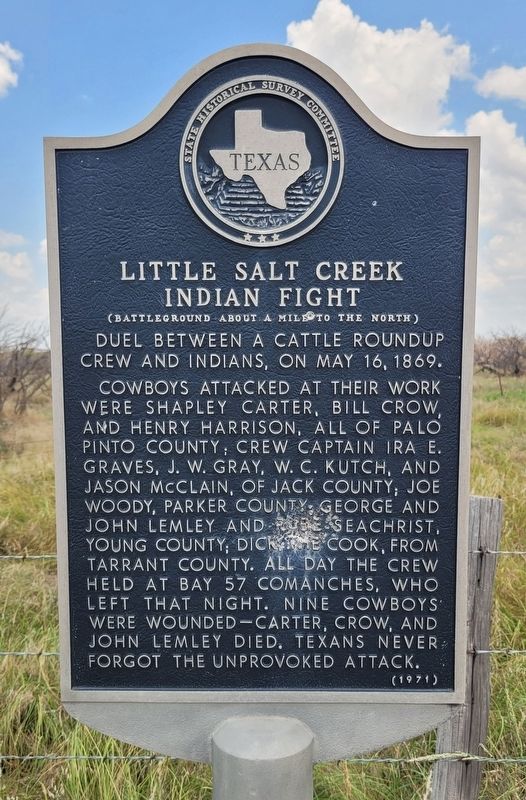
Photographed by James Hulse, July 25, 2024
1. Little Salt Creek Indian Fight Marker
Erected 1971 by State Historical Survey Committee. (Marker Number 3101.)
Topics. This historical marker is listed in these topic lists: Indigenous Peoples and Communities • Wars, US Indian. A significant historical date for this entry is May 16, 1869.
Location. 33° 20.28′ N, 98° 39.981′ W. Marker is near Olney, Texas, in Young County. It is on State Road 114 one mile east of Rodgers Road, on the left when traveling east. The marker is located along the highway. Touch for map. Marker is at or near this postal address: 3111 TX-114, Olney TX 76374, United States of America. Touch for directions.

Regionally, this marker is in Big Country. It is also on the American Great Plains. Globally, it is in North America, a Gulf of Mexico state, the Western Hemisphere, the Western World, and the Anglosphere. Historically, it finds itself in what was once New Spain, the Comanchería, the Republic of Texas, and one of the Confederate States of America.
Other nearby markers. At least 8 other markers are within 11 miles of this marker, measured as the crow flies: Site of Cottonwood Spring (approx. 2.9 miles away); The Confluence of the Brazos, Trinity, and Red River Watersheds (approx. 6.4 miles away); Townsite of Old Farmer (approx. 6.4 miles away); St. Luke Lutheran Church of Olney
this page online
Also see . . . Salt Creek Prairie. Texas State Historical Association (TSHA)
Salt Creek Prairie, once known as "the most dangerous prairie in Texas," is a rolling, intermittently timbered prairie extending about nine miles on either side of Salt Creek in Young County from Fort Belknap to Rock Creek near the Young-Jack county line. It was crossed by the Butterfield Overland Mail and was long a favorite area for Comanche and Kiowa war parties striking south from the Fort Sill area to waylay travelers and attack settlers. Some twenty-one graves were dug on the prairie for victims of Indian attacks over a four-year period in the early 1870s. Young county sheriff W. F. (State) Cox and 2d Lt. William R. Peveler were casualties of an Indian attack on the prairie in 1863. On May 16, 1869, a group of twelve cowboys, besieged by Comanches northwest of what is now Jean, held their attackers(Submitted on August 13, 2024, by James Hulse of Medina, Texas.)at bay for an entire day while pinned down in a buffalo wallow.Photographed by James Hulse, July 25, 20242. The view of the Marker along the highway

Credits. This page was last revised on August 13, 2024. It was originally submitted on August 13, 2024, by James Hulse of Medina, Texas. This page has been viewed 1,175 times since then and 271 times this year. Photos: 1, 2. submitted on August 13, 2024, by James Hulse of Medina, Texas.
