Whitefish Dunes State Park in Sturgeon Bay in Door County, Wisconsin — The American Midwest (Great Lakes)
Sailing Straight and Strong

Photographed by Sean Flynn, August 9, 2024
1. Sailing Straight and Strong Marker
Much like how the backbone of a fish supports its ribs, the keel and keelson provide the rigid structure or backbone for the vessel.
Extending from stem to stern, this assembly is what the entre vessel in built upon. It must be strong yet flexible to withstand twisting and bending that a ship endures as it sails.
Fastened on top of the frames is the keelson, the internal keel. It sandwiched the frames between the keel and keelson providing extra stability and strength.
In very large ships, the keelson was made of many timbers and was as tall as a man!
As ships grew larger and larger, their keelsons needed to be stronger and stronger. To add strength, additional timbers were added. These timbers are called sister and cousin keelsons depending on their location.
Larger keelson assemblies posed a disadvantage as they consumed a greater portion of cargo space and increased the weight of the
this page online
Shipwrecked: Hungarian
This 275-ton, three-masted barkentine was built by Asa Wilcox at Three Mile Bay, New York. During a three-day storm in October 1880, the Hungarian came ashore on the south side of Whitefish Bay along with two other schooners, the City of Woodstock and the M. N. Dunham. The Hungarian was loaded with 100 cards of wood when she grounded on the beach. Of the three vessels, only the Hungarian was a total loss, her keel having broken in two.
Erected by Wisconsin Department of Natural Resources; Wisconsin Historical Society.
Topics and series. This historical marker is listed in these topic lists: Disasters • Parks & Recreational Areas • Waterways & Vessels. In addition, it is included in the Lost at Sea series list. A significant historical month for this entry is October 1880.
Location. 44° 55.584′ N, 87° 10.922′ W.

Photographed by Sean Flynn, August 9, 2024
2. Sailing Straight and Strong Marker
The marker is in the center of the photo, along side several other markers as well as artifacts from Whitefish Bay shipwrecks. Lake Michigan and the Whitefish Dunes beach are in the background behind the trees.

Regionally, this marker is on Wisconsin’s Door Peninsula. It is also in the American Midwest and in the Corn Belt. Globally, it is in North America, on the Great Lakes, in the Western Hemisphere, in the Western World, and in the Anglosphere. Historically, it finds itself in what was once the territory of the Mississippian Culture and also the Northwest Territory.
Other nearby markers. At least 8 other markers are within walking distance of this marker: Combined in Strength (here,
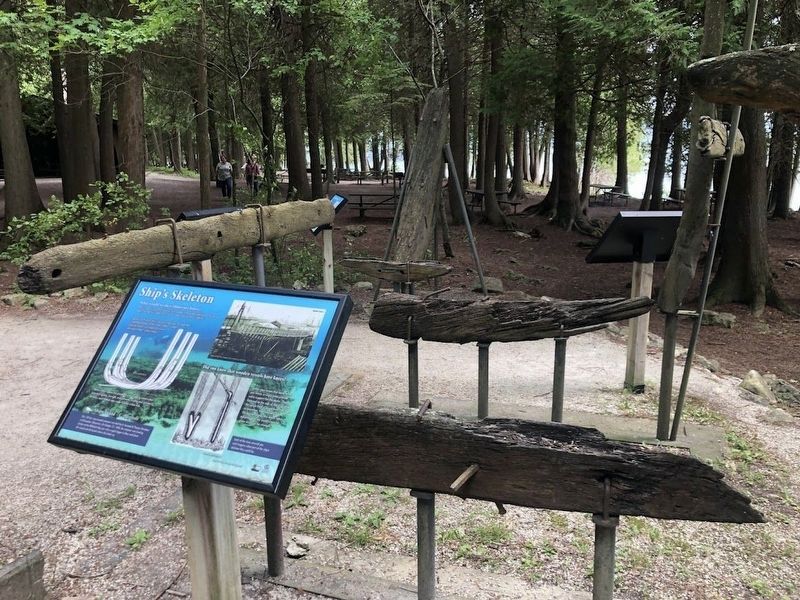
Photographed by Sean Flynn, August 9, 2024
3. Sailing Straight and Strong Marker
The marker is on the left side of this photo, obscured by the keel artifact it describes. Lake Michigan is in the far background.
More about this marker. This historical marker is one of nine placed around artifacts from shipwrecks.
Regarding Sailing Straight and Strong. The Hungarian was built in 1853 and was valued at $9,000 in 1874, according to a history of the boat. When it sank it was insured for $6,000.
Also see . . . Wisconsin Shipwreck: Hungarian. A history of the Hungarian
Excerpt: "The schooner Hungarian was blown ashore on the east side of Door County in Lake Michigan in October of 1880 along with two other vessels, the City of Woodstock and the M.N. Dunham. Of the three, only the Hungarian proved to be a total loss. The Milwaukee Sentinel on 10/19/1880 reported that she was broken in two and was insured for $6,000.(Submitted on August 13, 2024, by Sean P. Flynn of Oak Park, Illinois.)
"'The three-masted scow Hungarian, ashore on the south side of the Whitefish Bay pier (east side of Door Peninsula), is badly hogged and her spars will soon go by the board and the hull break up during the first heavy storm from the northeast or southeast.' Door County Advocate 11/11/1880."
Credits. This page was last revised on January 7, 2025. It was originally submitted on August 13, 2024, by Sean P. Flynn of Oak Park, Illinois. This page has been viewed 164 times since then and 23 times this year. Photos: 1, 2, 3. submitted on August 13, 2024, by Sean P. Flynn of Oak Park, Illinois.
