Energy Corridor in Houston in Harris County, Texas — The American South (West South Central)
The Post-Juneteenth Migration, 1865
Photographed by James Hulse, August 11, 2024
1. The Post-Juneteenth Migration, 1865 Marker
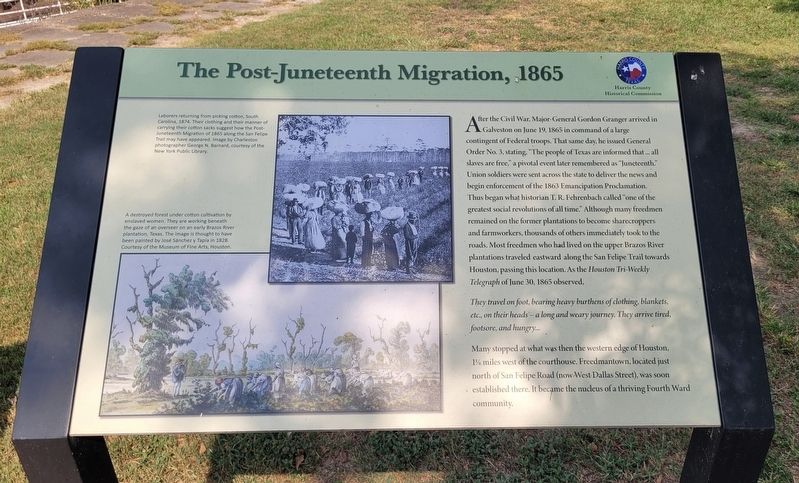
They travel on foot, bearing heavy burthens of clothing, blankets, etc., on their heads - a long and weary journey. They arrive tired, footsore, and hungry...
Many stopped at what was then the western edge of Houston, 1 1/4 miles west
this page online
Captions
Laborers returning from picking cotton, South Carolina, 1874. Their clothing and their manner of carrying their cotton sacks suggest how the Post- Juneteenth Migration of 1865 along the San Felipe Trail may have appeared. Image by Charleston photographer George N. Barnard, courtesy of the New York Public Library.
A destroyed forest under cotton cultivation by enslaved women. They are working beneath the gaze of an overseer on an early Brazos River plantation, Texas. The image is thought to have been painted by José Sánchez y Tapía in 1828. Courtesy of the Museum of Fine Arts, Houston.
Erected by Harris County Historical Commission.
Topics. This historical marker is listed in these topic lists: African Americans • Civil Rights • War, US Civil. A significant historical date for this entry is June 19, 1865.
Location. 29° 46.154′ N, 95° 38.635′ W. Marker is in Houston, Texas, in Harris County. It is in Energy Corridor. It is on Addicks-Howell
Photographed by James Hulse, August 11, 2024
2. The Post-Juneteenth Migration, 1865 Marker (right side)

Regionally, this marker is in the American South and on the Gulf Coast. Globally, it is in North America, a Gulf of Mexico state, the Western Hemisphere, the Western World, and the Anglosphere. Historically, it finds itself in what was once New Spain, the Republic of Texas, one of the Confederate States of America, and the Antebellum South.
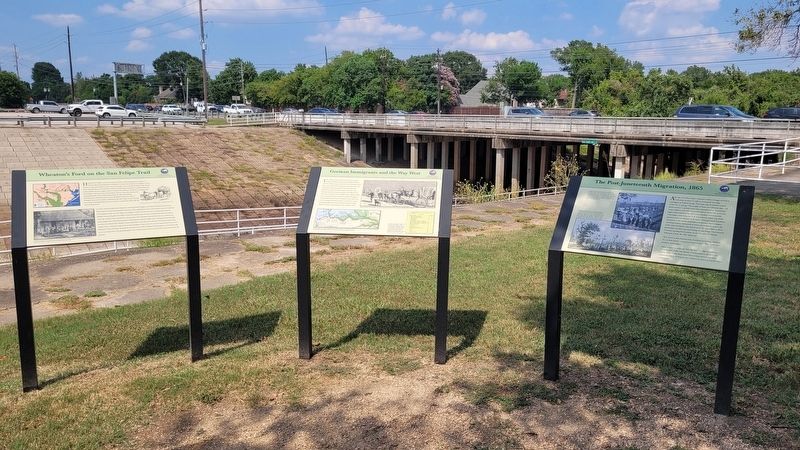
Other nearby markers. At least 8 other markers are within 4 miles of this marker, measured as the crow flies: German Immigrants and the Way West (here, next to this marker); Wheaton's Ford on the San Felipe Trail (here, next to this marker); Rabindranath Tagore (approx. 1.7 miles away); Gray Lodge No. 329, A.F.& A.M. (approx. 2.2 miles away); LH7 Ranch (approx. 2.6 miles away); Former Site of the Marks LH7 Ranch (approx. 2.6 miles away); Bear Creek Methodist Church and Cemetery
Photographed by James Hulse, August 11, 2024
3. The view of the markers along Buffalo Bayou
Also see . . . Juneteenth. Texas State Historical Association (TSHA)
On June 19 ("Juneteenth"), 1865, Union general Gordon Granger arrived in Galveston and issued General Order Number 3, which read, "The people of Texas are informed that, in accordance with a proclamation from the Executive of the United States, all slaves are free. This involves an absolute equality of personal rights and rights of property between former masters and slaves, and the connection heretofore existing between them becomes that between employer and hired labor. The freed are advised to remain at their present homes, and work for wages. They are informed that they will not be allowed to collect at military posts; and that they will not be supported in idleness either there or elsewhere." The tidings of freedom reached the approximately 250,000 slaves in Texas gradually as individual plantation owners informed their slaves over the months following the end of the war. The news elicited an array of personal celebrations, some of which have been described in The Slave Narratives of Texas (1974). The first broader celebrations of Juneteenth were used as political rallies and to teach freed African Americans about their voting rights. Within a short time, however, Juneteenth was marked by festivities throughout the state, some of which were organized by official Juneteenth committees.(Submitted on August 14, 2024, by James Hulse of Medina, Texas.)
Credits. This page was last revised on August 14, 2024. It was originally submitted on August 13, 2024, by James Hulse of Medina, Texas. This page has been viewed 518 times since then and 54 times this year. Photos: 1, 2, 3. submitted on August 14, 2024, by James Hulse of Medina, Texas.
