Hartland in Waukesha County, Wisconsin — The American Midwest (Great Lakes)
Gustaf Unonius, New Upsala, and the Scandinavian Parish

Photographed by Fitzie Heimdahl, July 16, 2024
1. Gustaf Unonius, New Upsala, and the Scandinavian Parish Marker
In the spring of 1841, Gustaf Unonius, his wife Charlotta, and several companions set out from Upsala, Sweden, for what was then the northwest frontier of the United States. Inspired by Swedish Romanticism, Gustaf pursued the dream of a life in a “cottage in the primeval forests” with Charlotta. On arrival in Wisconsin in the fall of 1841, the couple claimed land and built a cabin on the eastern shore of Pine Lake, the ancestral home of the Menominee and Ho-Chunk peoples and, from the 17th century, the Potawatomi. The letters Gustaf wrote about life in Wisconsin territory to Swedish newspapers in 1842 sparked the first wave of Scandinavian immigration. His memoir, A Pioneer in Northwest America, tells many vivid stories of life in Wisconsin as it was becoming a state. In 1842, after more Swedish families arrived in the Pine Lake area, this first Swedish settlement in Wisconsin was called New Upsala. Severe winters, disease, and crop failures made life difficult for the settlers. Discouraged with farming and encouraged by fellow settlers who wanted spiritual leadership, Gustaf enrolled at nearby Nashotah House, an Episcopal
this page online
Erected 2024 by Swedish American Historical Society of Wisconsin, Inc., Wisconsin Historical Society. (Marker Number 611.)
Topics and series. This historical marker is listed in these topic lists: Agriculture • Immigration • Religion & Religious Structures • Settlements & Settlers. In addition, it is included in the Wisconsin Historical Society series list. A significant historical year for this entry is 1841.
Location. 43° 6.366′ N, 88° 22.2′ W. Marker is in Hartland, Wisconsin, in Waukesha County. It is on
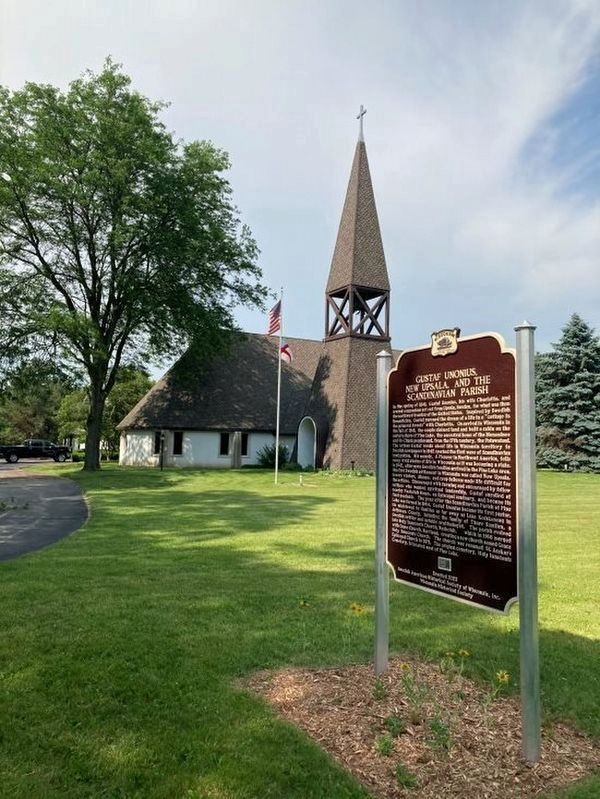
Photographed by Fitzie Heimdahl
2. St. Anskar’s Episcopal Church and Marker

Regionally, this marker is in Southeast Wisconsin and in Greater Milwaukee. It is also in the American Midwest and in the Corn Belt. Globally, it is in North America, the Western Hemisphere, the Western World, and the Anglosphere. Historically, it finds itself in what was once the Viceroyalty of New France, the territory of the Mississippian Culture, and the Northwest Territory.
Other nearby markers. At least 8 other markers are within 4 miles of this marker, measured as the crow flies: Village of Hartland (approx. 1.2 miles away); Hartland’s Founder’s Home, First Church and Historic Tavern (approx. 1.3 miles away); Beaumont Hop House (approx. 2.4 miles away); Stone Bank (approx. 3.2 miles away); Nashotah Mission (approx. 3.3 miles away); St. John's Military Academy (approx. 3.4 miles away); Northwestern Military and Naval Academy (approx. 3.4 miles away); Bishop Jackson Kemper Home Built 1849 (approx. 3.4 miles away). Touch for a list and map of all markers in Hartland.
Credits. This page was last revised on December 8, 2024. It was originally submitted on July 16, 2024, by Fitzie Heimdahl of Eau Claire, Wisconsin. This page has been viewed 2,632 times since then and 176 times this year. Last updated on August 15, 2024, by Fitzie Heimdahl of Eau Claire, Wisconsin. Photos: 1. submitted on July 16, 2024, by Fitzie Heimdahl of Eau Claire, Wisconsin. 2. submitted on July 25, 2024, by Fitzie Heimdahl of Eau Claire, Wisconsin. • J. Makali Bruton was the editor who published this page.
