
Riverfront in Chattanooga in Hamilton County, Tennessee — The American South (East South Central)
Ed Johnson Memorial
Photographed by Joel Seewald, April 29, 2024
1. Ed Johnson Memorial Marker — Chattanooga in 1906
[The Ed Johnson Memorial consists of nine plaques. From left to right, they are:]
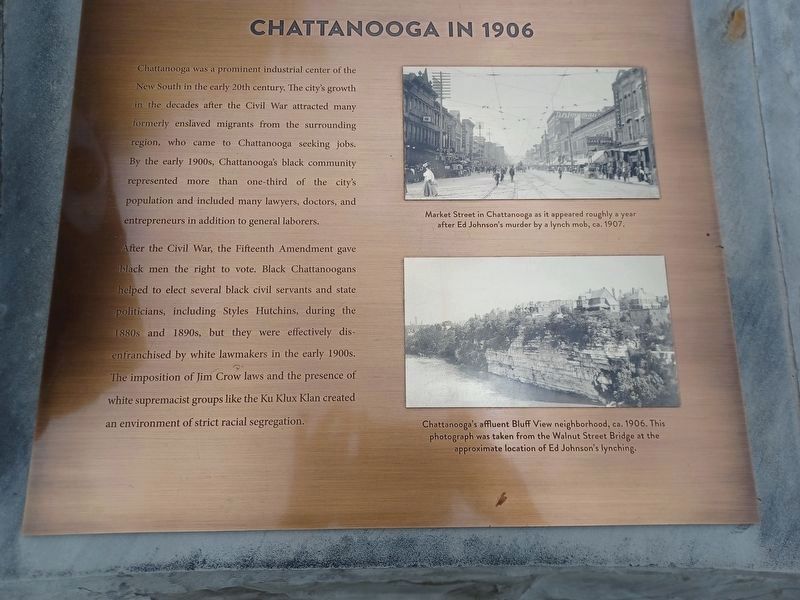
Chattanooga in 1906
Chattanooga was a prominent industrial center of the New South in the early 20th century. The city's growth in the decades after the Civil War attracted many formerly enslaved migrants from the surrounding region, who came to Chattanooga seeking jobs. By the early 1900s, Chattanooga's black community represented more than one-third of the city's population and included many lawyers, doctors, and entrepreneurs in addition to general laborers.
After the Civil War, the Fifteenth Amendment gave black men the right to vote. Black Chattanoogans helped to elect several black civil servants and state politicians, including Styles Hutchins, during the 1880s and 1890s, but they were effectively disenfranchised by white lawmakers in the early 1900s. The imposition of Jim Crow laws and the presence of white supremacist groups like the Ku Klux Klan created an environment of strict racial segregation.
Top image caption: Market Street in Chattanooga as it appeared roughly a year after Ed Johnson's murder by a lynch mob, ca. 1907.
Bottom image caption: Chattanooga's affluent Bluff View neighborhood, ca. 1906. This photograph was taken from the Walnut Street Bridge at the approximate location of Ed Johnson's lynching.
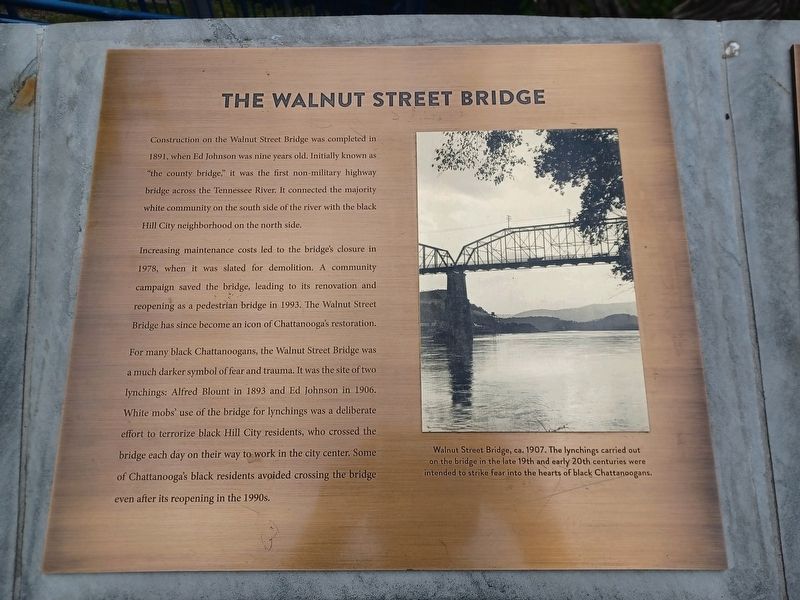
The Walnut Street Bridge
Construction
this page online
Increasing maintenance costs led to the bridge's closure in 1978, when it was slated for demolition. A community campaign saved the bridge, leading to its renovation and reopening as a pedestrian bridge in 1993. The Walnut Street Bridge has since become an icon of Chattanooga's restoration.
For many black Chattanoogans, the Walnut Street Bridge was a much darker symbol of fear and trauma. It was the site of two lynchings: Alfred Blount in 1893 and Ed Johnson in 1906. White mobs' use of the bridge for lynchings was a deliberate effort to terrorize black Hill City residents, who crossed the bridge each day on their way to work in the city center. Some of Chattanooga's black residents avoided crossing the bridge even after its reopening in the 1990s.
Image caption: Walnut Street Bridge, ca. 1907. The lynchings carried out on the bridge in the late 19th and early 20th centuries were intended to strike fear into the hearts of black Chattanoogans.
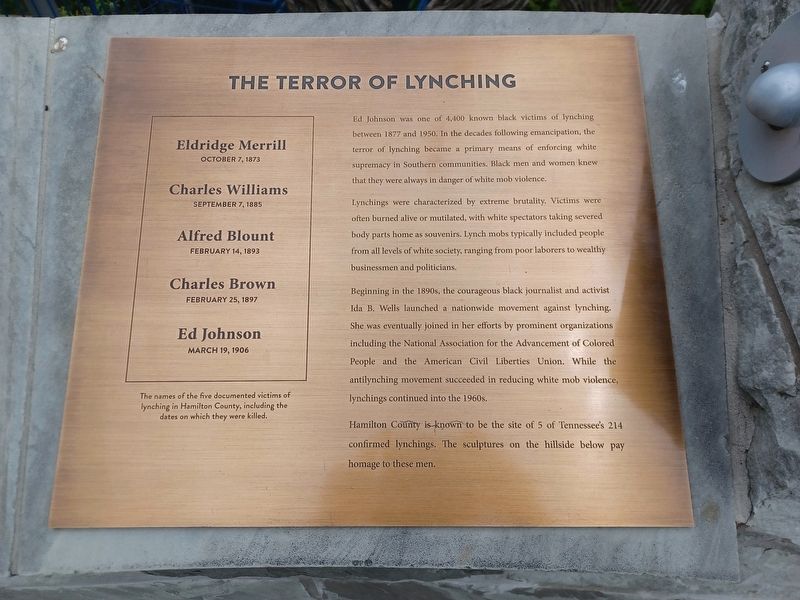
The Terror of Lynching
Ed
Photographed by Joel Seewald, April 29, 2024
2. Ed Johnson Memorial — The Walnut Street Bridge
Lynchings were characterized by extreme brutality. Victims were often burned alive or mutilated, with white spectators taking severed body parts home as souvenirs. Lynch mobs typically included people from all levels of white society, ranging from poor laborers to wealthy businessmen and politicians.
Beginning in the late 1890s, the courageous black journalist and activist Ida B. Wells launched a nationwide movement against lynching. She was eventually joined in her efforts by prominent organizations including the National Association for the Advancement of Colored People and the American Civil Liberties Union. While the antilynching movement succeeded in reducing white mob violence, lynchings continued into the 1960s.
Hamilton County is known to be the site of 5 of Tennessee's 214 confirmed lynchings. The sculptures on the hillside
Photographed by Joel Seewald, April 29, 2024
3. Ed Johnson Memorial — The Terror of Lynching
October 7, 1873
Charles Williams
September 7, 1885
Alfred Blount
February 14, 1893
Charles Brown
February 25, 1897
Ed Johnson
March 19, 1906
The names of the five documented victims of lynching in Hamilton County, including the dates on which they were killed.
A False Accusation
On January 25, 1906, Ed Johnson was falsely accused of raping Nevada Taylor, a local white woman. Johnson was a young black man who worked in Chattanooga as a day laborer. He was one of the builders of Chattanooga's Thankful Memorial Episcopal Church. Johnson also worked in various roles at the Last Chance Saloon, a local bar.
Johnson's accuser was a local man who blamed him for the rape in order to collect a $375 reward offered by the Hamilton County Sheriff. Despite being charged with the crime, Johnson maintained that he had never met or seen Nevada Taylor before his arrest. Multiple black and white witnesses would later confirm that Johnson had been working at the Last Chance Saloon at the time of the attack and could not have been the rapist.
Johnson was arrested and taken

Photographed by Joel Seewald, April 29, 2024
4. Ed Johnson Memorial — A False Accusation
In all likelihood, this was a case of an innocent man improperly branded a guilty brute and condemned to die from the start.
Supreme Court Justice Oliver Wendell Holmes in a statement to reporters on March 20, 1906, after hearing of Ed Johnson's lynching.
Image caption: Thankful Memorial Episcopal Church, also known as the Rock Church, in Chattanooga's St. Elmo neighborhood. Ed Johnson worked on the construction of the church building.
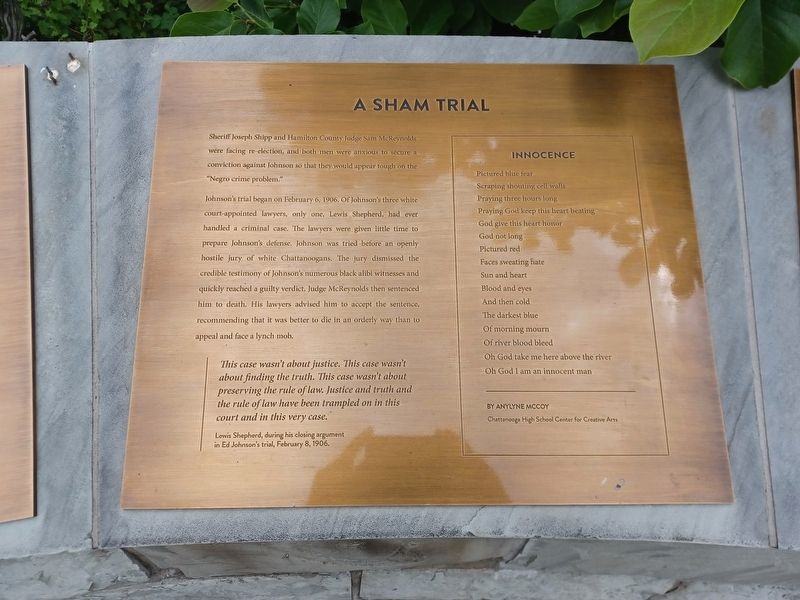
A Sham Trial
Sheriff Joseph Shipp and Hamilton County Judge Sam McReynolds were facing re-election, and both men were anxious to secure a conviction against Johnson so that they would appear tough on the "Negro crime problem."
Johnson's trial began on February 6, 1906. Of Johnson's three white court-appointed lawyers, only one, Lewis Shepherd, had ever handled a criminal case. The lawyers were given little time to prepare Johnson's defense. Johnson was tried before an openly hostile jury of white Chattanoogans.
Photographed by Joel Seewald, April 29, 2024
5. Ed Johnson Memorial — A Sham Trial
This case wasn't about justice. This case wasn't about finding the truth. This case wasn't about preserving the rule of law. Justice and truth and the rule of law have been trampled on in this court and in this very case.
Lewis Shepherd, during his closing argument in Ed Johnson's trial, February 8, 1906.
A Stay of Execution
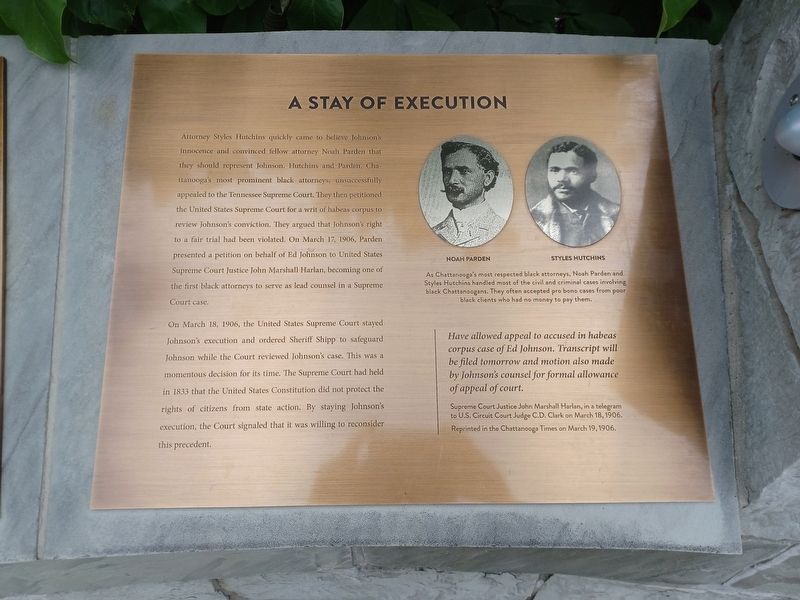
Attorney Styles Hutchins quickly came to believe Johnson's innocence and convinced fellow attorney Noah Parden that they should represent Johnson. Hutchins and Parden, Chattanooga's most prominent black attorneys, unsuccessfully appealed to the Tennessee Supreme Court. They then petitioned the United States Supreme Court for a writ of habeas corpus to review Johnson's conviction. They argued that Johnson's right to a fair trial had been violated. On March 17, 1906, Parden presented a petition on behalf
Photographed by Joel Seewald, April 29, 2024
6. Ed Johnson Memorial — A Stay of Execution
On March 18, 1906, the United States Supreme Court stayed Johnson's execution and ordered Sheriff Shipp to safeguard Johnson while the Court reviewed Johnson's case. This was a momentous decision for its time. The Supreme Court had held in 1833 that the United States Constitution did not protect the rights of citizens from state action. By staying Johnson's execution, the Court signaled that it was willing to reconsider this precedent.
Have allowed appeal to accused in habeas corpus case of Ed Johnson. Transcript will be filed tomorrow and motion also made by Johnson's counsel for formal allowance of appeal of court.
Supreme Court Justice John Marshall Harlan, in a telegram to U.S. Circuit Court Judge C.D. Clark on March 18, 1906.
Reprinted in the Chattanooga Times on March 19, 1906.
Images: Left, Noah Parden; right, Styles Hutchins
Caption: As Chattanooga's most respected black attorneys, Noah Parden and Styles Hutchins handled most of the civil and criminal cases involving black Chattanoogans. They often accepted pro bono cases from poor black clients who had no money to pay them.
An Unjust Death
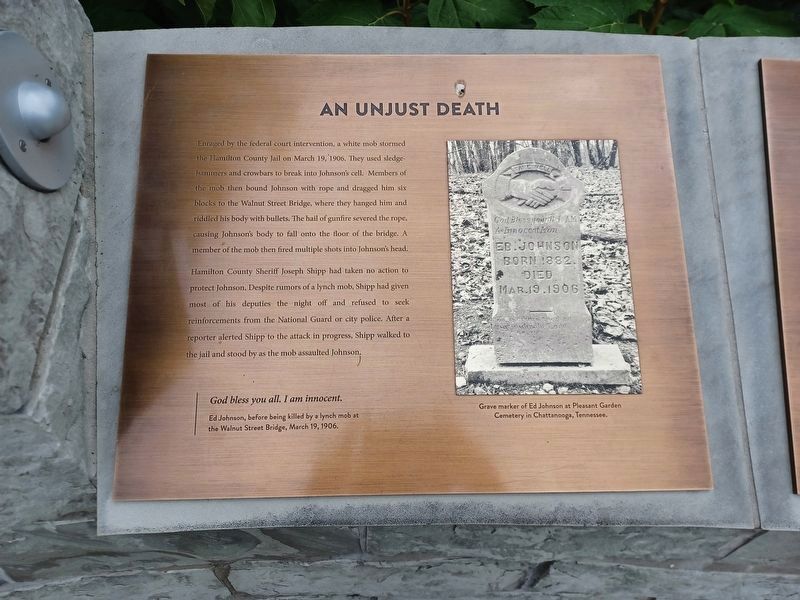
Enraged
Photographed by Joel Seewald, April 29, 2024
7. Ed Johnson Memorial — An Unjust Death
Hamilton County Sheriff Joseph Shipp had taken no action to protect Johnson. Despite rumors of a lynch mob, Shipp had given most of his deputies the night off and refused to seek reinforcements from the National Guard or city police. After a reporter alerted Shipp to the attack in progress, Shipp walked to the jail and stood by as the mob assaulted Johnson.
God bless you all. I am innocent.
Ed Johnson, before being killed by a lynch mob at the Walnut Street Bridge, March 19, 1906.
Image caption: Grave marker of Ed Johnson at Pleasant Garden Cemetery in Chattanooga, Tennessee.
Image caption: Grave marker of Ed Johnson at Pleasant Garden Cemetery in Chattanooga, Tennessee.
A Divided Community
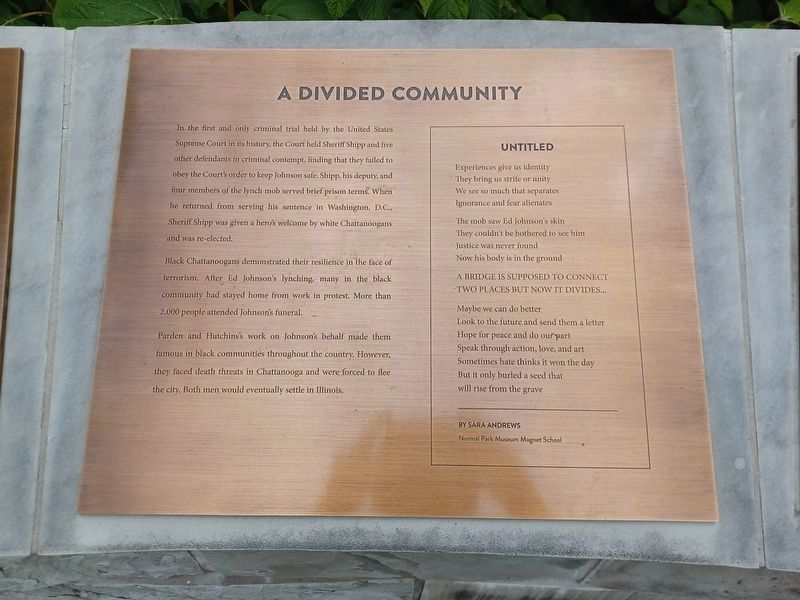
In
Photographed by Joel Seewald, April 29, 2024
8. Ed Johnson Memorial — A Divided Community
Black Chattanoogans demonstrated their resilience in the face of terrorism. After Ed Johnson's lynching, many in the black community had stayed home from work in protest. More than 2,000 people attended Johnson's funeral.
Parden and Hutchins's work on Johnson's behalf made them famous in black communities throughout the country. However, they faced death threats in Chattanooga and were forced to flee the city. Both men would eventually settle in Illinois.
A Need for Healing
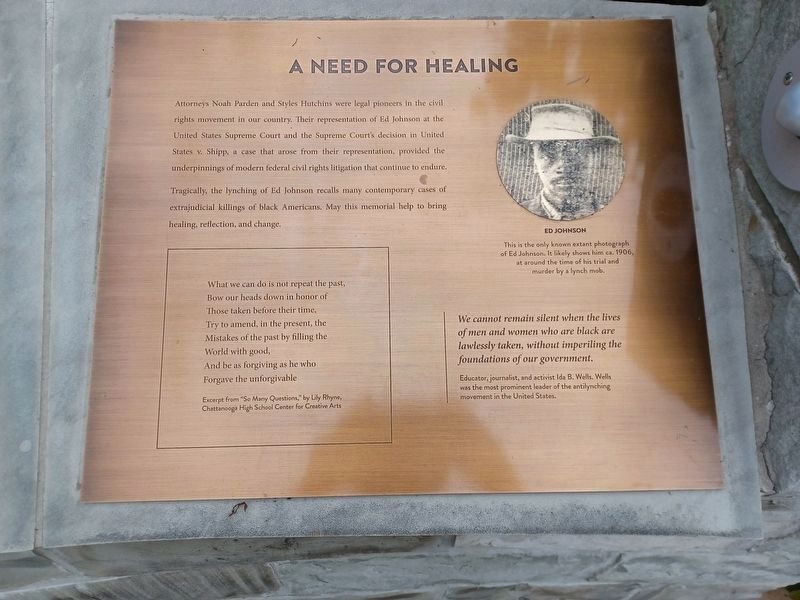
Attorneys Noah Parden and Styles Hutchins were legal pioneers in the civil rights movement in our country. Their representation of Ed Johnson at the United States Supreme Court and the Supreme Court's
Photographed by Joel Seewald, April 29, 2024
9. Ed Johnson Memorial — A Need for Healing
Tragically, the lynching of Ed Johnson recalls many contemporary cases of extrajudicial killings of black Americans. May this memorial help to bring healing, reflection, and change.
We cannot remain silent when the lives of men and women who are black are lawlessly taken, without imperiling the foundations of our government.
Educator, journalist, and activist Ida B. Wells. Wells was the most prominent leader of the antilynching movement in the United States.
Image caption: Ed Johnson. This is the only known extant photograph of Ed Johnson. It likely shows him ca. 1906, at around the time of his trial and murder by a lynch mob.
Topics. This historical marker and memorial is listed in these topic lists: African Americans • Bridges & Viaducts • Civil Rights. A significant historical date for this entry is January 25, 1906.
Location. 35° 3.356′ N, 85° 18.465′ W. Marker is in Chattanooga, Tennessee, in Hamilton County. It is in Riverfront. It can be reached from Walnut

Photographed by Joel Seewald, April 29, 2024
10. Ed Johnson Memorial
Memorial showing the plaques with the Walnut Street Bridge in the background.

Regionally, this marker and memorial is in the American South, specifically in the Upper South, in Appalachia, and in Southern Appalachia. Globally, it is in North America, the Western Hemisphere, the Western World, and the Anglosphere. Historically, it finds itself in what was once the original Cherokee Nation, the territory of the Mississippian Culture, one of the Confederate States of America, and the Antebellum South.
Other nearby markers. At least 8 other markers are within walking distance of this marker: Headquarters Row (within shouting distance of this marker); Bluff Furnace Historic Site (within shouting distance of this marker); The Cherokee, the Chickamauga, and John Ross (within shouting distance of this marker); Chattanooga's Early Industry (within shouting distance of this marker); From Oblivion to Rebirth: Archaeological Research at the Bluff Furnace Site (within shouting distance of this marker); Innovation and Disaster (within shouting distance of this marker); Bluff Furnace Historical Park (within shouting distance of this marker); Ross's Landing: River Crossing and Port (within shouting distance of this marker). Touch for a list and map of all markers in Chattanooga.
Also see . . .
1. Walking with Ed Johnson. "Take a walking tour through Chattanooga, TN and be guided visually and audibly from 1906 through 2021 to learn the history of Ed Johnson." Note that the map shows up best on larger screens. (Submitted on August 15, 2024, by Joel Seewald of Madison Heights, Michigan.)
2. The Ed Johnson Memorial. More information about the memorial and the case that inspired it on the Friends of the Ed Johnson Memorial website. (Submitted on August 15, 2024, by Joel Seewald of Madison Heights, Michigan.)
Credits. This page was last revised on August 15, 2024. It was originally submitted on August 15, 2024, by Joel Seewald of Madison Heights, Michigan. This page has been viewed 615 times since then and 128 times this year. Photos: 1, 2, 3, 4, 5, 6, 7, 8, 9, 10. submitted on August 15, 2024, by Joel Seewald of Madison Heights, Michigan.
