
Riverfront in Chattanooga in Hamilton County, Tennessee — The American South (East South Central)
The Cherokee, the Chickamauga, and John Ross
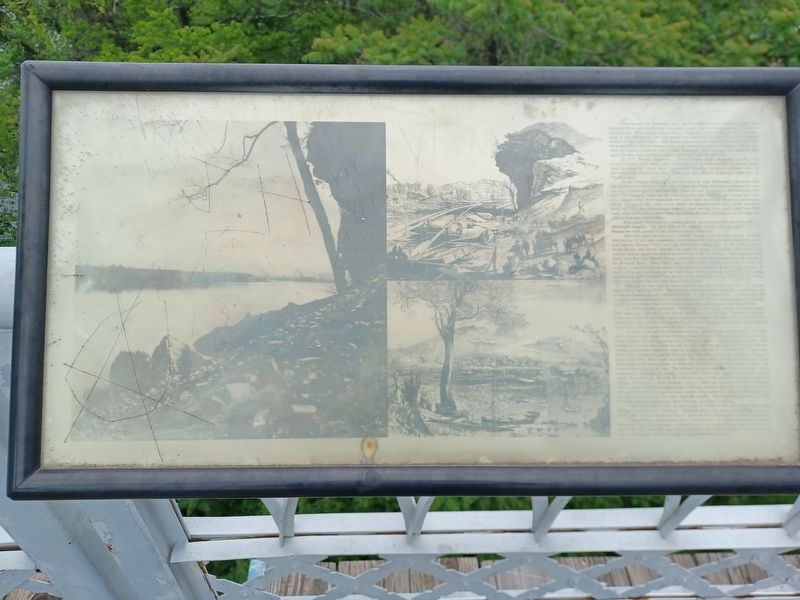
Photographed by Joel Seewald, April 29, 2024
1. The Cherokee, the Chickamauga, and John Ross Marker
From the time the Tennessee Valley was first inhabited over 10,000 years ago, the Tennessee River and its tributaries have been a vital source of transportation, communication and trade. When regular contact between Europeans and Cherokees became common, much of the Chattanooga area was hunted but uninhabited because it was the disputed territory of three native tribes. After Britain gained colonial control of all lands east of the Mississippi River, they proclaimed much of the southwest territory off-limits to settlers. So, while the British considered much of East Tennessee, North Georgia, and Northeast Alabama Cherokee land, American settlers wanted these lands for their own.
In 1775, Richard Henderson, a North Carolina judge, negotiated a treaty with several Cherokee chiefs which ceded 20,000,000 acres of Cherokee land. It was this treaty which provoked the young brave Tsu-gun-sini--Draggin Canoe--to withdraw his followers to the Chattanooga area. From here they planned to prevent further loss of Cherokee lands.
In this struggle, Draggin Canoe was aided by John McDonald, a Scotsman who had established a trading
this page online
Ross joined McDonald as a trading partner, and cemented this union by marrying McDonald's daughter. The third child of this marriage, though only one-eighth Cherokee, became one of the greatest of the Cherokee leaders, John Ross.
John Ross spent his first years in North Georgia, near the Coosa River. In 1800, when he was 10, his father established a homestead at the foot of Lookout Mountain, on the road between Brown's Ferry and John McDonald's trading post. In 1813, Ross married Quatie Brown, and shortly thereafter,
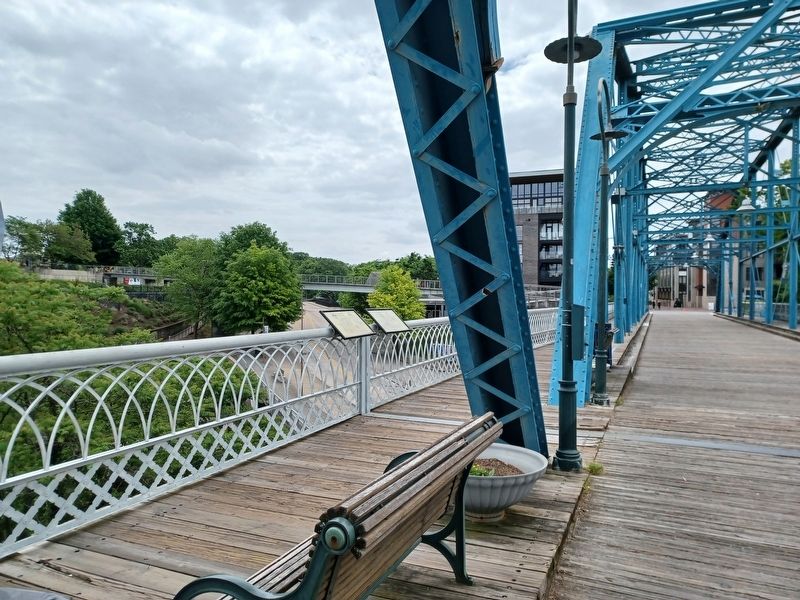
Photographed by Joel Seewald, April 29, 2024
2. The Cherokee, the Chickamauga, and John Ross Marker
View looking south along the Walnut Street bridge toward downtown Chattanooga. This marker is the one on the right.
The type of ferry built by Ross is not known, but a swing ferry (pictured bottom right) was in use in the 1850's. This ferry traveled from bank to bank like a pendulum, with its hub on Chattanooga (now Maclellan) Island. A cable attached to this hub was suspended by several buoys and attached to a flat-bottomed craft. By moving the rudder, the operator could use the current of the river to push the platform and its cargo to the chosen bank.
In 1819, Cherokee land north of the Tennessee River was ceded to the United States. That same year, John Ross was elected president of the Cherokee National Committee. Tennessee's General Assembly created Hamilton County in the fall of 1819, making Ross's Landing an active hub for the transfer of goods from one nation to another. Ross himself stood as the chief negotiator between these two nations.
In 1826, Ross sold his Rossville holdings, the ferry, and the warehouse. He then moved closer to the capital of the Cherokee Nation in North Georgia, committing his energy to the struggle to maintain possession of Cherokee lands. Though many Cherokees had moved west of the Mississippi as early as 1817, the vast majority had remained behind, hoping a permanent settlement could be reached with the U.S. Government. Chief John Ross worked toward this goal for 20 years, but when three rival leaders signed the Treaty of Removal in 1836, Ross's work was futile. This treaty ceded all Cherokee land east of the Mississippi to the United States. In return, the Cherokees received five million dollars and seven million acres in the west. The removal was to be completed within two years. Ross continued to challenge the validity of the treaty (those who signed it were later assassinated, but to no avail. In 1838, the Cherokee were forcibly removed from their farms and villages, to be held in three stockades, one of which was located near Ross's Landing. Three groups left Ross's Landing in June, 1838, but sent news that poor traveling conditions had caused the death of several of their number. Ross asked for a delay in the Removal so that the summer heat and low water might be avoided. This delay was granted, and 2500 Cherokees spent the summer in Camp Cherokee, near Ross's Landing.
Later in the fall of 1838, the final group of 13,000 marched away from Rattlesnake Springs, near Charleston, Tennessee. Hundreds died on the journey, and among them was Ross's wife. The loss, both to our region, and to its native inhabitants, remains incalculable.
Though Ross and his people were forced to leave, the settlement which had grown around his ferry and warehouse continued to grow as a center of the river and rail trade, and just twenty-five years after the forced removal of the Cherokee Nation, the Chattanooga area would again be the site of a tragic struggle between two nations.
Topics. This historical marker is listed in these topic lists: Indigenous Peoples and Communities • Settlements & Settlers. A significant historical month for this entry is June 1838.
Location. 35° 3.383′ N, 85° 18.451′ W. Marker is in Chattanooga, Tennessee, in Hamilton County. It is in Riverfront. It can be reached from Bluff View Avenue. Marker can be reached from Walnut Street at the south and Forest Street at the north. Marker is on the east side of the Walnut Street [pedestrian] Bridge, between the first and second truss spans from the south. Touch for map. Marker is in this post office area: Chattanooga TN 37403, United States of America. Touch for directions.

Regionally, this marker is in the American South, specifically in the Upper South, in Appalachia, and specifically in Southern Appalachia. Globally, it is in North America, the Western Hemisphere, the Western World, and the Anglosphere. Historically, it finds itself in what was once the original Cherokee Nation, the territory of the Mississippian Culture, one of the Confederate States of America, and the Antebellum South.
Other nearby markers. At least 8 other markers are within walking distance of this marker: Chattanooga's Early Industry (here, next to this marker); Bluff Furnace Historic Site (here, next to this marker); Ross's Landing: River Crossing and Port (within shouting distance of this marker); Bluff Furnace Historical Park (within shouting distance of this marker); Innovation and Disaster (within shouting distance of this marker); From Oblivion to Rebirth: Archaeological Research at the Bluff Furnace Site (within shouting distance of this marker); The Beginnings of Iron Manufacture in Chattanooga (within shouting distance of this marker); Ed Johnson Memorial (within shouting distance of this marker). Touch for a list and map of all markers in Chattanooga.
Credits. This page was last revised on August 26, 2024. It was originally submitted on August 17, 2024, by Joel Seewald of Madison Heights, Michigan. This page has been viewed 950 times since then and 68 times this year. Photos: 1, 2. submitted on August 17, 2024, by Joel Seewald of Madison Heights, Michigan.
