
Riverfront in Chattanooga in Hamilton County, Tennessee — The American South (East South Central)
Tennessee River Traffic
Photographed by Joel Seewald, April 29, 2024
1. Tennessee River Traffic Marker
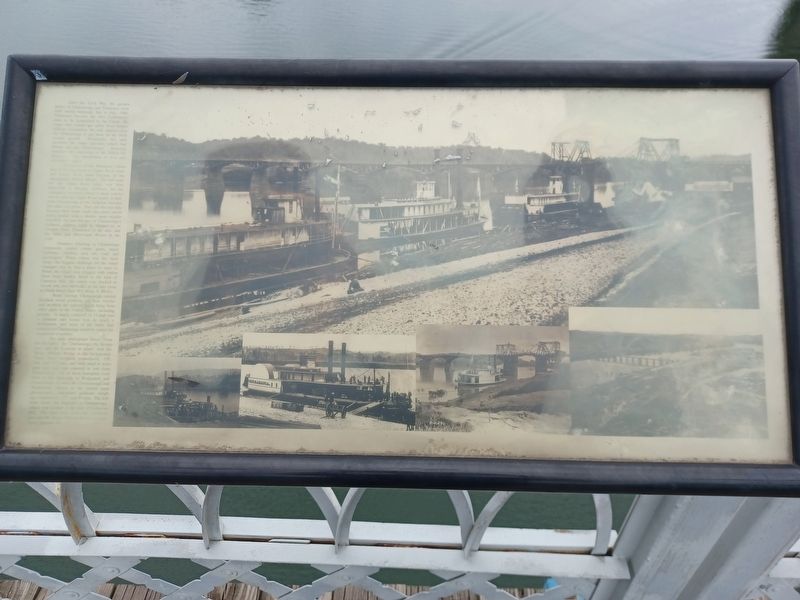
After the Civil War, the governments of Chattanooga and Tennessee were both nearly bankrupt, but in July, 1866, Tennessee became the first Confederate state to be readmitted to the Union. Because they would not suffer from further military occupation, the way seemed clear for Chattanooga to get back on the track toward growth. Essentially, this path involved the same activities which had driven pre-war Chattanooga: attracting industry and exploiting to the fullest the already excellent possibilities of river and rail transportation.
Navigation of the Tennessee continued to be organized as Upper River trade and Lower River trade because of the unnavigable Muscle Shoals. The full route for the Upper River boats was from Knoxville to Decatur, Alabama, but the companies involved found it more convenient to split the Upper River nearly in half, with Chattanooga as the midpoint between the other two ports. They did this not only because their boats could stay more consistently loaded with a shorter, more regular schedule, but also because at Chattanooga's railhead, cargoes could be shipped to, or brought from, Charleston
this page online
Steamers wharfing in Chattanooga commonly carried cotton, grain, sugar, molasses, whiskey, iron ore, coal, and passengers. When cotton was the main cargo, the biggest challenge for the wharf manager was to find a place to store it. When the wharf was clogged with cotton bales from Market Street to the foot of Cameron Hill, the cotton was stacked in vacant lots and sidewalks as far into town as Ninth Street (now M.L.King, Jr. Blvd.).
Boats leaving Chattanooga carried finished wood products, pig iron, textiles and anything the railroad might bring from other parts of the United States, including people. A stately cruise of 12-15 mph was a pleasant and scenic way to reach a destination, and most of the boats that wharfed in Chattanooga could be rented for excursions or parties.
The large photograph shows (from left to right): the Chattanooga, the Bridgeport, and the Lookout at wharf, with the Meigs Military Bridge in the background. These boats weighed, respectively, 159, 184, and 193 tons, and were used to transport men and war materiel to and from Chattanooga. All
Photographed by Joel Seewald, April 29, 2024
2. Tennessee River Traffic Marker
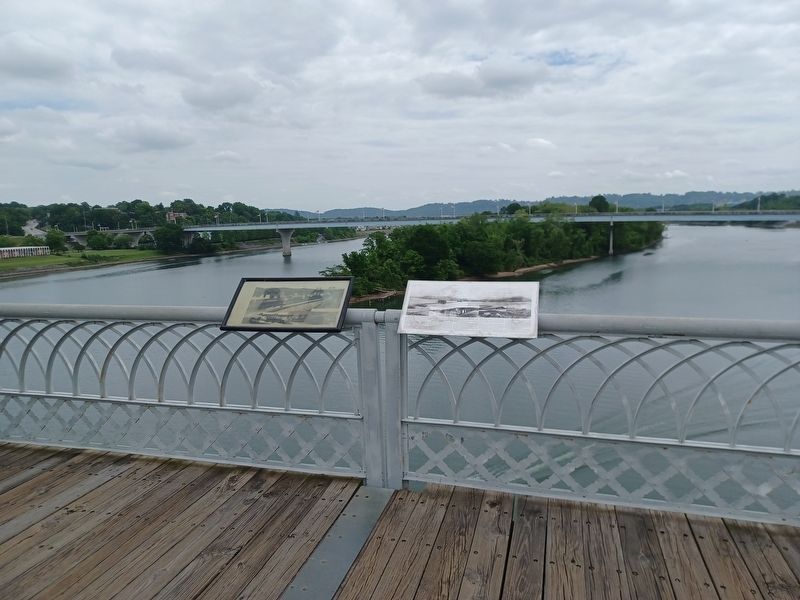
View of the marker (on the left) with the Tennessee River, Maclellan Island, and Veterans Memorial Bridge in the background.
Topics. This historical marker is listed in these topic lists: Industry & Commerce • Waterways & Vessels. A significant historical month for this entry is July 1866.
Location. 35° 3.42′ N, 85° 18.446′ W. Marker is in Chattanooga, Tennessee, in Hamilton County. It is in Riverfront. It can be reached from Bluff View Avenue. Marker can be reached from Walnut Street at the south and Forest Street at the north. Marker is on the east side of the Walnut Street [pedestrian] Bridge, between the second and third truss spans from the south. Touch for map. Marker is in this post office area: Chattanooga TN 37402, United States of America. Touch for directions.

Regionally, this marker is in the American South, specifically in the Upper South, in Appalachia, and specifically in Southern Appalachia. Globally, it is in North America, the Western Hemisphere, the Western World, and the Anglosphere. Historically, it finds itself in what was once the original Cherokee Nation, the territory of the Mississippian Culture, one of the Confederate States of America, and the Antebellum South.
Other nearby markers. At least 8 other markers are within walking distance of this marker: The Civil War in Chattanooga (here, next to this marker); Ross's Landing: River Crossing and Port (within shouting distance of this marker); Chattanooga's Early Industry (within shouting distance of this marker); The Cherokee, the Chickamauga, and John Ross (within shouting distance of this marker); Bluff Furnace Historic Site (within shouting distance of this marker); Tennesee River Flooding and the First Chattanooga Bridges (about 300 feet away, measured in a direct line); Bluff Furnace Historical Park (about 300 feet away); The Beginnings of Iron Manufacture in Chattanooga (about 300 feet away). Touch for a list and map of all markers in Chattanooga.
Credits. This page was last revised on August 26, 2024. It was originally submitted on August 17, 2024, by Joel Seewald of Madison Heights, Michigan. This page has been viewed 169 times since then and 16 times this year. Photos: 1, 2. submitted on August 17, 2024, by Joel Seewald of Madison Heights, Michigan.
