Lexington, Virginia — The American South (Mid-Atlantic)
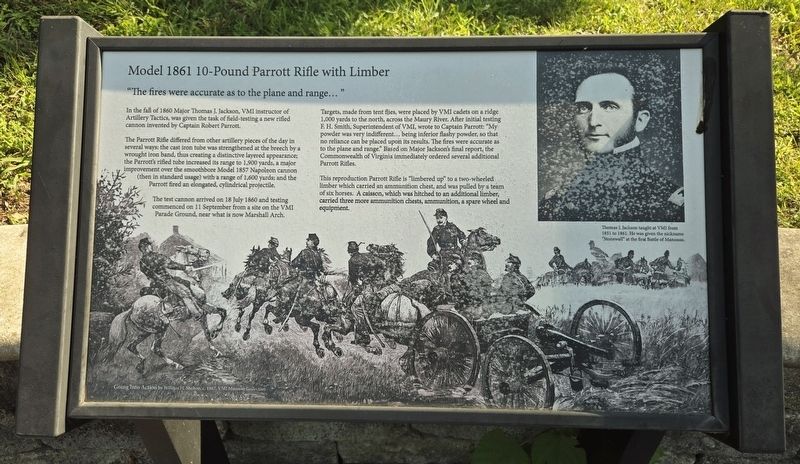
Model 1861 10-Pound Parrott Rifle with Limber
"The fires were accurate as to the plane and range... "
Photographed by Bradley Owen, August 12, 2024
1. Model 1861 10-Pound Parrott Rifle with Limber Marker
In the fall of 1860 Major Thomas J. Jackson, VMI instructor of Artillery Tactics, was given the task of field-testing a new rifled cannon invented by Captain Robert Parrott.
The Parrott Rifle differed from other artillery pieces of the day in several ways: the cast iron tube was strengthened at the breech by a wrought iron band, thus creating a distinctive layered appearance; the Parrott's rifled tube increased its range to 1,900 yards, a major improvement over the smoothbore Model 1857 Napoleon cannon (then in standard usage) with a range of 1,600 yards; and the Parrott fired an elongated, cylindrical projectile.
The test cannon arrived on 18 July 1860 and testing commenced on 11 September from a site on the VMI Parade Ground, near what is now Marshall Arch.
Targets, made from tent flies, were placed by VMI cadets on a ridge 1,000 yards to the north, across the Maury River. After initial testing F. H. Smith, Superintendent of VMI, wrote to Captain Parrott: "My powder was very indifferent... being inferior flashy powder, so that no reliance can be placed upon its results. The fires were accurate as to the plane
this page online
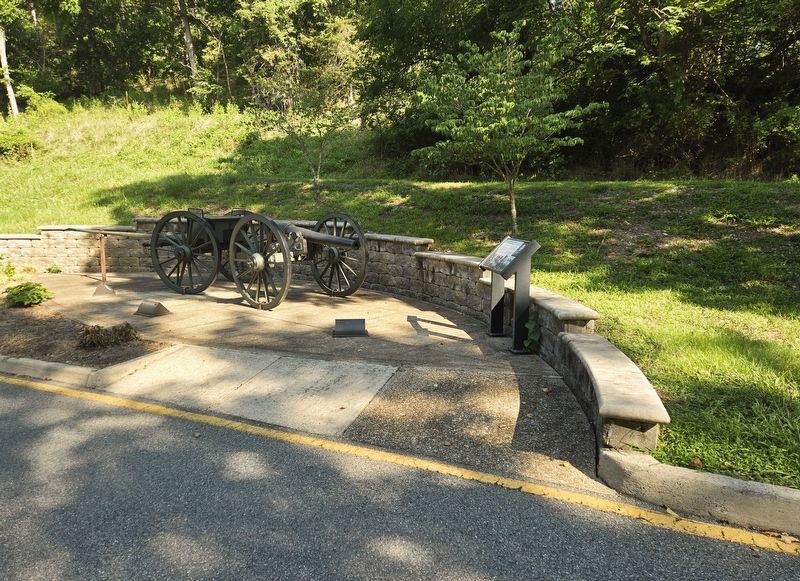
This reproduction Parrott Rifle is "limbered up" to a two-wheeled limber which carried an ammunition chest, and was pulled by a team of six horses. A caisson, which was hitched to an additional limber, carried three more ammunition chests, ammunition, a spare wheel and equipment.
(Captions):
Going Into Action by William H. Shelton, c. 1887. VMI Museum Collection
Thomas J. Jackson taught at VMI from 1851 to 1861. He was given the nickname "Stonewall" at the first Battle of Manassas.
Topics. This historical marker is listed in these topic lists: Education • Military • War, US Civil. A significant historical date for this entry is July 18, 1860.
Location. 37° 47.527′ N, 79° 25.809′ W. Marker is in Lexington, Virginia. It is on Jordan Point Road west of Moses Mill Road, on the right when traveling west. Touch for map. Marker is in this post office area: Lexington VA 24450, United States of America. Touch for directions.

Regionally, this marker is in the Shenandoah Valley. It is also in the
Photographed by Bradley Owen, August 12, 2024
2. Model 1861 10-Pound Parrott Rifle with Limber Marker
Other nearby markers. At least 8 other markers are within walking distance of this marker: Saunders Fields (a few steps from this marker); Road, River and Rail: (within shouting distance of this marker); Virginia Military Institute (within shouting distance of this marker); The Rise and Fall of an American Waterfront (within shouting distance of this marker); Iron Rails, Steam Locomotives, 90 years (within shouting distance of this marker); Jordan's Point (within shouting distance of this marker); Mills, Forges and Foundries... (within shouting distance of this marker); Entrepreneurs, Tradesmen and Laborers (about 300 feet away, measured in a direct line). Touch for a list and map of all markers in Lexington.
Another marker is no longer nearby. Jordan’s Point (was within shouting distance of this marker but has been replaced with another marker now near it).
Credits. This page was last revised on August 17, 2024. It was originally submitted on August 17, 2024, by Bradley Owen of Morgantown, West Virginia. This page has been viewed 278 times since then and 48 times this year. Photos: 1, 2. submitted on August 17, 2024, by Bradley Owen of Morgantown, West Virginia.
