Bridgewater in Rockingham County, Virginia — The American South (Mid-Atlantic)
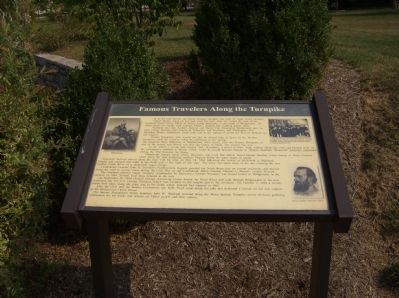
Famous Travelers Along the Turnpike
Photographed by Robert H. Moore, II, September 26, 2007
1. Famous Travelers Along the Turnpike Marker
In its 82 year history, the Warm Springs Turnpike was used by many noted travelers. Daniel Boone, when an old man, used the road when he visited the sons of his boyhood friend Henry Miller at Mossy Creek Ironworks to the south of Bridgewater. He spent about two weeks with younger Millers, hunting and recalling earlier times.
Tradition says that Andrew Jackson and Henry Clay frequented Bridgewater inns on their travels between their homes in Tennessee and Kentucky, and Washington, D.C. President Martin Van Buren’s coach took him to the springs to avoid the heat of summer in the Capitol.
Jerome Bonaparte, who would one day be named king of Spain by his brother Napoleon, used the roadway when he journeyed to the springs.
The beautiful Betsy Patterson of Bordentown, New Jersey, who met Jerome Bonaparte at one of the resorts and almost cost him the crown of Spain, also passed this way.
In the 1840s a young man named “Jed” Hotchkiss, a native of New York, walked along this road and became tutor of the ironmaster’s children at Mossy Creek. Later he would become famous as Thomas Jonathan “Stonewall” Jackson’s mapmaker during the
this page online
Nineteenth century writer, illustrator, and Civil War officer David Hunter Strother, better known as Porte Crayon, came along the road exploring western Virginia before the guns began to sound.
Stonewall Jackson moved along the road with his army on May 18, 1862 following the victory at McDowell in Highland County and camped that night in the fields just to the right of this sign. The army had spent most of the day crossing the rain swollen North River on a makeshift wagon bridge.
Confederate General John D. Imboden’s Northwestern Brigade guarded the North River line on several occasions, and moved along the road at various times during the Civil War, as did Confederate Major General Thomas L. Rosser’s cavalry division. The Southern partisan ranger company commanded by Missourian Charles Woodson was issued horses at Bridgewater in the summer of 1864. Several local boys enlisted in the unit.
On September 30, 1864, General George Armstrong Custer forded the North River and road through Bridgewater to his new command, the 3rd U.S. Cavalry Division, which was camped on the heights just to the northeast. On October
Photographed by Robert H. Moore, II, September 26, 2007
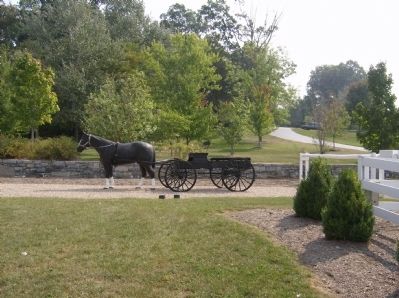
2. Static display on the grade of the old turnpike
After the Civil War the famous spy Belle Boyd came along the pike and delivered a lecture on her war exploits at the Bridgewater Opera House.
The famous Shenandoah Valley historian John W. Wayland traveled along the Warm Springs Turnpike scores of times gathering information for his books and articles on Valley people and their culture.
Topics and series. This historical marker is listed in these topic lists: Roads & Vehicles • War, US Civil. In addition, it is included in the Former U.S. Presidents: #08 Martin Van Buren series list. A significant historical date for this entry is May 18, 1862.
Location. 38° 23.524′ N, 78° 57.757′ W. Marker is in Bridgewater, Virginia, in Rockingham County. It is on North Main Street (State Highway 42) north of Oakwood Drive, on the right when traveling north. Touch for map. Marker is at or near this postal address: 100 Oakwood Dr, Bridgewater VA 22812, United States of America. Touch for directions.

Regionally, this marker is in the Shenandoah Valley. It is also in the American South and specifically in the Upper South. Globally, it is in North America, the Western Hemisphere, the Western World, and the Anglosphere. Historically, it finds itself in what was once the territory of the Mississippian Culture, one of the original Thirteen Colonies, one of the Confederate States of America, and the Antebellum South.
Other nearby markers. At least 8 other markers are within 2 miles of this marker, measured as the crow flies: The Alexander Mack Memorial Library (approx. one mile away); Sipe Center (approx. one mile away); Bridgewater Historic District (approx. 1.1 miles away); Dr. John G. Brown House (approx. 1.1 miles away); In Honor and Remembrance (approx. 1.2 miles away); The Litten Water Gardens at Edgebriar Park (approx. 1.2 miles away); The Roscoe Burgess Riverwalk (approx. 1.2 miles away); Bridgewater (approx. 1.2 miles away). Touch for a list and map of all markers in Bridgewater.
More about this marker. On the left is a painting of Daniel Boone. On the upper right is a photo captioned, Coaches like this one served the Warm Springs Turnpike on a daily basis. Travelers used the coaches to go to the “healing” springs west of here and to summer resorts to avoid the heat of the city. On the lower right is a portrait of Thomas Jonathan “Stonewall” Jackson.
Credits. This page was last revised on August 20, 2024. It was originally submitted on February 26, 2009, by Robert H. Moore, II of Winchester, Virginia. This page has been viewed 2,019 times since then and 68 times this year. Last updated on August 20, 2024, by Carl Gordon Moore Jr. of North East, Maryland. Photos: 1, 2. submitted on February 26, 2009, by Robert H. Moore, II of Winchester, Virginia. • Devry Becker Jones was the editor who published this page.
