New Market in Shenandoah County, Virginia — The American South (Mid-Atlantic)
The Rice Farm
Battlefield Headquarters
| — | Civil War New Market | — |
Photographed by Bradley Owen, August 11, 2024
1. The Rice Farm Marker
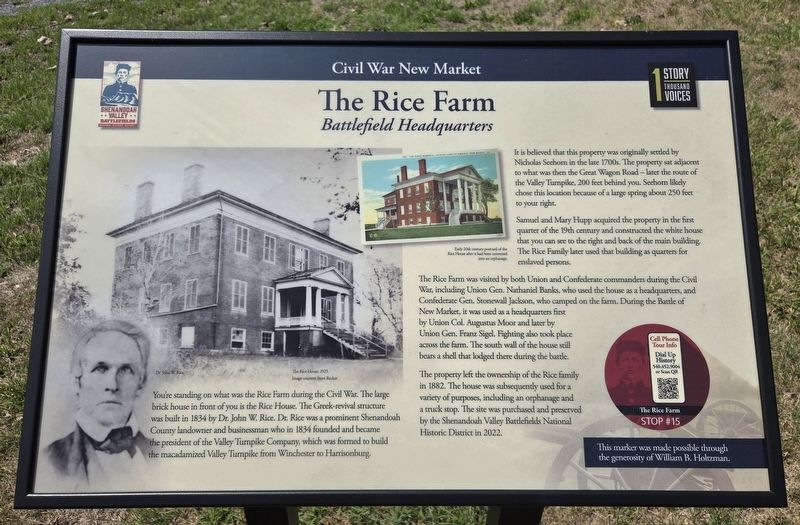
You're standing on what was the Rice Farm during the Civil War. The large brick house in front of you is the Rice House. The Greek-revival structure was built in 1834 by Dr. John W. Rice. Dr. Rice was a prominent Shenandoah County landowner and businessman who in 1834 founded and became the president of the Valley Turnpike Company, which was formed to build the macadamized Valley Turnpike from Winchester to Harrisonburg.
It is believed that this property was originally settled by Nicholas Seehorn in the late 1700s. The property sat adjacent to what was then the Great Wagon Road - later the route of the Valley Turnpike, 200 feet behind you. Seehorn likely chose this location because of a large spring about 250 feet to your right.
Samuel and Mary Hupp acquired the property in the first quarter of the 19th century and constructed the white house that you can see to the right and back of the main building. The Rice Family later used that building as quarters for enslaved persons.
The Rice Farm was visited by both Union and Confederate commanders during the Civil War, including Union Gen. Nathaniel Banks, who used
this page online
The property left the ownership of the Rice family in 1882. The house was subsequently used for a variety of purposes, including an orphanage and a truck stop. The site was purchased and preserved by the Shenandoah Valley Battlefields National Historic District in 2022.
(Captions):
Dr. John W. Rice
The Rice House, 1925.
Image courtesy Steve Recker
Early 20th century postcard of the Rice House after it had been converted into an orphanage.
This marker was made possible through the generosity of William B. Holtzman.
Erected 2024 by Shenandoah Valley Battlefields Foundation.
Topics. This historical marker is listed in these topic lists: Industry & Commerce • Roads & Vehicles • Settlements & Settlers • War, US Civil. A significant historical year for this entry is 1834.
Location. 38° 39.265′ N,
Photographed by Bradley Owen, August 11, 2024
2. The Rice Farm Marker
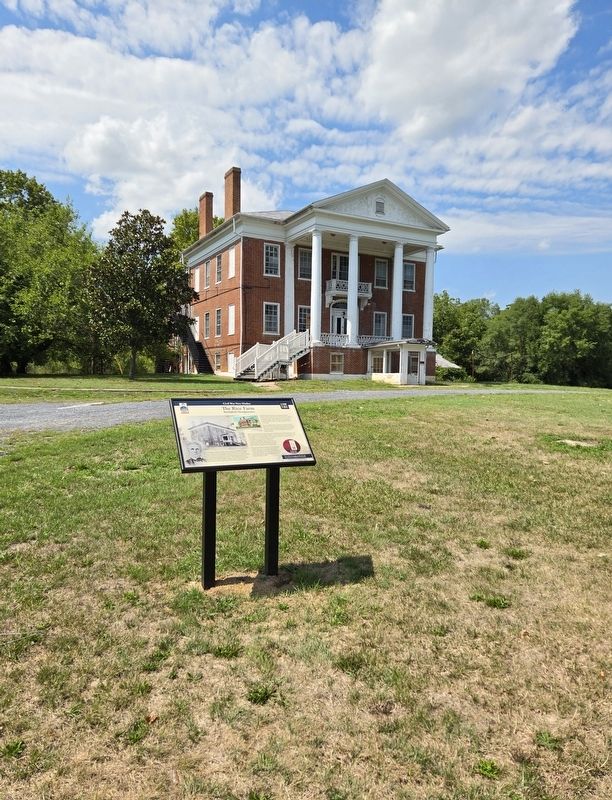
The Rice House is in the background.

Regionally, this marker is in the Shenandoah Valley. It is also in the American South, specifically in the Upper South, and in the Mid-Atlantic. Globally, it is in North America, the Western Hemisphere, the Western World, and the Anglosphere. Historically, it finds itself in what was once the territory of the Mississippian Culture, one of the original Thirteen Colonies, one of the Confederate States of America, and the Antebellum South.
Other nearby markers. At least 8 other markers are within walking distance of this marker: Cannon Along the Turnpike (within shouting distance of this marker); Slavery on the Rice Farm (within shouting distance of this marker); Confederate Memorial (approx. 0.2 miles away); The Church Cemetery (approx. ¼ mile away); Action on the River Road

Photographed by Bradley Owen, August 11, 2024
3. The Rice Farm Marker
Artillery shell fired during the Battle of New Market lodged in the south wall of the Rice House.
Credits. This page was last revised on August 26, 2024. It was originally submitted on August 26, 2024, by Bradley Owen of Morgantown, West Virginia. This page has been viewed 1,579 times since then and 182 times this year. Photos: 1, 2, 3. submitted on August 26, 2024, by Bradley Owen of Morgantown, West Virginia.
