Near Greece in Monroe County, New York — The American Northeast (Mid-Atlantic)
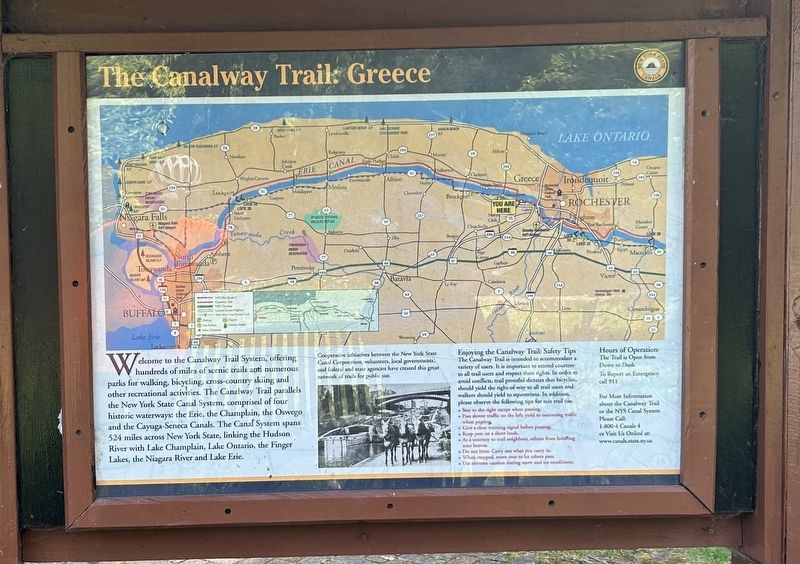
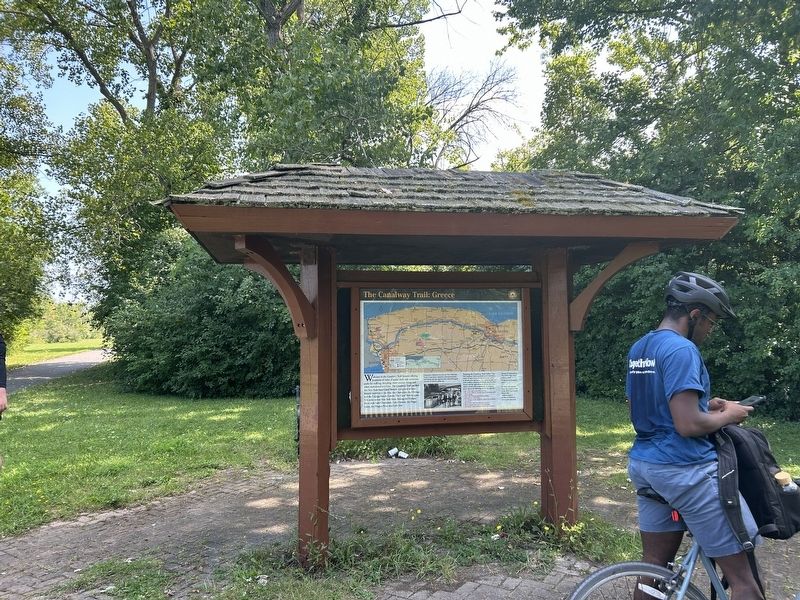
The Canalway Trail: Greece
Photographed by Steve Stoessel, August 25, 2024
1. The Canalway Trail: Greece Marker
Welcome to the Canalway Trail System, offering hundreds of miles of scenic trails and numerous parks for walking, bicycling, cross country skiing and other recreational activities. The Canalway Trail parallels the New York State Canal System, comprised of four historic waterways: the Erie, the Champlain, the Oswego and the Cayuga-Seneca Canals. The Canal System spans 524 miles across New York State, linking the Hudson River with the Lake Champlain, Lake Ontario, the Finger Lakes, the Niagara River and Lake Erie.
Cooperative initiatives between the New York State Canal Corporation, volunteers, local governments, and federal and state agencies have created this great network of trails for public use. When completed, the Canalway Trail will span over 500 miles connecting numerous cities, towns and villages along the Canal System, making it one of the most extensive trail networks in the country.
Enjoying the Canalway Trail: Safety Tips
The Canalway Trail is intended to accommodate a variety of users. It is important to extend courtesy to all trail users and respect their rights. In order to avoid conflicts, trail protocol
this page online
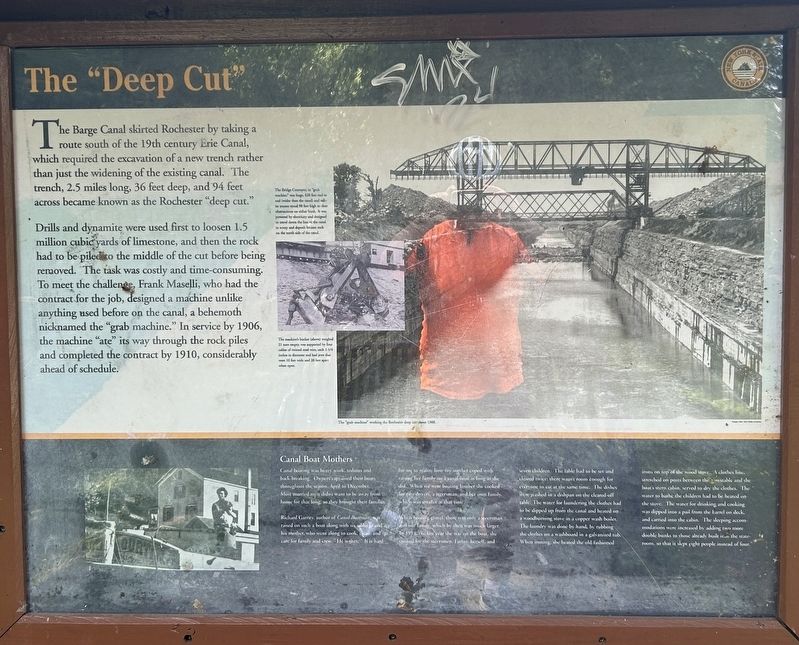
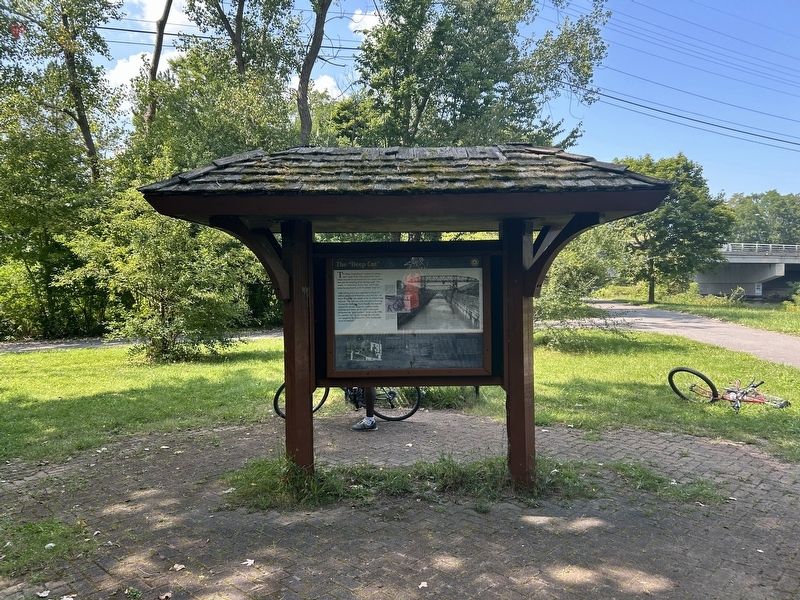
Drills and dynamite were used first to loosen 1.5 million cubie yards of limestone, and then the rock had to be piled to the middle of the cut before being removed. The task was costly and time-consuming. To meet the challenge, Frank Maselli, who had the contract for the job, designed a machine unlike anything used before on the canal, a behemoth nicknamed the "grab machine." In service by 1906, the machine "ate" its way through the rock piles and completed the contract by 1910, considerably ahead of schedule.
The Bridge Conveyor or “grab machine was huge, 428 feet end to end (wider than the canal) and [obscure] trusses stood
Photographed by Steve Stoessel, August 25, 2024
2. The Canalway Trail: Greece Marker
The machine’s bucket weighed 21 tons empty, was supported by four cables of twisted wire, each 1 ¼ inches in diameter and had jaws 10 fear wide and 20 feet apart when open.
The"grab machine" working the Rochester deep cut about 1908.
Canal Boat Mothers:
Canal boating was heavy work, tedious and back-breaking. Owners captained their boats throughout the season, April to December. Most married men didn't want to be away from home for that long, so they brought their families.
Richard Garrity, author of Canal Boatman, was raised on such a boat along with six siblings and his mother, who went along to cook, clean, and care for family and crew. He writes "It is hard for me to realize how my mother coped with raising her family on canal boat as long as she did. When we were boating lumber, she cooked for two drivers, a steersman and her own family, which way smaller at that time.
When boating gavel, there was only a steersman and our family,
Photographed by Steve Stoessel, August 25, 2024
3. The Canalway Trail: Greece Marker
Erected by Erie Canalway.
Topics. This historical marker is listed in these topic
Photographed by Steve Stoessel, August 25, 2024
4. The Canalway Trail: Greece Marker
Location. 43° 10.919′ N, 77° 42.058′ W. Marker is near Greece, New York, in Monroe County. It is at the intersection of Empire State Trail and Long Pond Road (County Route 136), on the left when traveling west on Empire State Trail. Marker is on the Empire State Trail, a short walk down ramp from bridge over the canal on Long Pond Road. Marker isn’t accessible by car. Touch for map. Marker is in this post office area: Rochester NY 14606, United States of America. Touch for directions.

Regionally, this marker is in Upstate New York, specifically in Western New York, in the Finger Lakes, and in the Rochester Metropolitan Area. It is also in the American Northeast and in the Mid-Atlantic. Globally, it is in North America, on the Great Lakes, in the Western Hemisphere, in the Western World, and in the Anglosphere. Historically, it finds itself in what was once the Haudenosaunee (Iroquois) Confederacy, New Netherland, and one of the original Thirteen Colonies.
Other nearby markers. At least 8 other markers are within 3 miles of this marker,
Photographed by Steve Stoessel, July 27, 2024
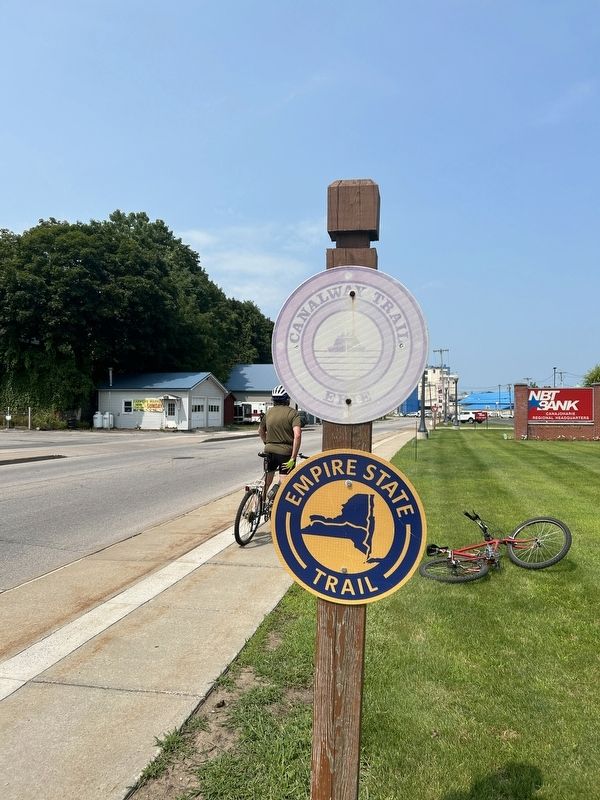
5. The Canalway is Now the Empire State Trail
More about this marker. The Canalway is now called the Empire State Trail.
Also see . . . Erie Canal (Wikipedia). (Submitted on August 27, 2024, by Steve Stoessel of Niskayuna, New York.)
Credits. This page was last revised on August 27, 2024. It was originally submitted on August 26, 2024, by Steve Stoessel of Niskayuna, New York. This page has been viewed 170 times since then and 23 times this year. Photos: 1, 2. submitted on August 26, 2024, by Steve Stoessel of Niskayuna, New York. 3, 4, 5. submitted on August 27, 2024, by Steve Stoessel of Niskayuna, New York.
Editor’s want-list for this marker. Better close up pictures of marker • Can you help?
