St. Charles Garnier, SJ
May 28, 1606 - December 7, 1649
| — | Canadian Martyr | — |
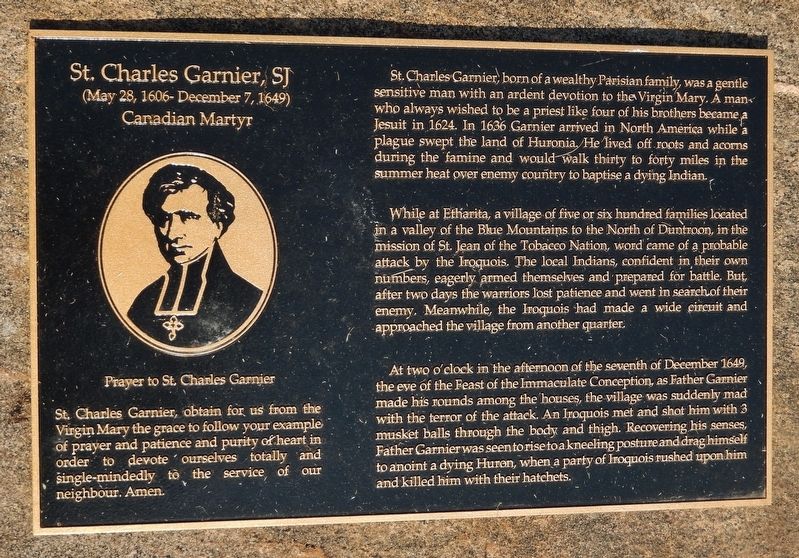
St. Charles Garnier, born of a wealthy Parisian family, was a gentle sensitive man with an ardent devotion to the Virgin Mary. A man who always wished to be a priest like four of his brothers became a Jesuit in 1624. In 1636 Garnier arrived in North America while a plague swept the land of Huronia. He lived off roots and acorns during the famine and would walk thirty to forty miles in the summer heat over enemy country to baptize a dying Indian.
While at Etharita, a village of five or six hundred families located in a valley of the Blue Mountains to the North of Duntroon, in the mission of St. Jean of the Tobacco Nation, word came of a probable attack by the Iroquois. The local Indians, confident in their own numbers, eagerly armed themselves and prepared for battle. But, after two days the warriors lost patience and went in search of their enemy. Meanwhile, the Iroquois had made a wide circuit and approached the village from another quarter.
At two o’clock in the afternoon of the seventh of December 1649, the eve of the Feast of the Immaculate Conception, as Father Garnier made his rounds among the houses, the village
this page online
Topics. This historical marker is listed in these topic lists: Colonial Era • Indigenous Peoples and Communities • Religion & Religious Structures. A significant historical date for this entry is December 7, 1649.
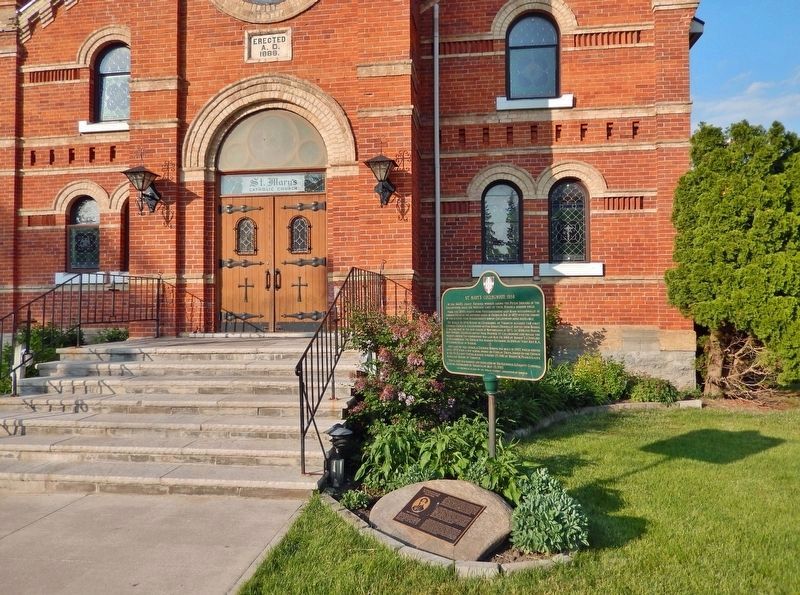
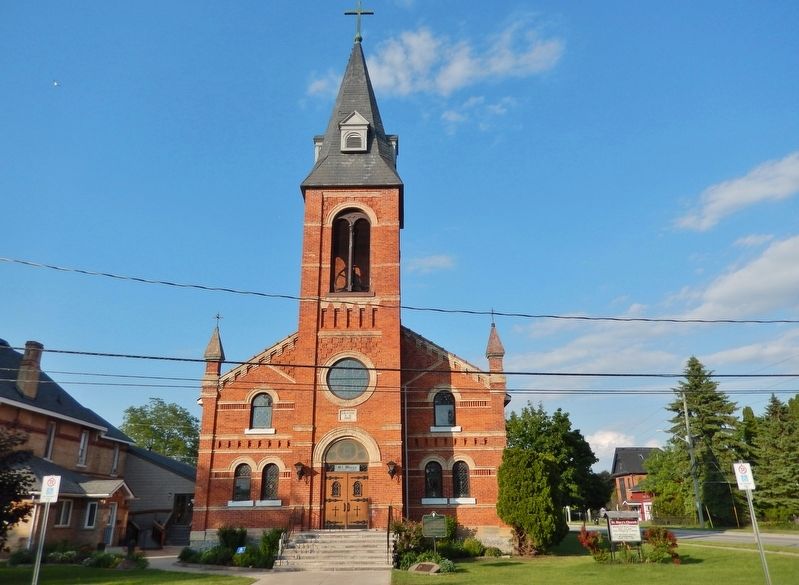
Location. 44° 29.982′ N, 80° 12.848′ W. Marker is in Collingwood, Ontario, in Simcoe County. It is on Elgin Street just north of Ontario Street, on the right when traveling north. The marker is mounted on a rock, at ground-level, beside the walkway on the right side of St. Mary's front entrance on Elgin Street. Touch for map. Marker is at or near this postal address:

Regionally, this marker is in Central Ontario Cottage Country and specifically in Georgian Bay Country. It is also in Central Canada. Globally, it is in North America, on the Great Lakes, in the Western Hemisphere, in the Western World, and in the Anglosphere. Historically, it finds itself in what was once a British colony, the Viceroyalty of New France, the Haudenosaunee (Iroquois) Confederacy, and Rupert’s Land.
Other nearby markers. At least 8 other markers are within walking distance of this marker: St. Mary's Collingwood, 1858 (here, next to this marker); All Saints' Anglican Church (about 90 meters away, measured in a direct line); Simcoe Street - Late 1890's (about 180 meters away); Pride Flag (about 210 meters away); Collingwood World War I Cenotaph (approx. 0.3 kilometers away); The Northern Railway Company of Canada (approx. 0.4 kilometers away); The Associated Country Women of the World / L'union mondiale des femmes rurales (approx. 0.4 kilometers away); Collingwood - An Overview / Collingwood Elevators (approx. 0.4 kilometers away).
Also see . . .
1. Charles Garnier (Wikipedia).
Excerpt: Charles Garnier, SJ was a Jesuit missionary working in New France. He reached the colony of New France in June 1636. He served for the rest of his life as a missionary among the Huron. He was killed by Iroquois in a Petun (Tobacco Nation) village on December 7, 1649. Garnier was canonized in 1930 by Pope Pius XI with the seven other Canadian Martyrs (also known as the North American Martyrs).(Submitted on August 28, 2024, by Cosmos Mariner of Cape Canaveral, Florida.)
2. Saint Charles Garnier (www.jesuits.global).
Excerpt: Garnier spent his first three years in New France learning the Huron language and ministering at the mission in Ossossané. In November 1639 he and Father Isaac Jogues were sent to the Petuns who would not accept them because they remembered the accusation that the Black Robes had caused the epidemic that swept through the Huron lands in 1636. The two Jesuits spent the winter months among the Petun, then returned to Ossossané because they thought they had failed. Father Garnier returned during the winter of 1647 and founded two missions because the people were more responsive than on his previous visits.(Submitted on August 28, 2024, by Cosmos Mariner of Cape Canaveral, Florida.)For several years the Iroquois had been increasing their attacks on the Huron world; they had already killed Father Anthony Daniel in 1648, so Garnier took very seriously the report he received in November 1649 that the Iroquois were on the warpath against the Petun and threatened to burn their villages. He sent his newly-arrived assistant, Father Noel Chabanel back to the mission headquarters because he did not want to leave him at risk; Garnier himself was firm in wanting to stay with his people. On November 7 at mid-afternoon, the Iroquois attacked, killing anyone they found. Garnier was shot twice, once in the chest and once in the abdomen. He was stripped of his cassock and left to die in the cold, but he regained consciousness and tried to move towards a Petun man who had been wounded. An attacker scalped him and then killed him with a blow to the head. Another Jesuit came to the village the next day and buried the gentleman's son in a shallow grave among the people he so wanted to bring to Christ.
3. The Canadian Martyrs (Wikipedia).
Excerpt: The Canadian Martyrs, also known as the North American Martyrs, were eight Jesuit missionaries from Sainte-Marie among the Hurons. They were ritually tortured and killed on various dates in the mid-17th century in Canada, in what is now southern Ontario, and in upstate New York, during the warfare between the Iroquioan tribes the Mohawk and the Huron. They have subsequently been canonized and venerated as martyrs by the Catholic Church.(Submitted on August 28, 2024, by Cosmos Mariner of Cape Canaveral, Florida.)
Credits. This page was last revised on August 28, 2024. It was originally submitted on August 28, 2024, by Cosmos Mariner of Cape Canaveral, Florida. This page has been viewed 283 times since then and 38 times this year. Photos: 1, 2, 3. submitted on August 28, 2024, by Cosmos Mariner of Cape Canaveral, Florida.
