Collingwood in Simcoe County, Ontario — Central Canada (North America)
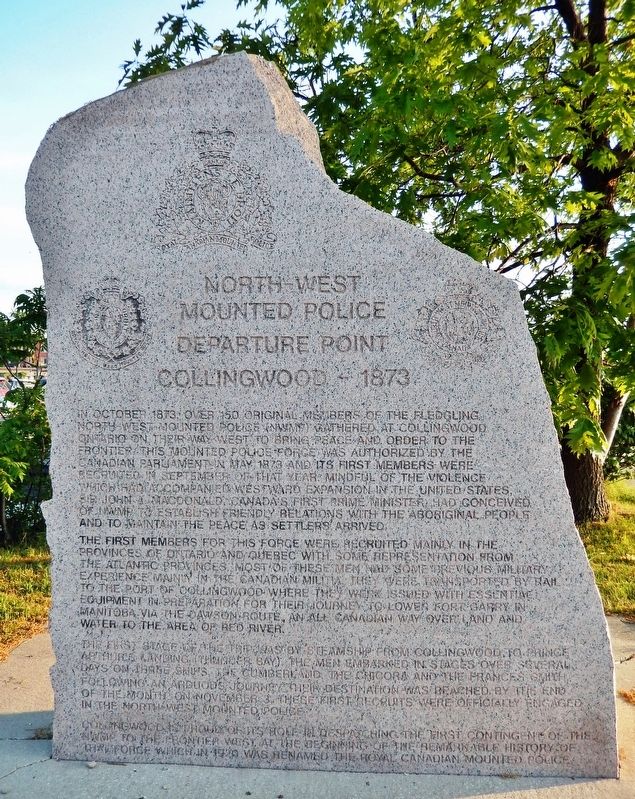
North-West Mounted Police Departure Point
Collingwood — 1873
Photographed by Cosmos Mariner, June 4, 2024
1. North-West Mounted Police Departure Point Marker
In October 1873, over 150 original members of the fledgling North-West Mounted Police (NWMP) gathered at Collingwood Ontario on their way west to bring peace and order to the frontier. This mounted police force was authorized by the Canadian Parliament in May 1873 and its first members were recruited in September of that year. Mindful of the violence which had accompanied westward expansion in the United States, Sir John A. Macdonald, Canada’s first Prime Minister, had conceived of NWMP to establish friendly relations with the aboriginal people and to maintain the peace as settlers arrived.
The first members for this force were recruited mainly in the provinces of Ontario and Quebec with some representation from the Atlantic provinces. Most of these men had some previous military experience, mainly in the Canadian Militia. They were transported by rail to the Port of Collingwood where they were issued with essential equipment in the preparation for their journey to Lower Fort Gary in Manitoba via the Dawson Route, an all Canadian way over land and water to the area of Red River.
The first stage of the trip was by steamship
this page online
Collingwood is proud of its role in dispatching the first contingent of the NWMP to the frontier west at the beginning of the remarkable history of that force which in 1920 was renamed The Royal Canadian Mounted Police.
Topics. This historical marker is listed in these topic lists: Indigenous Peoples and Communities • Law Enforcement • Peace • Settlements & Settlers. A significant historical month for this entry is October 1873.
Location. 44° 30.477′ N, 80° 13.147′ W. Marker is in Collingwood, Ontario, in Simcoe County. It can be reached from Heritage Drive 0.6 kilometers north of Huron Street (Provincial Highway 26), on the left when traveling north. The marker is located at the northwest corner of the Collingwood Yacht Club parking lot, overlooking Collingwood Harbour. Touch for map. Marker
Photographed by Cosmos Mariner, June 4, 2024
2. North-West Mounted Police Departure Point Marker
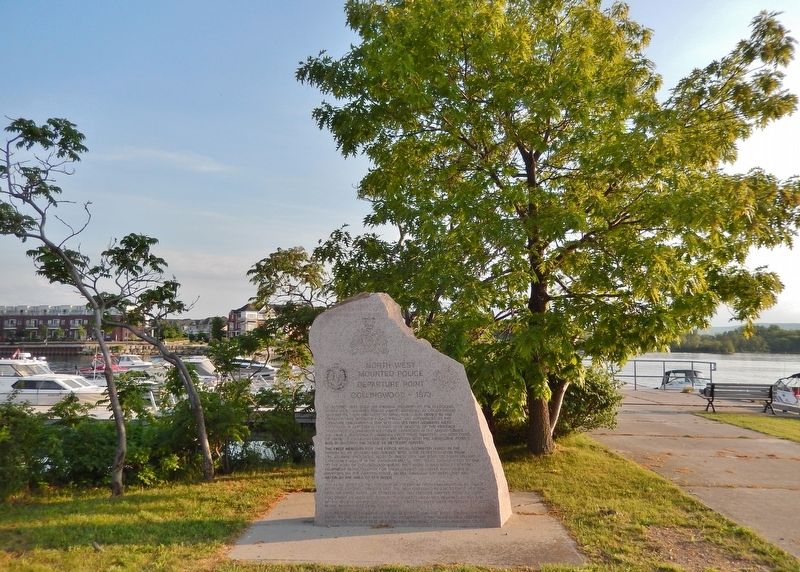
Looking southwest from the Collingwood Yacht Club parking lot, Collingwood Harbour is in the background.

Regionally, this marker is in Central Ontario Cottage Country and specifically in Georgian Bay Country. It is also in Central Canada. Globally, it is in North America, on the Great Lakes, in the Western Hemisphere, in the Western World, and in the Anglosphere. Historically, it finds itself in what was once a British colony, the Viceroyalty of New France, the Haudenosaunee (Iroquois) Confederacy, and Rupert’s Land.
Other nearby markers. At least 8 other markers are within walking distance of this marker: Steam Hammer (about 90 meters away, measured in a direct line); Enclosed Steam Winch (about 120 meters away); Steam Engine (about 150 meters away); A Harbour in Need of a Lighthouse / Un phare pour le port de Collingwood (approx. 0.6 kilometers away); Collingwood - An Overview / Collingwood Elevators (approx. 0.6 kilometers away); Water Transportation via Collingwood 1854-1900 (approx. 0.6 kilometers away); The Northern Railway Company of Canada (approx. 0.7 kilometers away); The Associated Country Women of the World / L'union mondiale des femmes rurales (approx. 0.7 kilometers away). Touch for a list and map of all markers in Collingwood.
Also see . . .
1. North-West Mounted Police (Wikipedia).
Excerpt: The North-West Mounted Police was a Canadian paramilitary police force, established in 1873, to maintain order in the new Canadian North-West Territories following the 1870 transfer of Rupert's Land and North-Western Territory to Canada from the Hudson's Bay Company, the Red River Rebellion and in response to lawlessness, demonstrated by the subsequent Cypress Hills Massacre and fears of United States military intervention. Mackenzie initially suggested sending a joint Canadian-United States military expedition, but, after the Governor General and others noted the serious implications of inviting the United States Army to deploy into Canadian territory, he instead agreed to deploy the new mounted police to carry out the operation. A small, mobile police force was chosen to reduce potential for tensions with the United States and First Nations. The NWMP uniforms included red coats deliberately reminiscent of British and Canadian military uniforms. The mounted police's deployment onto the plains in 1874 became known as the "March West".(Submitted on August 28, 2024, by Cosmos Mariner of Cape Canaveral, Florida.)
2. The first contingent: the North-West Mounted Police, 1873-74 (by Philip Goldring).
Excerpt: Its earliest efforts were to be directed against American-based whisky traders, whose operations in Canada's remote unsettled lands were threatening the welfare of the natives and mocking the Dominion's sovereignty over lands it could not police. The first administrative headquarters of the North-West Mounted Police was Lower Fort Garry, a Hudson's Bay Company post of declining commercial importance in Manitoba. There the first contingent of 150 men received basic training and the weaknesses caused by hasty recruitment of inexperienced men were ironed out over the winter of 1873-74. At Lower Fort Garry plans were made to outfit the force for its long march to the foothills of the Rockies.(Submitted on August 28, 2024, by Cosmos Mariner of Cape Canaveral, Florida.)
Credits. This page was last revised on August 28, 2024. It was originally submitted on August 28, 2024, by Cosmos Mariner of Cape Canaveral, Florida. This page has been viewed 279 times since then and 37 times this year. Photos: 1, 2. submitted on August 28, 2024, by Cosmos Mariner of Cape Canaveral, Florida.
