Niederdorf in Zürich, Switzerland — Central Europe (the Alps)
Schwule, Lesben und trans Menschen
⎯⎯⎯
Gays, Lesbians, and Transgender Persons in Zurich
Infotafel Barfüsser
Photographed by Andrew Ruppenstein, August 17, 2024
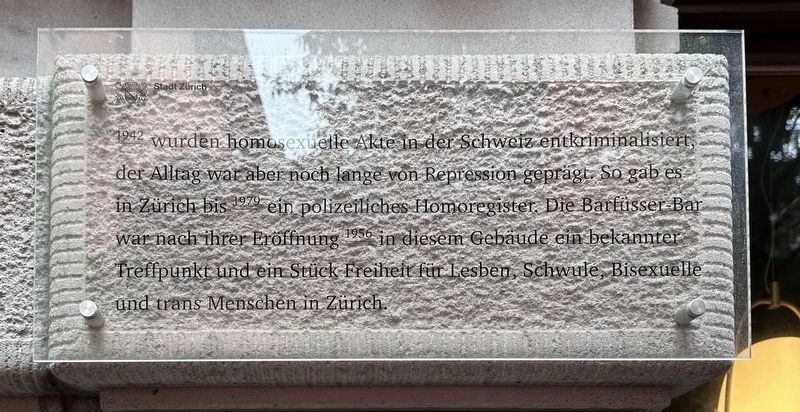
1. Schwule, Lesben und trans Menschen / Gays, Lesbians, and Transgender Persons Marker - upper panel

1942 wurden homosexuelle Akte in der Schweiz entkriminalisiert, der Alltag war aber noch lange von Repression geprägt. So gab es in Zürich bis 1979 ein polizeiliches Homoregister. Die Barfüsser-Bar war nach ihrer Eröffnung 1956 in diesem Gebäude ein bekannter Treffpunkt und ein Stück Freiheit für Lesben, Schwule, Bisexuelle und trans Menschen in Zürich.
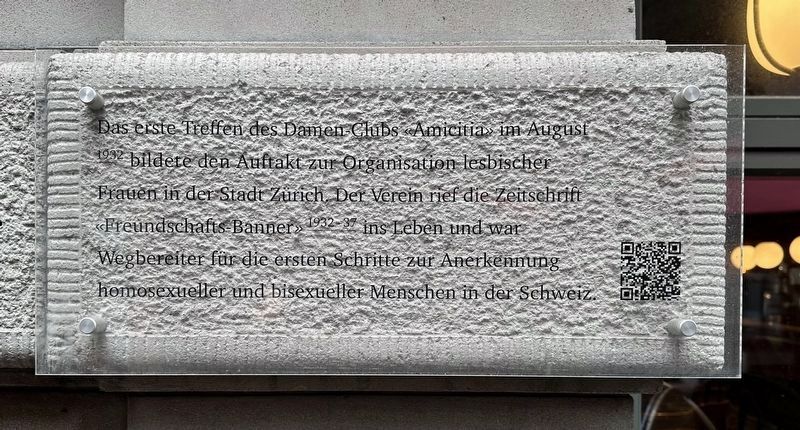
Das erste Treffen des Damen Clubs «Amicitia» im August 1932 bildete den Auftakt zur Organisation lesbischer Frauen in der Stadt Zurich, Der Verein rief die Zeitschrift «Freundschafts Banner» 1932-37 ins Leben und war Wegbereiter für die ersten Schritte zur Anerkennung homosexueller und bisexueller Menschen in der Schweiz.
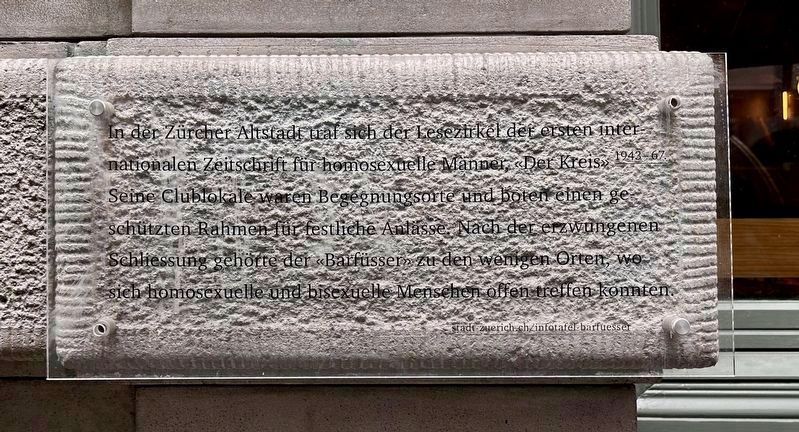
In der Zürcher Altstadt traf sich der Lesezirkel der ersten internationalen Zeitschrift für homosexuelle Manner, «Der Kreis» 1943-67. Seine Clublokale waren Begegnungsorte und boten einen geschützten Rahmen für festliche Anlässe. Nach der erzwungenen Schliessung gehörte der «Barfusser» zu den wenigen Orten, wo sich homosexuelle und bisexuelle Menschen offen treffen konnten.
(English translation:)
In 1942, homosexual acts were
this page online
The first meeting of the women's club "Amicitia" in August 1932 marked the beginning of the organization of lesbian women in the city of Zurich. The association published the magazine Freundschafts Banner (“Flag of Friendship”) from 1932 to 1937 and paved the way for the first steps towards the recognition of homosexual and bisexual people in Switzerland. The reading circle of the first international magazine for homosexual men, Der Kreis, met in Zurich's old town from 1943 to 1967. Its club premises were a place to meet and offered a protected setting for festive occasions. After the forced closure, the "Barfusser" was one of the few places where homosexual and bisexual people could meet openly.
Erected 2015 by Stadt Zürich.
Topics. This historical marker is listed in these topic lists:
Photographed by Andrew Ruppenstein, August 17, 2024
2. Schwule, Lesben und trans Menschen / Gays, Lesbians, and Transgender Persons Marker - middle panel
Location. 47° 22.416′ N, 8° 32.677′ E. Marker is in Zürich. It is in Niederdorf. It is on Spitalgasse west of Zähringerplatz, on the right when traveling east. The marker was originally installed on the Brunngasse side of the building in 2015, but was recently moved to the Spitalgasse side of the building. Touch for map. Marker is at or near this postal address: Spitalgasse 14, Zürich 8001, Switzerland. Touch for directions.

Regionally, it is in Europe, Central Europe, the Schengen Area, Western Europe, and the Western World. Historically, it finds itself in what was once the Roman Empire and specifically also the Holy Roman Empire.
Other nearby markers. At least 8 other markers are within walking distance of this marker: Brunnenhof (within shouting distance of this marker); Hirschen (within shouting distance of this marker); Johann Georg Bodmer (within shouting distance of this marker); Kerzenstock (about 90 meters away, measured in a direct line); Pinkus & Co. (about 90 meters away); Alte Landkutsche (about 90 meters away);
Photographed by Andrew Ruppenstein, August 17, 2024
3. Schwule, Lesben und trans Menschen / Gays, Lesbians, and Transgender Persons Marker - bottom panel
Also see . . .
1. Infotafel Barfüsser (Stadt Zürich, in German). The QR code on the middle panel leads to this page. It has little information on the marker’s topics, but is rather about the marker itself. Has 36 pictures of the marker dedication festivities in 2015 at the marker’s old location.
Excerpt (in translation): The historical marker at Spitalgasse 14 was initiated by the citizens' initiative Es its Liebe ("It's Love") and implemented by the Office for Equality in the City of Zurich. We would like to thank the Es its Liebe association, the Zurich Homosexual Working Groups (HAZ) and the Network association, who collected donations for the concept and the content research, as well as all other private donors for their contributions.(Submitted on August 28, 2024.)
2. Damenclub Amicitia (L-Wiki.ch, in German).
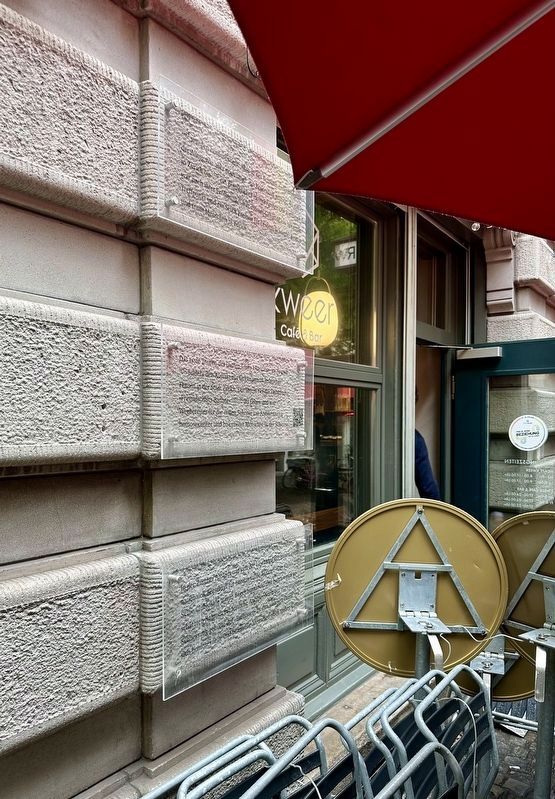
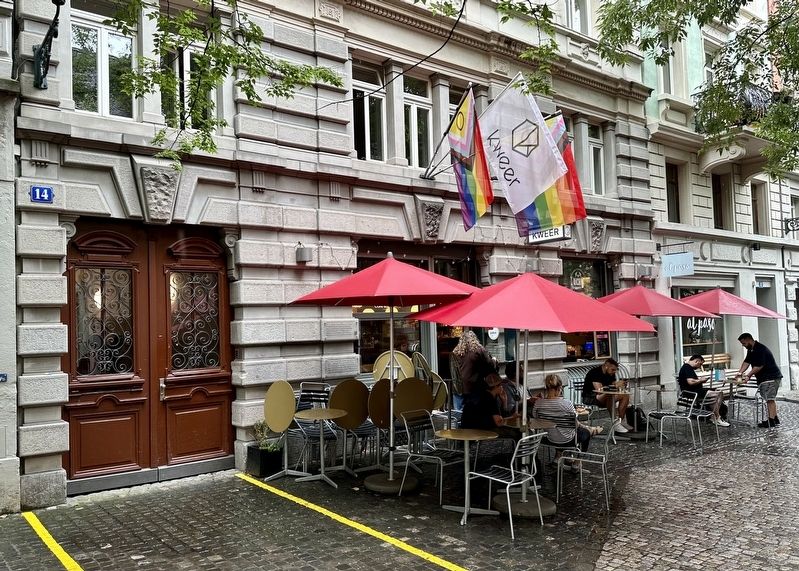
Excerpt (in translation): On August 5 (or 6), 1931, the women’s club met publicly for the first time at 8 a.m. in the Goldenen Löwen ("Golden Lion") restaurant, Löwenstrasse(Submitted on August 28, 2024.)66, 1st floor (separate entrance) - to which a small advertisement in the Zurich City Daily Newspaper of August 5, 1931 had invited. 21 women showed up, six of whom had a German lesbian newspaper with them as a badge of identification. In the next few months, the founders of the women’s club Amicitia decided that the club should only be for "conspecifics" (along with "soul mates" a common term for lesbians at the time). In late autumn they merged with the men's club Excentric.Photographed by Andrew Ruppenstein, August 17, 20244. Gays, Lesbians, and Transgender Persons in Zurich Marker - wide viewThe three panels are located to the left of the entrance to the Kweer Café. They’re easy to miss because of their transparency, and might also be at times obscured by the café’s table umbrellas.
3. The Circle Trailer - Switzerland's Oscar submission (YouTube, 2:13,with English subtitle). “The Circle was Switzerland's Foreign language Oscar entry in 2014. It played to great acclaim at film festivals and in a limited theatrical in the US.” (Submitted on August 28, 2024.)
Additional keywords. LGBT, LGBTQ
Photographed by Andrew Ruppenstein, August 17, 2024
5. Gays, Lesbians, and Transgender Persons in Zurich Marker - wider view
Credits. This page was last revised on January 28, 2026. It was originally submitted on August 28, 2024, by Andrew Ruppenstein of Lamorinda, California. This page has been viewed 177 times since then and 25 times this year. It was the Marker of the Week May 31, 2026. Photos: 1, 2, 3, 4, 5. submitted on August 28, 2024, by Andrew Ruppenstein of Lamorinda, California.
