Near Iona Station in Elgin County, Ontario — Central Canada (North America)
Southwold Earthworks/Les Fortifications en Terre de Southwold

Photographed by Tim Boyd, August 23, 2024
1. Southwold Earthworks/Les Fortifications en Terre de Southwold Marker

This prehistoric site was once a fortified village occupied by the Neutral Indians between about 1500 and 1650 A.D. An earth and palisade wall, later strengthened by a second wall, protected a cluster of longhouses. The Neutrals, who emerged as a distinct group within Iroquois culture about 1450, were so-called because they did not participate in wars with traditional Iroquois rivals. This neutrality aroused the ire of the Iroquois contederacy, and Mohawk and Seneca raids brought about the demise of the Neutral nation by 1650.
Ce site préhistorique était autrefois un village fortifié, occupé de 1500 à 1650 par les Indiens qui reçurent le nom de Neutres. Un mur de terre et une palissade plus tard renforcés par un second mur protégeaient un ensemble de maisons communes. Vers 1450, les Neutres formèrent un groupe culturel distinct au sein de l’Iroquoisie. Leur nom s'explique par leur attitude pacifique lors des guerres entre Indiens. Cette neutralité souleva la colère de la confédération des Iroquois et, à la longue les Neutres succombèrent aux attaques
this page online
Historic Sites and Monuments Board of Canada.
Commission des lieux et monuments historiques du Canada, Government of Canada • Gouvernement du Canada
Erected by Historic Sites and Monuments Board of Canada.
Topics and series. This historical marker is listed in these topic lists: Anthropology & Archaeology • Forts and Castles • Indigenous Peoples and Communities. In addition, it is included in the Canada, Historic Sites and Monuments Board series list. A significant historical year for this entry is 1500.
Location. 42° 40.452′ N, 81° 21.624′ W. Marker is near Iona Station, Ontario, in Elgin County. It is on Iona Road one kilometer north of Fingal Line, on the right when traveling north. The marker is approx. 300 metres from the entrance to the Southwold Earthworks National Historic Site. Touch for map. Marker is at or near this postal address: 7930 Iona Road, Iona Station ON N0L 1P0, Canada. Touch for directions.

Regionally, this marker is in the Southwest Ontario Area and in Southwestern Ontario. It is also in Central Canada. Globally, it is in

Photographed by Tim Boyd, August 23, 2024
2. Southwold Earthworks/Les Fortifications en Terre de Southwold Marker
Other nearby markers. At least 8 other markers are within 11 kilometers of this marker, measured as the crow flies: Southwold: The remains of an indian village/Southwold: Les vestiges d’un village amérindien (approx. 0.3 kilometers away); Burwell’s Corners (approx. 1.3 kilometers away); Col. Mahlon Burwell (approx. 1.3 kilometers away); RCAF No. 4 Bombing and Gunnery School (approx. 2.8 kilometers away); The Talbot Settlement / La Colonie de Talbot (approx. 3.8 kilometers away); Col. Thomas Talbot (approx. 3.8 kilometers away); John Kenneth Galbraith (approx. 7.6 kilometers away); Ellis Wellwood Sifton, V.C. (approx. 10 kilometers away). Touch for a list and map of all markers in Iona Station.
Also see . . . Southwold Earthworks National Historic Site (parks.canada.ca).
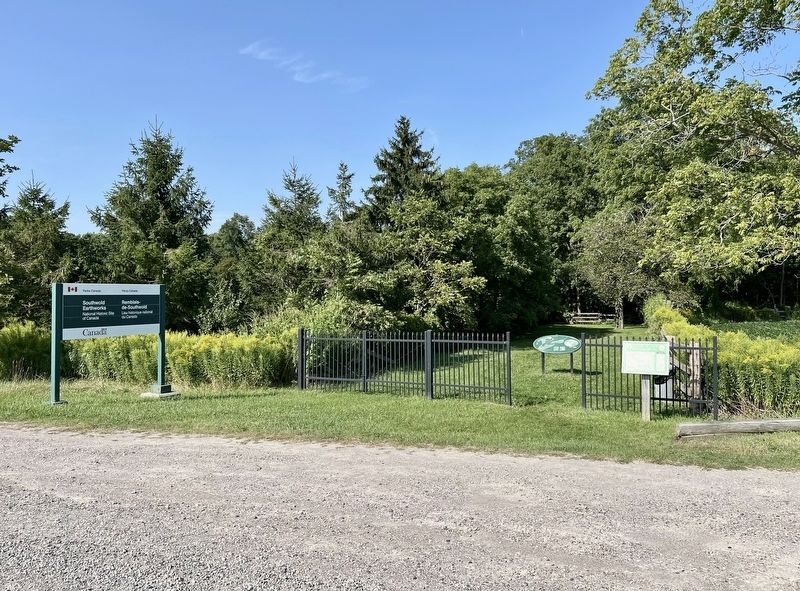
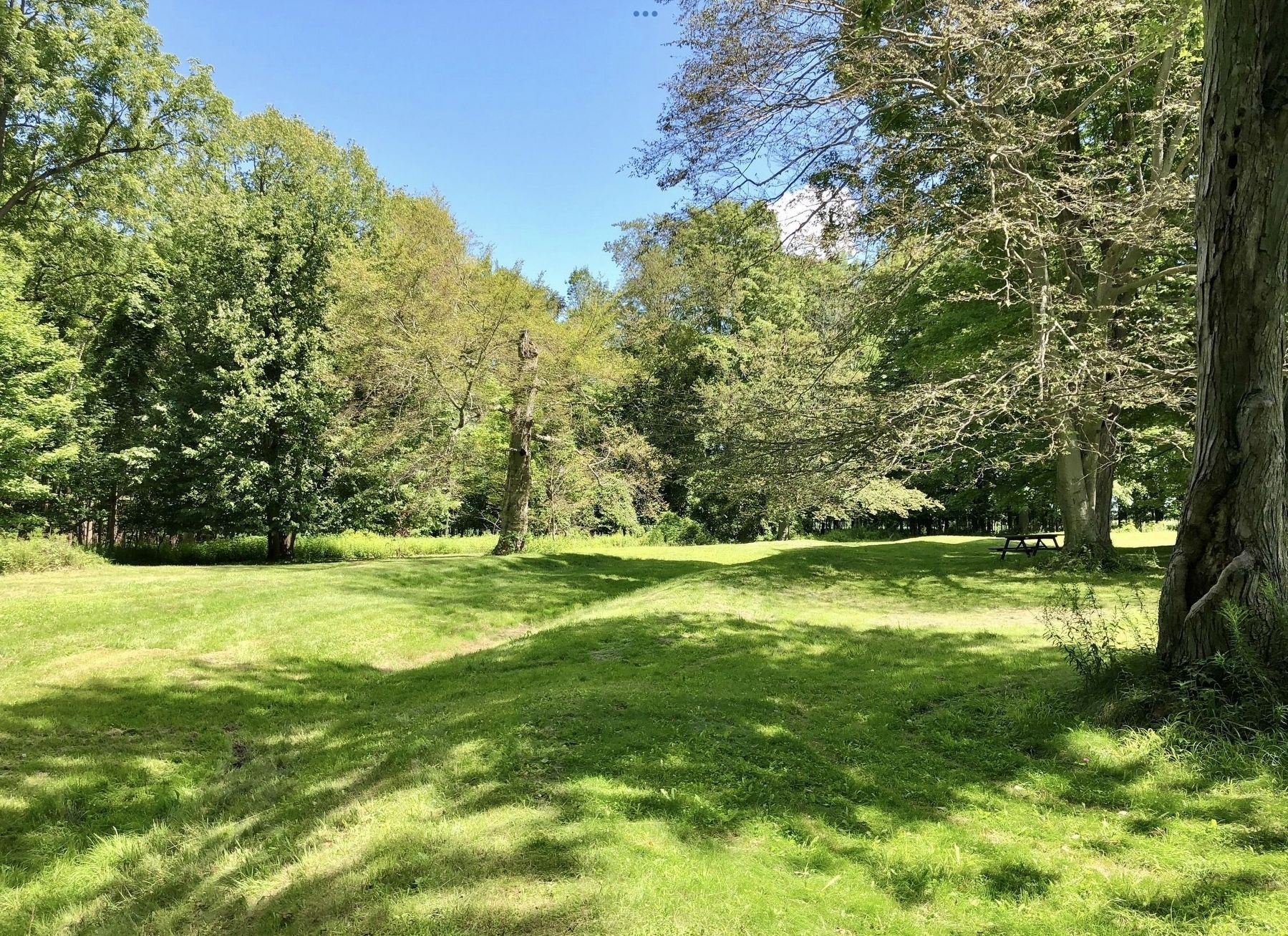
The village was, and is, surrounded by conspicuous earthworks. The 17th-century(Submitted on August 28, 2024, by Tim Boyd of Hamilton, Ontario.)French referred to the Attiwandaron as the “la nation Neutre” or the Neutrals. There is no distinct descendant population of the Attiwandaron today, as the entire confederacy was dispersed or incorporated into the Five Nations Iroquois during the years 1647 to 1651. This is the only Iroquoian village administered by Parks Canada that is commemorated as a village in itself.Photographed by Tim Boyd, August 23, 20243. Entrance to Southwold Earthworks National Historic Site
Photographed by Tim Boyd, August 2021
4. Remains of the double earthworks Southwold Earthworks National Historic Site
Credits. This page was last revised on August 29, 2024. It was originally submitted on August 28, 2024, by Tim Boyd of Hamilton, Ontario. This page has been viewed 229 times since then and 43 times this year. Photos: 1, 2, 3, 4. submitted on August 28, 2024, by Tim Boyd of Hamilton, Ontario. • Andrew Ruppenstein was the editor who published this page.
