
Memphis in Shelby County, Tennessee — The American South (East South Central)
Randolph, Tennessee
⎯⎯⎯
Hatchie River
⎯⎯⎯
Fort Pillow, Tennessee
Mississippi River Walk
Photographed by Jason Voigt, August 2, 2024
1. Randolph, Tennessee/Hatchie River/Fort Pillow, Tennessee Marker
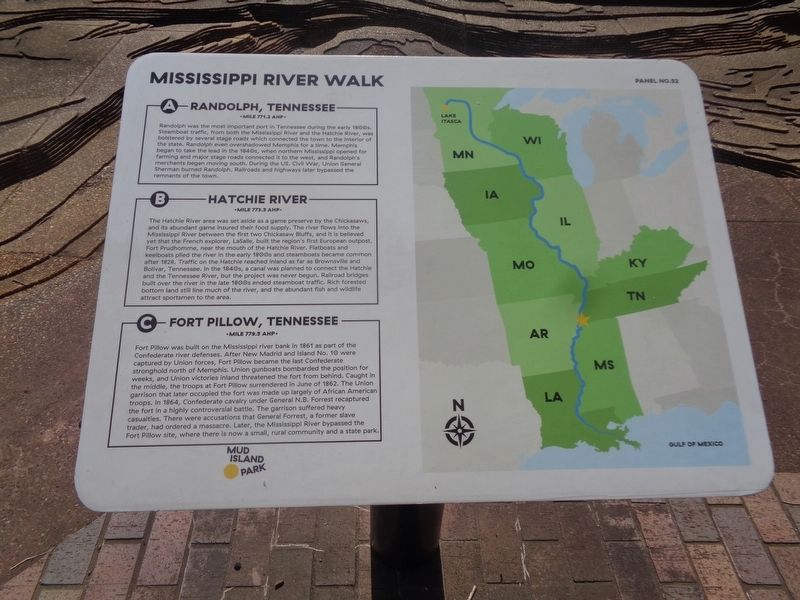
A) Randolph, Tennessee
Mile 771.3 AHP
Randolph was the most important port in Tennessee during the early 1800s. Steamboat traffic, from both the Mississippi River and the Hatchie River, was bolstered by several stage roads which connected the town to the interior of the state. Randolph even overshadowed Memphis for a time. Memphis began to take the lead in the 1840s, when northern Mississippi opened for farming and major stage roads connected it to the west, and Randolph's merchants began moving south. During the U.S. Civil War, Union General Sherman burned Randolph. Railroads and highways later bypassed the remnants of the town.
B) Hatchie River
Mile 773.5 AHP
The Hatchie River area was set aside as a game preserve by the Chickasaws, and its abundant game insured their food supply. The river flows into the Mississippi River between the first two Chickasaw Bluffs, and it is believed yet that the French explorer, LaSalle, built the region's first European outpost, Fort Prudhomme, near the mouth of the Hatchie River. Flatboats and keelboats plied the river in the early 1800s and steamboats became common after
this page online
C) Fort Pillow, Tennessee
Mile 779.5 AHP
Fort Pillow was built on the Mississippi river bank in 1861 as part of the Confederate river defenses. After New Madrid and Island No. 10 were captured by Union forces, Fort Pillow became the last Confederate stronghold north of Memphis. Union gunboats bombarded the position for weeks, and Union victories inland threatened the fort from behind. Caught in the middle, the troops at Fort Pillow surrendered in June of 1862. The Union garrison that later occupied the fort was made up largely of African American troops. In 1864, Confederate cavalry under General N.B. Forrest recaptured the fort in a highly controversial battle. The garrison suffered heavy casualties. There were accusations

Photographed by Jason Voigt, August 2, 2024
2. Randolph, Tennessee/Hatchie River/Fort Pillow, Tennessee Marker
Marker is on the left
Erected by Mud Island Park. (Marker Number 52.)
Topics. This historical marker is listed in these topic lists: African Americans • Forts and Castles • War, US Civil • Waterways & Vessels. A significant historical month for this entry is June 1862.
Location. 35° 8.955′ N, 90° 3.527′ W. Marker is in Memphis, Tennessee, in Shelby County. It can be reached from Island Drive. Marker is located at Mud Island Park. Touch for map. Marker is at or near this postal address: 57 North Mud Island Road, Memphis TN 38103, United States of America. Touch for directions.

Regionally, this marker is in West Tennessee. It is also in the American South, specifically in the Deep South, in the Upper South, in the Mississippi Delta, and in the Great River Road Region. Globally, it is in North America, the Western Hemisphere, the Western World, and the Anglosphere. Historically, it finds itself in what was once the territory of the Mississippian Culture, one of the Confederate States of America, and the Antebellum South.
Other nearby markers. At least 8 other markers are within walking distance of this marker: Plum Point/Osceola, Arkansas (here, next to this marker); Golddust, Tennessee/Daniel's Point, Arkansas/Ashport, Tennessee/Canadian Reach (a few steps from this marker); The Mississippi Riverwalk (a few steps from this marker); Island No. 25/Forked Deer River/Tomato, Arkansas (a few steps from this marker); Island No. 40 and No. 41/Centennial Cutoff/Chickasaw Bluff No. 3 (a few steps from this marker); Obion River/Hale's Point, Tennessee/Needham Cutoff (a few steps from this marker); Hopefield Point, Arkansas/Chicken Island/Redman Point (within shouting distance of this marker); Cow Islands No. 47 and No. 48/West Memphis, Arkansas/President's Island No. 45 (within shouting distance of this marker). Touch for a list and map of all markers in Memphis.
Credits. This page was last revised on August 13, 2025. It was originally submitted on August 30, 2024, by Jason Voigt of Glen Carbon, Illinois. This page has been viewed 429 times since then and 79 times this year. Photos: 1, 2. submitted on August 30, 2024, by Jason Voigt of Glen Carbon, Illinois.
