Old Irving Park in Chicago in Cook County, Illinois — The American Midwest (Great Lakes)
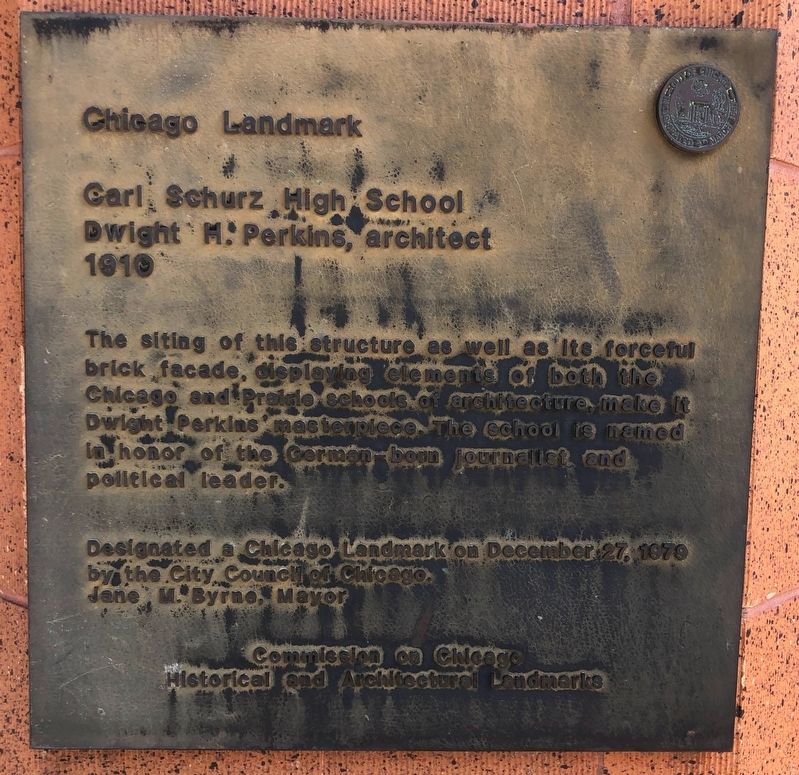
Carl Schurz High School
Dwight M. Perkins, architect; 1910
| — | Chicago Landmark | — |
Photographed by Sean P. Flynn, September 1, 2024
1. Carl Schurz High School Marker
Designated a Chicago Landmark on December 27, 1979 by the City Council of Chicago.
Jane M. Byrne, Mayor
Erected 1979 by Commission on Chicago Historical and Architectural Landmarks; City of Chicago.
Topics and series. This historical marker is listed in these topic lists: Architecture • Education •
this page online
Location. 41° 56.84′ N, 87° 44.139′ W. Marker is in Chicago, Illinois, in Cook County. It is in Old Irving Park. It is on North Milwaukee Avenue 0.1 miles north of West Addison Street, on the right when traveling north. The marker is to the right of the central entrance to Schurz High School, facing Milwaukee Avenue. Touch for map. Marker is at or near this postal address: 3601 North Milwaukee

Photographed by Sean P. Flynn, September 1, 2024
2. Carl Schurz High School Marker

Regionally, this marker is on Chicago’s North Side. It is also in the American Midwest. Globally, it is in North America, on the Great Lakes, in the Western Hemisphere, in the Western World, and in the Anglosphere. Historically, it finds itself in what was once the Viceroyalty of New France, the territory of the Mississippian Culture, and the Northwest Territory.
Other nearby markers. At least 8 other markers are within walking distance of this marker: John and Phebe Gray House (approx. 0.2 miles away); John and Phebe Gray

Photographed by Sean P. Flynn, September 1, 2024
3. Carl Schurz High School
The marker is to the right of the doors.
More about this marker. The plaque is time-worn and somewhat difficult to read in spots.
Regarding Carl Schurz High School. Schurz High School, situated on eight acres on Chicago's northwest side, consistently appears

Photographed by Sean P. Flynn, September 1, 2024
4. Carl Schurz High School Marker
The building’s central section, set back about 100 yards from Milwaukee Avenue, opened in the fall of 1910, replacing another Carl Schurz High School that had been about

Photographed by Sean P. Flynn, September 1, 2024
5. Carl Schurz High School's "Addison wing"
Dwight Perkins was raised

Chicago Daily News Collection, Chicago History Museum, circa 1910
6. Carl Schurz High School
This photo was likely taken around the time of the school’s opening in 1910.

Chicago Daily News Collection, Chicago History Museum, circa 1908
7. Dwight Perkins, architect
Perkins is in the middle; he is flanked on the left by Joseph G. Magrady, a school board member, and on the right by architect Arthur F. Hussander. Hussander succeeded Perkins as the chief architect for Chicago Public Schools when Perkins was ousted in 1910, and he served in that role until 1920.
Carl Schurz was born in Prussia in 1829 and fought for the revolutionary army during the revolutions of 1848. After their defeat, he fled to Paris, and then London, where he married the sister of a fellow revolutionary. Like many of the revolutionaries he moved to the United

Library of Congress Prints and Photographs Division, circa 1888
8. Carl Schurz (1829-1906)
This drawing of Schurz appeared in Harper's Weekly in 1888.
Also see . . .
1. Schurz High School National Register of Historic Places registration form. The building was added to the NRHP in 2011. (Submitted on September 2, 2024, by Sean P. Flynn of Oak Park, Illinois.)
2. Dwight H. Perkins (1867-1941). A bio of Dwight Perkins from the Chicago Historic Schools blog
Excerpt: “He brought his sense of humanity and progressive spirit to the design of school architecture. Perkins wanted the buildings to serve as holistic community centers, so he placed auditoriums on the first floor to make them more accessible for after-hours functions. He also sought to improve upon difficulties in the way that the earlier schools functioned by widening stairwells and hallways to minimize crowding, creating bathrooms on every floor (the only toilet rooms in the older schools were in basements), and maximizing the amount of natural light in the classrooms.”(Submitted on September 2, 2024, by Sean P. Flynn of Oak Park, Illinois.)
Credits. This page was last revised on June 22, 2026. It was originally submitted on September 2, 2024, by Sean P. Flynn of Oak Park, Illinois. This page has been viewed 801 times since then and 110 times this year. Photos: 1, 2, 3, 4, 5, 6, 7. submitted on September 2, 2024, by Sean P. Flynn of Oak Park, Illinois. 8. submitted on January 15, 2025, by Sean P. Flynn of Oak Park, Illinois.
