Anastasia in St. Augustine in St. Johns County, Florida — The American South (South Atlantic)
Coastal Hammock Native Vegitation
⎯⎯⎯
Coastal Hammock Wildlife
Photographed by Craig Doda, September 1, 2024
1. Coastal Hammock Native Vegitation - Coastal Hammock Wildlife Marker
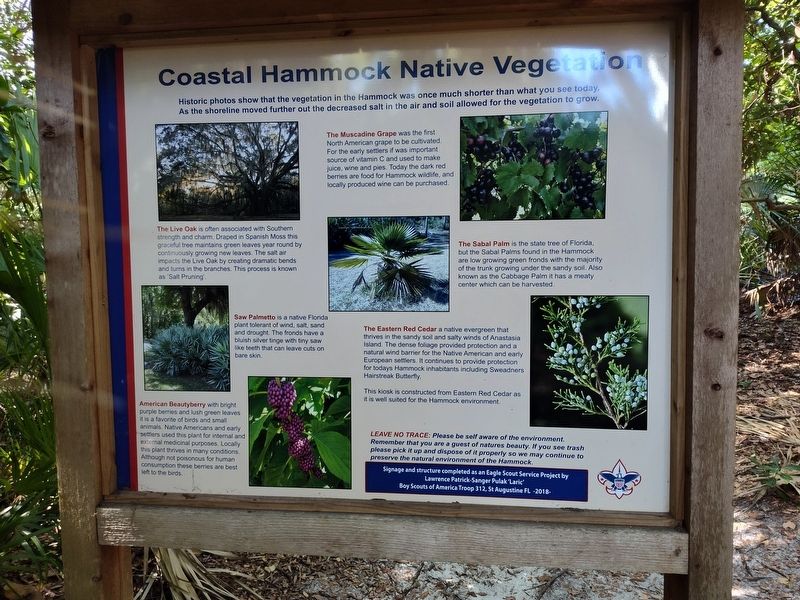
Historic photos show that the vegetation in the Hammock was once much shorter than what you see today. As the shoreline moved further out the decreased salt in the air and soil allowed for the vegetation to grow.
The Live Oak is often associated with Southern strength and charm. Draped in Spanish Moss this graceful tree maintains green leaves year round by continuously growing new leaves. The salt air impacts the Live Oak by creating dramatic bends and turns in the branches. This process is known as 'Salt Pruning'.
Saw Palmetto is a native Florida plant tolerant of wind, salt, sand and drought. The fronds have a bluish silver tinge with tiny saw like teeth that can leave cuts on bare skin.
American Beautyberry with bright purple berries and lush green leaves it is a favorite of birds and small animals. Native Americans and early settlers used this plant for internal and external medicinal purposes. Locally this plant thrives in many conditions. Although not poisonous for human consumption these berries are best left to the birds.
The Muscadine Grape was the first North American grape
this page online
The Sabal Palm is the state tree of Florida, but the Sabal Palms found in the Hammock are low growing green fronds with the majority of the trunk growing under the sandy soil. Also known as the Cabbage Palm it has a meaty center which can be harvested.
The Eastern Red Cedar a native evergreen that thrives in the sandy soil and salty winds of Anastasia Island. The dense foliage provided protection and a natural wind barrier for the Native American and early European settlers. It continues to provide protection for todays Hammock inhabitants including Sweadners Hairstreak Butterfly.
Coastal Hammock Wildlife
Eastern Grey Squirrel and Raccoons were important to the early Lighthouse Keepers, they provided a source of meat and their pelts were used for hats. Today they live in the Hammock eating nuts, berries and other food items not disposed of correctly.
Red Bellied Woodpecker may be heard tapping on wood to attract

Photographed by Craig Doda, September 1, 2024
2. Coastal Hammock Native Vegitation - Coastal Hammock Wildlife Marker
Eastern Screech Owl is mainly active at night sitting high in the trees watching for prey. When other birds are aware an owl is nearby they will make quite a racket alarming one another of the danger. Owls are not often seen, but you'll know they are around by listening to the other birds.
Sweadners Hairstreak Butterfly is an endangered insect with a range that is limited to coastal St. Augustine. They have brownish speckled wings and blend into the Eastern Red Cedar for protection from predators.
Cats were an essential part of Lighthouse life and were used to fend off vermin such as rats, mice and even sometimes snakes. Legend says that one famous Lighthouse cat, Smokey, was dropped from the tower and was able to live out his other 8 lives!
Northern Cardinal is found in dense shrubby areas and backyards with native vegetation. Mated pairs will sing the same song to locate one another while looking for food.
Blue Jay is most often noted for their noisy calls and ability to mimic other birds. Found near the
Photographed by Craig Doda, September 1, 2024
3. Coastal Hammock Native Vegitation - Coastal Hammock Wildlife Marker
Carolina Wren frequents the Hammock and lowland marshy areas eating, insects, fruit, sweet gum and even poison ivy.
Erected 2018 by Boy Scouts of America Troop 312, St Augustine FL.
Topics. This historical marker is listed in these topic lists: Animals • Horticulture & Forestry • Indigenous Peoples and Communities • Science & Medicine.
Location. 29° 53.102′ N, 81° 17.311′ W. Marker is in St. Augustine, Florida, in St. Johns County. It is in Anastasia. It can be reached from the intersection of Red Cox Drive and Ocean Vista Avenue, on the right when traveling south. Touch for map. Marker is at or near this postal address: 100 Red Cox Dr, Saint Augustine FL 32080, United States of America. Touch for directions.

Regionally, this marker is in First Coast and in Greater Jacksonville. It is also in the American South and on the Eastern Seaboard. Globally, it is in the North Atlantic Region, North America, a Gulf of Mexico state, the Western Hemisphere, the Western World, and the Anglosphere. Historically,
Photographed by Craig Doda, September 1, 2024
4. Coastal Hammock Native Vegitation - Coastal Hammock Wildlife Marker
Other nearby markers. At least 8 other markers are within walking distance of this marker: Q: Were Women Lighthouse Keepers? (a few steps from this marker); Maritime Hammock (within shouting distance of this marker); Keepers' Garden (within shouting distance of this marker); Q: What Did The Keepers' Wives Do At The Light Station? (within shouting distance of this marker); Discover Four Authentic Experiences (within shouting distance of this marker); 1872 South Privy (within shouting distance of this marker); Q: Did The Keepers And Their Families Have Animals? (within shouting distance of this marker); Q: Did The Area Around The Lighthouse Always Look Like It Does Now? (within shouting distance of this marker). Touch for a list and map of all markers in St. Augustine.
Credits. This page was last revised on September 10, 2024. It was originally submitted on September 5, 2024, by Craig Doda of Napoleon, Ohio. This page has been viewed 180 times since then and 38 times this year. Photos: 1, 2, 3, 4. submitted on September 5, 2024, by Craig Doda of Napoleon, Ohio. • Devry Becker Jones was the editor who published this page.
