Historic District in St. Augustine in St. Johns County, Florida — The American South (South Atlantic)
Prehistoric Technology of the Florida Indians
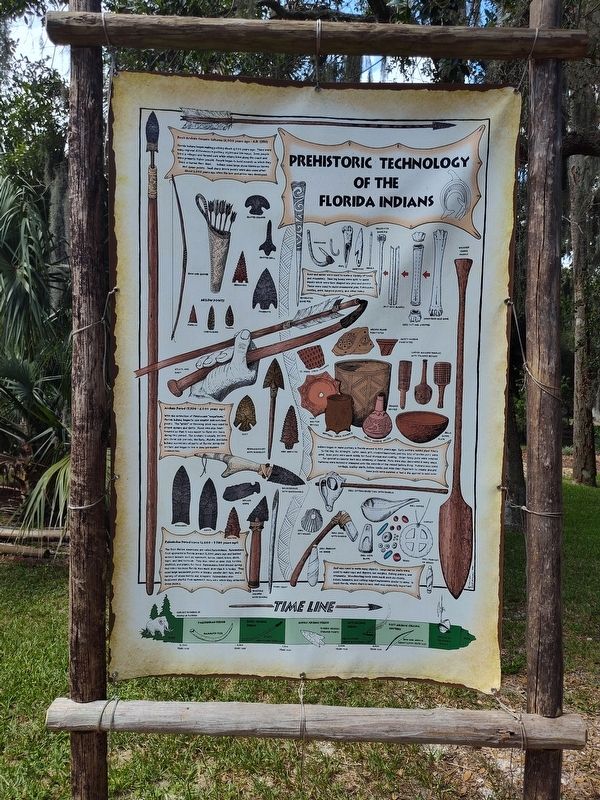
Photographed by Craig Doda, September 1, 2024
1. Prehistoric Technology of the Florida Indians Marker
Florida Indians began making pottery about 4,000 years ago. There were many regional differences in pottery styles and life-ways. Some people lived in villages and farmed com while others lived along the coast and were primarily fisher-people. People began to build mounds on which they Dred or buried their dead. Indians used large stone blades as knives and spear points. Small sharp arrow points were also used after about 2,000 years ago when the bow and arrow was developed.
Bone and antler were used to make a variety of tools and ornaments. Dear leg bones were split to make blanks which were then shaped into pies and points. These were used to make ornamental pins. fishhooks, needles, awls, harpoon points, and other items.
Archaic Period (9,500-4.000 years ago)
With the extinction of Pleistocene "megafauna," Florida Indians began to use smaller side-notched points. The "atlatl" or throwing stick was used to propel spears and darts. Stone was also heat- treated so that it was easier to flake into tools during this period. The Archaic is usually divided into
this page online
Indians began to make pottery in Florida around 4,000 years ago. Early potters added plant fibers to the clay for strength. Later, sand, grit, crushed limestone, and tiny bits of broken pots were used. Some pots were made solely for food storage and cooking. Other fancy pots were created for special occasions such as a ceremony or funeral. Pots were also decorated in many ways. Patterns were incised or stamped onto the outside of the vessel before firing. Potters also used cordage, scallop shells, hollow reeds, and even their fingernails to create designs. Some pots were painted or had a slip applied to add color.
Paleoindian Period (circa 12,000-9.500 years ago)
The first Native Americans are called Paleoindians. Paleoindians first appeared in Florida around 12,000 years ago and hunted extinct animals such as mammoth, horse, camel, bison, sloth, tapir, and land tortoise. They also relied on deer, fish, turtles, shellfish, and plants for food. Paleoindians lived around spring-
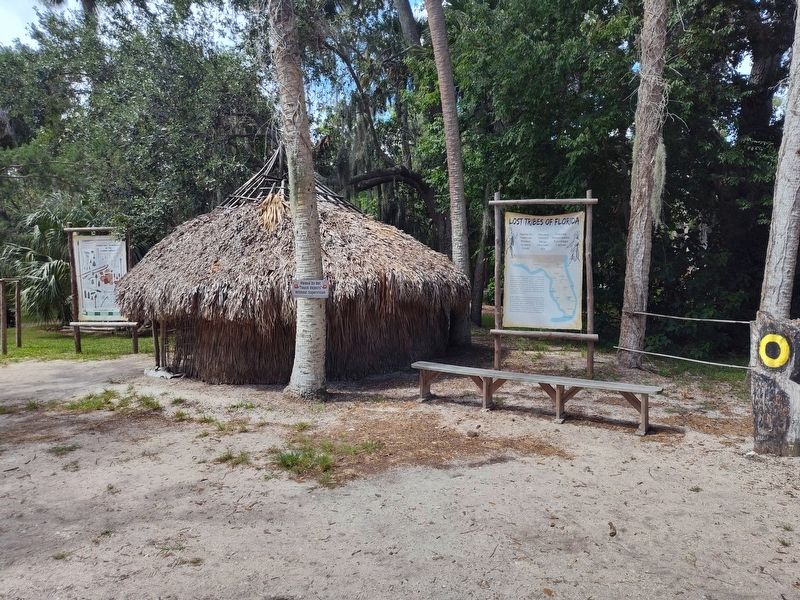
Photographed by Craig Doda, September 1, 2024
2. Prehistoric Technology of the Florida Indians Marker
Shell was used to make many objects. Large marine shells were used to make cups and dippers, net weights, fishing sinkers, and ornaments. Woodworking tools were made such as chisels, adzas, hammers, and cutting-edged implements similar to exes. In South Florida, where chert is rare, shell was especially important.
Topics. This historical marker is listed in these topic lists: Anthropology & Archaeology • Indigenous Peoples and Communities.
Location. 29° 54.392′ N, 81° 18.906′ W. Marker is in St. Augustine, Florida, in St. Johns County. It is in the Historic District. It can be reached from the intersection of Magnolia Avenue and Williams Street, on the right when traveling north. Touch for map. Marker is at or near this postal address: 11 Magnolia Ave, Saint Augustine FL 32084, United States of America. Touch for directions.

Regionally, this marker is in First Coast and in Greater Jacksonville. It is also in the American South and on the Eastern Seaboard. Globally, it is in the North Atlantic Region, North America, a Gulf of Mexico state, the Western Hemisphere, the Western World, and the Anglosphere. Historically, it finds itself in what was once New Spain, the territory of the Mississippian Culture, one of the Confederate States of America, and the Antebellum South.
Other nearby markers. At least 8 other markers are within walking distance of this marker: Lost Tribes OF Florida (here, next to this marker); Life In The Timucuan Village (a few steps from this marker); Communal Feasts (a few steps from this marker); Seloy (a few steps from this marker); The Timucuan Home (a few steps from this marker); The Timucuan Way Of Life (a few steps from this marker); The Owl Totem from Hontoon Island (within shouting distance of this marker); Timucuan Style Dugout Canoe (within shouting distance of this marker). Touch for a list and map of all markers in St. Augustine.
Credits. This page was last revised on September 7, 2024. It was originally submitted on September 6, 2024, by Craig Doda of Napoleon, Ohio. This page has been viewed 472 times since then and 95 times this year. Photos: 1, 2. submitted on September 6, 2024, by Craig Doda of Napoleon, Ohio. • Bernard Fisher was the editor who published this page.
