Historic District in St. Augustine in St. Johns County, Florida — The American South (South Atlantic)
The Menendez Settlement Field: Rebuilding The Past
Photographed by Craig Doda, September 1, 2024
1. The Menendez Settlement Field: Rebuilding The Past Marker
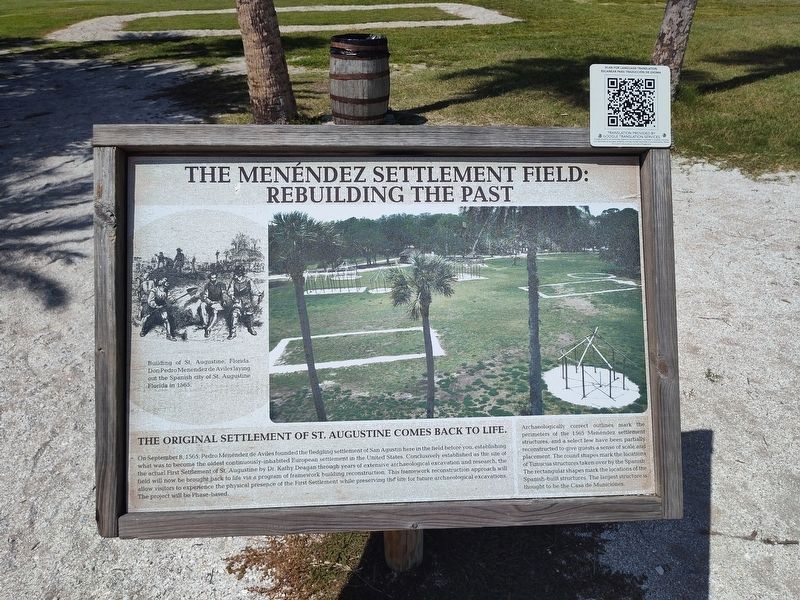
On September 8, 1565, Pedro Menéndez de Aviles founded the fledgling settlement of San Agustín here in the field before you, establishing what was to become the oldest continuously-inhabited European settlement in the United States. Conclusively established as the site of the actual First Settlement of St. Augustine by Dr. Kathy Deagan through years of extensive archaeological excavation and research, the field will now be brought back to life via a program of framework building reconstruction. This framework reconstruction approach will allow visitors to experience the physical presence of the First Settlement while preserving the site for future archaeological excavations. The project will be Phase-based.
(captions)
Building of St. Augustine, Florida. Don Pedro Menendez de Aviles laying out the Spanish city of St. Augustine Florida in 1565.
Archaeologically correct outlines mark the perimeters of the 1565 Menéndez settlement structures, and a select few have been partially reconstructed to give guests a sense of scale and placement. The round shapes
this page online
Topics. This historical marker is listed in these topic lists: Anthropology & Archaeology • Colonial Era • Settlements & Settlers. A significant historical date for this entry is September 8, 1565.
Location. 29° 54.408′ N, 81° 18.825′ W. Marker is in St. Augustine, Florida, in St. Johns County. It is in the Historic District. It can be reached from the intersection of Magnolia Avenue and Williams Street, on the right when traveling north. Touch for map. Marker is at or near this postal address: 11 Magnolia Ave, Saint Augustine FL 32084, United States of America. Touch for directions.

Regionally, this marker is in First Coast and in Greater Jacksonville. It is also in the American South and on the Eastern Seaboard. Globally, it is in the North Atlantic Region, North America, a Gulf of Mexico state, the Western Hemisphere, the Western World, and the Anglosphere. Historically, it finds itself in what was once New Spain, the territory
Photographed by Craig Doda, September 1, 2024
2. The Menendez Settlement Field: Rebuilding The Past Marker
Other nearby markers. At least 8 other markers are within walking distance of this marker: Continuing Archaeology (here, next to this marker); Don Juan Ponce De Leon (a few steps from this marker); Sentinels of the Spanish Coast (a few steps from this marker); The Matchlock Arquebus (within shouting distance of this marker); Welcome (within shouting distance of this marker); 17th & 18th Century Cannons (within shouting distance of this marker); First Muster of Militiamen in the Continental United States (within shouting distance of this marker); 17th & 18th Century Cannons / 17o y Cañones del 18o siglo (within shouting distance of this marker). Touch for a list and map of all markers in St. Augustine.
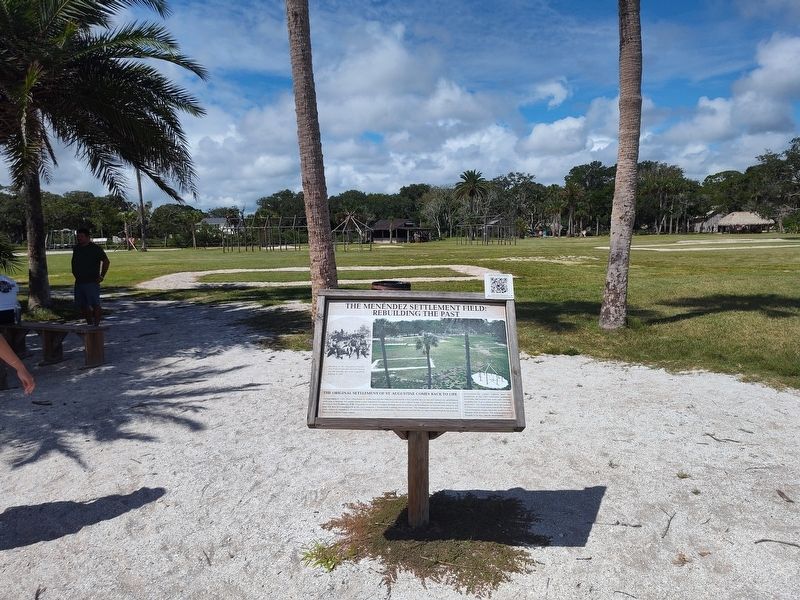
More about this marker. There are two of these markers on the grounds of the park.
Credits. This page was last revised on September 7, 2024. It was originally submitted on September 6, 2024, by Craig Doda of Napoleon, Ohio. This page has been viewed 186 times since then and 25 times this year. Photos: 1, 2. submitted on September 6, 2024, by Craig Doda of Napoleon, Ohio. • Bernard Fisher was the editor who published this page.
