St. Augustine in St. Johns County, Florida — The American South (South Atlantic)
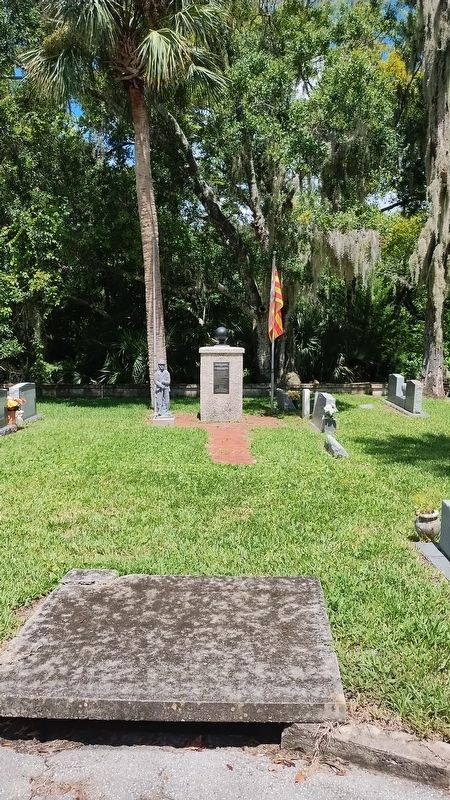
San Lorenzo Cemetery Civil War Memorial

Photographed by Craig Doda, September 1, 2024
1. San Lorenzo Cemetery Civil War Memorial Marker
Dedicated to the ten Confederate Soldiers buried in unmarked graves in San Lorenzo Cemetery
Andreu, Claudio D. PVT Company B, 1st Fl. Inf. Reg.
Armau, Francisco C. PVT Company B, 3rd Fl. Inf. Reg.
Canova, Isadore MUSCIAN Company C, 4th Fl. Inf. Reg.
Capo, Joseph PVT Company B, 3rd Fl. Inf. Reg.
Hernandez, Benj. Venantio PVT Company B, 25th S. C. Inf. Reg.
Pacetti, Thomas A. G. CPT C. S. N.
Perpall, Charles Furman PVT Company A, 3rd Fl. Inf. Reg.
Pomar, Cristobal PVT Manufactured Gun Carriages
Pomar, Peter Rafino PVT Company I, 10th Fl. Inf. Reg.
Triay, Juan A. PVT Company A, 1st Bn. Ga. Inf.
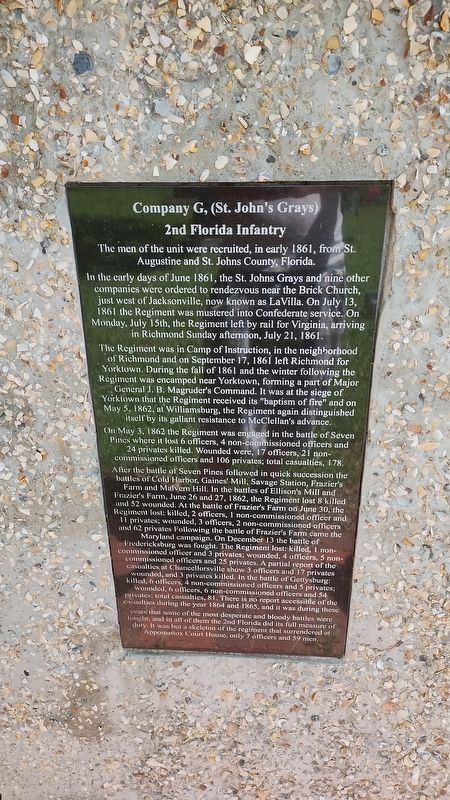
Company G, (St. John's Grays)
2nd Florida Infantry
The men of the unit were recruited, in early 1861, from St. Augustine and St. Johns County, Florida.
In the early days of June 1861, the St. Johns Grays and nine other companies were ordered to rendezvous near the Brick Church, just west of Jacksonville, now known as LaVilla. On July 13, 1861 the Regiment was mustered into Confederate service. On Monday,
this page online
The Regiment was in Camp of Instruction, in the neighborhood of Richmond and on September 17, 1861 left Richmond for Yorktown. During the fall of 1861 and the winter following the Regiment was encamped near Yorktown, forming a part of Major General J. B. Magruder's Command. It was at the siege of Yorktown that the Regiment received its "baptism of fire" and on May 5, 1862, at Williamsburg, the Regiment again distinguished itself by its gallant resistance to McClellan's advance.
On May 3, 1862 the Regiment was engaged in the battle of Seven Pines where it lost 6 officers, 4 non-commissioned officers and 24 privates killed. Wounded were, 17 officers, 21 non- commissioned officers and 106 privates; total casualties, 178.
After the battle of Seven Pines followed in quick succession the battles of Cold Harbor, Gaines' Mill, Savage Station, Frazier's Farm and Malvern Hill. In the battles of Ellison's Mill and Frazier's Farm, June 26 and 27, 1862, the Regiment lost 8 killed and 52 wounded. At the battle of Frazier's Farm on June
Photographed by Craig Doda, September 1, 2024
2. San Lorenzo Cemetery Civil War Memorial
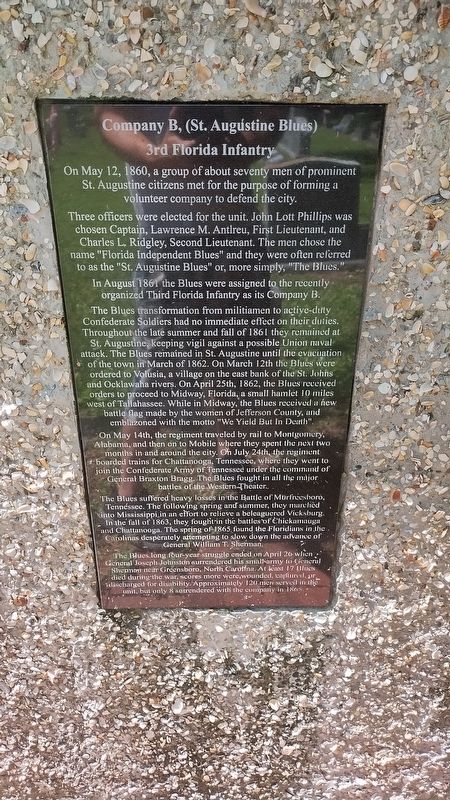
Company B, (St. Augustine Blues)
3rd Florida Infantry
On May 12, 1860, a group of about
Photographed by Craig Doda, September 1, 2024
3. San Lorenzo Cemetery Civil War Memorial
Three officers were elected for the unit. John Lott Phillips was chosen Captain, Lawrence M. Antlreu, First Lieutenant, and Charles L. Ridgley, Second Lieutenant. The men chose the name "Florida Independent Blues" and they were often referred to as the "St. Augustine Blues" or, more simply, "The Blues."
In August 1861 the Blues were assigned to the recently organized Third Florida Infantry as its Company B.
The Blues transformation from militiamen to active-duty Confederate Soldiers had no immediate effect on their duties. Throughout the late summer and fall of 1861 they remained at St. Augustine, keeping vigil against a possible Union naval attack. The Blues remained in St. Augustine until the evacuation of the town in March of 1862. On March 12th the Blues were ordered to Volusia, a village on the east bank of the St. Johns and Ocklawaha rivers. On April 25th, 1862, the Blues received orders to proceed to Midway, Florida, a small hamlet 10 miles west of Tallahassee. While in Midway, the Blues received a new
Photographed by Craig Doda, September 1, 2024
4. San Lorenzo Cemetery Civil War Memorial
On May 14th, the regiment traveled by rail to Montgomery, Alabama, and then on to Mobile where they spent the next two months in and around the city. On July 24th, the regiment boarded trains for Chattanooga, Tennessee, where they went to join the Confederate Army of Tennessee under the command of General Braxton Bragg. The Blues fought in all the major battles of the Western Theater.
The Blues suffered heavy losses in the Battle of Murfreesboro, Tennessee. The following spring and summer, they marched into Mississippi, in an effort to relieve a beleaguered Vicksburg. In the fall of 1863, they fought in the battles of Chickamauga and Chattanooga. The spring of 1865 found the Floridians in the Carolinas desperately attempting to slow down the advance of General William T. Sherman.
The Blues long four-year struggle ended on April 26. when General Joseph Johnston surrendered his small army to General Sherman near Greensboro, North Carolina. At least 17 Blues died during the war, scores more were, wounded, captured, or -discharged
Photographed by Craig Doda, September 1, 2024
5. San Lorenzo Cemetery Civil War Memorial
Erected 2015 by Ancient City Chapter 2232 UDC - Gen. William W. Loring Camp 1316 SCV - Lee's Legacy Chapter 946 CofC.
Topics. This memorial is listed in these topic lists: Cemeteries & Burial Sites • War, US Civil. A significant historical date for this entry is May 12, 1860.
Location. 29° 52.437′ N, 81° 19.543′ W. Memorial is in St. Augustine, Florida, in St. Johns County. It can be reached from the intersection of Old Moultrie Road (County Route 5A) and Cemetery Road, on the right when traveling north. The eastern entrance to San Lorenzo Cemetery is accessible from Dixie Highway (US-1) just south of Old Dixie Highway. Touch for map. Memorial is at or near this postal address: 1635 US-1, Saint Augustine FL 32084, United States of America. Touch for directions.

Regionally, this memorial is in First Coast and in Greater Jacksonville. It is also in the American South and on the Eastern Seaboard. Globally, it is in the North Atlantic Region, North America, a Gulf of Mexico state, the Western Hemisphere, the Western World, and the Anglosphere. Historically, it finds itself in what was once New Spain, the territory of the Mississippian Culture, one of the Confederate States of America, and the Antebellum South.
Other nearby markers. At least 8 other markers are within walking distance of this marker: 177 Twine Street (approx. 0.9 miles away); Reverend Goldie M. Eubanks (approx. 0.9 miles away); Twine Park (approx. 0.9 miles away); 160 M.L. King Avenue (approx. 0.9 miles away); 222 Riberia Street (approx. 0.9 miles away); 156 M.L. King Avenue (approx. 0.9 miles away); 94 South Street (approx. one mile away); 111 Lincoln Street (approx. one mile away). Touch for a list and map of all markers in St. Augustine.
Credits. This page was last revised on September 7, 2024. It was originally submitted on September 7, 2024, by Craig Doda of Napoleon, Ohio. This page has been viewed 289 times since then and 39 times this year. Photos: 1, 2, 3, 4, 5. submitted on September 7, 2024, by Craig Doda of Napoleon, Ohio. • Bernard Fisher was the editor who published this page.
