Manchester in Richmond, Virginia — The American South (Mid-Atlantic)
Richmond's Burgeoning Trade
| — | Richmond Slave Trail | — |
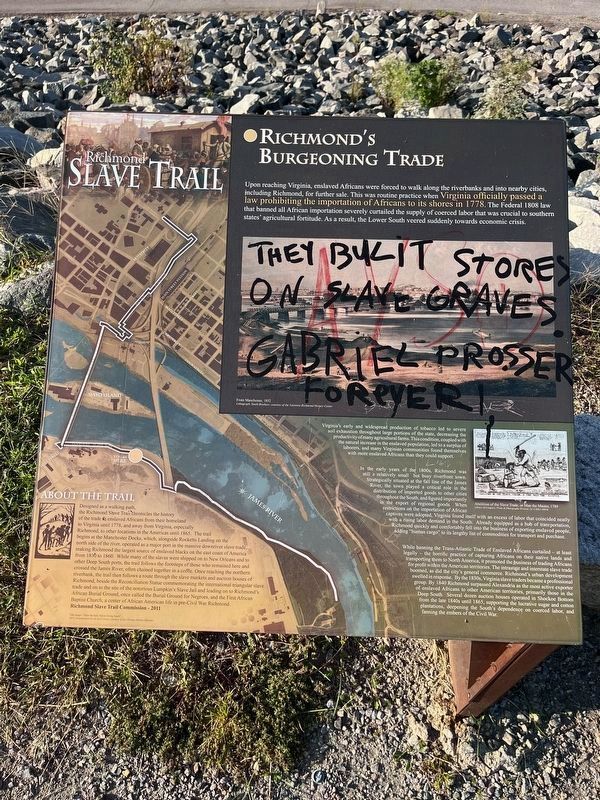
Photographed by Devry Becker Jones (CC0), September 6, 2024
1. Richmond's Burgeoning Trade Marker
The marker has been defaced with protest graffiti.
Upon reaching Virginia, enslaved Africans were forced to walk along the riverbanks and into nearby cities, including Richmond, for further sale. This was routine practice when Virginia officially passed a law prohibiting the importation of Africans to its shores in 1778. The Federal 1808 law that banned all African importation curtailed the supply of coerced labor that was crucial to southern states' agricultural fortitude. As a result, the Lower South veered suddenly towards economic crisis.
Virginia's early and widespread production of tobacco led to severe soil exhaustion throughout large portions of the state, decreasing the productivity of many agricultural farms. This condition, coupled with the natural increase in the enslaved population, led to a surplus of laborers, and many Virginian communities found themselves with more enslaved Africans than they could support.
In the early years of the 1800s, Richmond was still a relatively small but busy riverfront town. Strategically situated at the fall line of the James River, the town played a critical role in the distribution of imported goods to other cities
this page online
While banning the Trans-Atlantic Trade of Enslaved Africans curtailed — at least legally — the horrific practice of capturing Africans on their native lands and transporting them to North America, it promoted the business of trading Africans for profit within the American territories. The intrastate and interstate slave trade boomed, as did the city's general commerce. Richmond's urban development swelled in response. By the 1830s, Virginia slave traders became a professional group. By 1840 Richmond surpassed Alexandria as the most active exporter of enslaved Africans to other American territories, primarily those in the Deep South. Several dozen auction houses operated

About the Trail
Designed as a walking path, the Richmond Slave Trail chronicles the history of the trade in enslaved Africans from their homeland to Virginia until 1778, and away from Virginia, especially Richmond, to other locations in the Americas until 1865. The trail begins at the Manchester Docks, which, alongside Rocketts Landing on the north side of the river, operated as a major port in the massive downriver slave trade, making Richmond the largest source of enslaved blacks on the east coast of America from 1830 to 1860. While many of the slaves were shipped on to New Orleans and to other Deep South ports, the trail follows the footsteps of those who remained here and crossed the James River, often chained together in a coffle. Once reaching the northern riverbank, the trail then follows a route through the slave markets and auction houses of Richmond, beside the Reconciliation Statue commemorating the international triangular
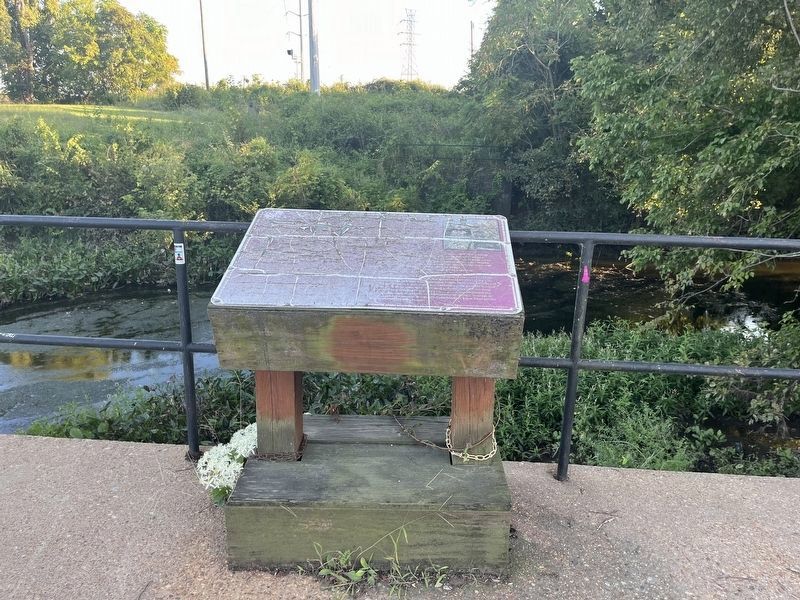
Photographed by Devry Becker Jones (CC0), September 6, 2024
3. Nearby sign
Down the hill to the south stands a sign whose inscription is severely faded. Unfortunately at this time, it is unclear whether this was a historical marker.
Erected 2011 by Richmond Slave Trail Commission. (Marker Number 7.)
Topics. This historical marker is listed in these topic lists: African Americans • Agriculture • Industry & Commerce. A significant historical year for this entry is 1778.
Location. 37° 31.587′ N, 77° 25.864′ W. Marker has been reported damaged. Marker is in Richmond, Virginia. It is in Manchester. It is on Manchester Flood Wall 0.1 miles Maury Street, on the right when traveling east. Touch for map. Marker is at or near this postal address: 201 Manchester Rd, Richmond VA 23224, United States of America. Touch for directions.

Regionally, this marker is in Central Virginia. It is also in the American South and specifically in the Upper South. Globally, it is in North America, the Western Hemisphere, the Western World, and the Anglosphere. Historically, it finds itself in what was once the territory of the Mississippian Culture, one of the original Thirteen Colonies, one of the Confederate States of America, and the Antebellum South.
Other nearby markers. At least 8 other markers are within walking distance of this location: Slavery Challenged (about 700 feet away, measured in a direct line); a different marker also named Transitions (approx. ¼ mile away); Diversity Park (approx. ¼ mile away); Manchester Canal (approx. ¼ mile away); Native Markets (approx. 0.3 miles away); Mayo's Bridge (approx. 0.3 miles away); Libby Prison (approx. 0.4 miles away); John Mayo (approx. 0.4 miles away). Touch for a list and map of all markers in Richmond.
Another marker is no longer nearby. Transitions (was approx. ¼ mile away but has been replaced with another marker now near it).
Credits. This page was last revised on September 8, 2024. It was originally submitted on September 8, 2024, by Devry Becker Jones of Washington, District of Columbia. This page has been viewed 336 times since then and 55 times this year. Photos: 1, 2, 3. submitted on September 8, 2024, by Devry Becker Jones of Washington, District of Columbia.
