College in Fairbanks North Star Borough, Alaska — Northwest (North America)
Engineering challenge: preserve the permafrost
Photographed by William Fischer, Jr., August 17, 2024
1. Engineering challenge: preserve the permafrost Marker
Air convection embankments keep the air moving
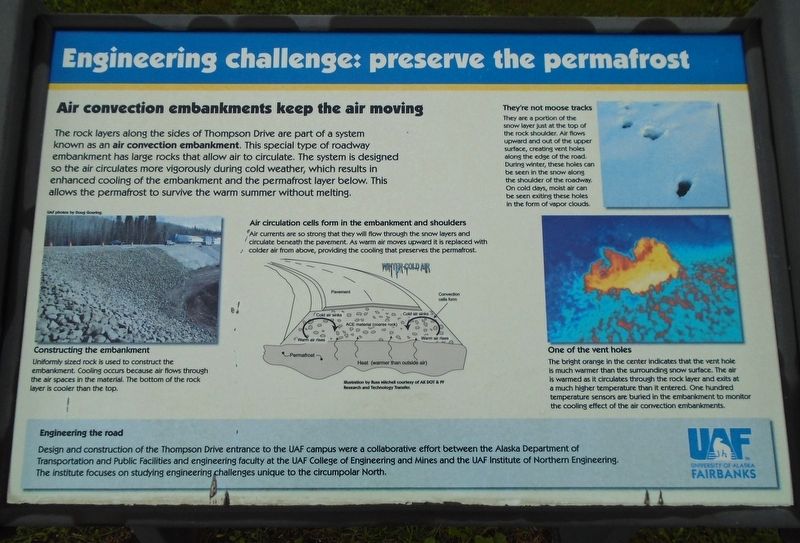
The rock layers along the sides of Thompson Drive are part of a system known as an air convection embankment. This special type of roadway embankment has large rocks that allow air to circulate. The system is designed so the air circulates more vigorously during cold weather, which results in enhanced cooling of the embankment and the permafrost layer below. This allows the permafrost to survive the warm summer without melting.
Air circulation cells form in the embankment and shoulders
Air currents are so strong that they will flow through the snow layers and circulate beneath the pavement. As warm air moves upward it is replaced with colder air from above, providing the cooling that preserves the permafrost.
[Diagram of road construction]
Constructing the embankment
Uniformly sized rock is used to construct the embankment. Cooling occurs because air flows through the air spaces in the material. The bottom of the rock layer is cooler than the top.
They're not moose tracks
They are a portion of the snow layer just at the top of the rock shoulder. Air flows upward and
this page online
One of the vent holes
The bright orange in the center indicates that the vent hole is much warmer than the surrounding snow surface. The air is warmed as it circulates through the rock layer and exits at a much higher temperature than it entered. One hundred temperature sensors are buried in the embankment to monitor the cooling effect of the air convection embankments.
Engineering the road
Design and construction of the Thompson Drive entrance to the UAF campus were a collaborative effort between the Alaska Department of Transportation and Public Facilities and engineering faculty at the UAF College of Engineering and Mines and the UAF Institute of Northern Engineering. The institute focuses on studying engineering challenges unique to the circumpolar North.
Erected by University of Alaska Fairbanks.
Topics. This historical marker is listed in these topic lists: Education •

Photographed by William Fischer, Jr., August 17, 2024
2. Engineering challenge: preserve the permafrost Marker
Location. 64° 51.073′ N, 147° 50.549′ W. Marker is in College, Alaska, in Fairbanks North Star Borough. It is on Thompson Drive 0.1 miles north of Geist Road, on the right when traveling north. Marker is at an informational pulloff on the UAF campus. Touch for map. Marker is at or near this postal address: 821 Thompson Dr, Fairbanks AK 99709, United States of America. Touch for directions.

Regionally, this marker is in the Alaska Railroad Corridor, in the Athabascan Region, and in Interior Alaska. It is also on the American Pacific Coast. Globally, it is in North America, on the Pacific Rim, in the Western Hemisphere, in the Western World, and in the Anglosphere. Historically, it finds itself in what was once the Russian Empire.
Other nearby markers. At least 8 other markers are within walking distance of this marker: Engineering challenge: build a road on permafrost (here, next to this marker); Boreal forest: living around Thompson Drive (here, next to this marker); UAF: a Land, Sea and Space Grant institution (a few steps from this
Photographed by William Fischer, Jr., August 17, 2024
3. Welcome to Nanook Nation Sign
Also see . . .
1. UAF road project has become model for permafrost construction (UAF, 2017). (Submitted on September 8, 2024, by William Fischer, Jr. of Reynoldsburg, Ohio.)
2. Roads and Airfields Constructed on Permafrost Technical Brief (2022). (Submitted on September 8, 2024, by William Fischer, Jr. of Reynoldsburg, Ohio.)
Credits. This page was last revised on September 23, 2024. It was originally submitted on September 8, 2024, by William Fischer, Jr. of Reynoldsburg, Ohio. This page has been viewed 159 times since then and 25 times this year. Photos: 1, 2, 3. submitted on September 8, 2024, by William Fischer, Jr. of Reynoldsburg, Ohio.
