College in Fairbanks North Star Borough, Alaska — Northwest (North America)
What is the Aurora?
Photographed by William Fischer, Jr., August 17, 2024
1. What is the Aurora? Marker
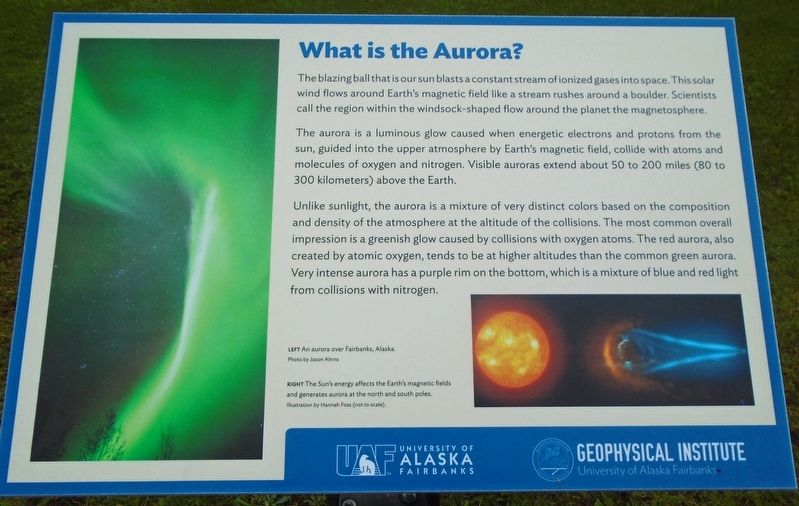
The blazing ball that is our sun blasts a constant stream of ionized gases into space. This solar wind flows around Earth's magnetic field like a stream rushes around a boulder. Scientists call the region within the windsock-shaped flow around the planet the magnetosphere.
The aurora is a luminous glow caused when energetic electrons and protons from the sun, guided into the upper atmosphere by Earth's magnetic field, collide with atoms and molecules of oxygen and nitrogen. Visible auroras extend about 50 to 200 miles (80 to 300 kilometers) above the Earth.
Unlike sunlight, the aurora is a mixture of very distinct colors based on the composition and density of the atmosphere at the altitude of the collisions. The most common overall impression is a greenish glow caused by collisions with oxygen atoms. The red aurora, also created by atomic oxygen, tends to be at higher altitudes than the common green aurora. Very intense aurora has a purple rim on the bottom, which is a mixture of blue and red light from collisions with nitrogen.
LEFT [photo caption reads] An aurora over Fairbanks, Alaska.
RIGHT [illustration caption reads]
this page online
Erected by University of Alaska Fairbanks.
Topics. This historical marker is listed in these topic lists: Air & Space • Environment • Science & Medicine.
Location. 64° 51.538′ N, 147° 50.939′ W. Marker is in College, Alaska, in Fairbanks North Star Borough. It is on North Koyukuk Drive, on the left when traveling west. Marker and rocket are northwest of the Arctic Health Research Building, on the University of Alaska Fairbanks campus. Touch for map. Marker is at or near this postal address: 2155 N Koyukuk Dr, Fairbanks AK 99709, United States of America. Touch for directions.

Regionally, this marker is in the Alaska Railroad Corridor, in the Athabascan Region, and in Interior Alaska. It is also on the American Pacific Coast. Globally, it is in North America, on the Pacific Rim, in the Western Hemisphere, in the Western World, and in the Anglosphere. Historically, it finds itself in what was once the Russian Empire.
Other nearby markers. At least 8 other
Photographed by William Fischer, Jr., August 17, 2024
2. What is the Aurora? Marker and Rocket
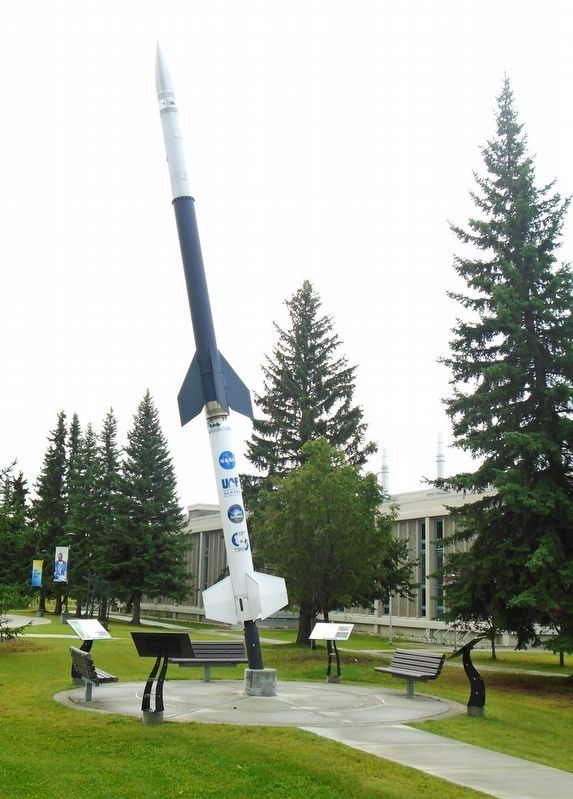
Regarding What is the Aurora?. While the marker is strictly natural history related, it is one of four surrounding the sounding rocket that UAF and NASA have used to study the aurora. Hence, it compliments the other markers and enhances overall understanding.
Credits. This page was last revised on September 23, 2024. It was originally submitted on September 8, 2024, by William Fischer, Jr. of Reynoldsburg, Ohio. This page has been viewed 195 times since then and 24 times this year. Photos: 1, 2. submitted on September 8, 2024, by William Fischer, Jr. of Reynoldsburg, Ohio.
