South Nashville in Davidson County, Tennessee — The American South (East South Central)
The Civil War and Its Aftermath
Photographed by Darren Jefferson Clay, August 25, 2022
1. The Civil War and Its Aftermath Marker
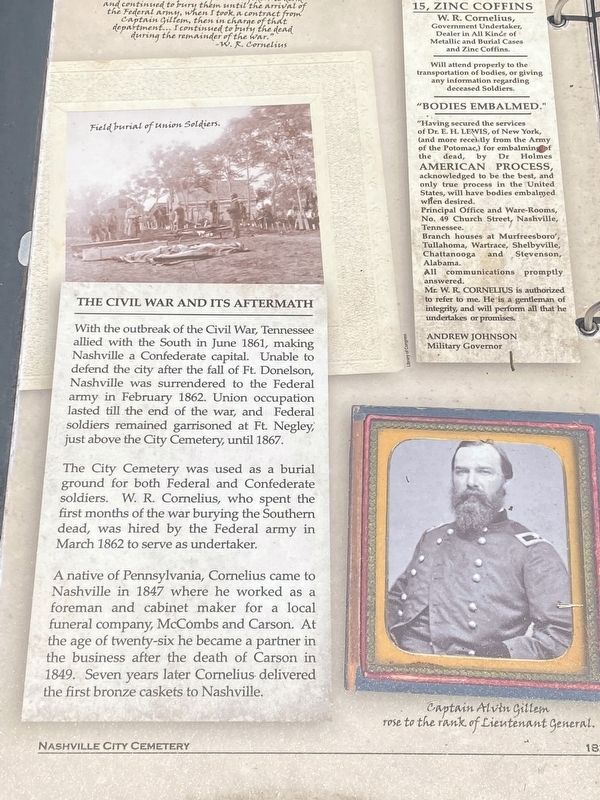
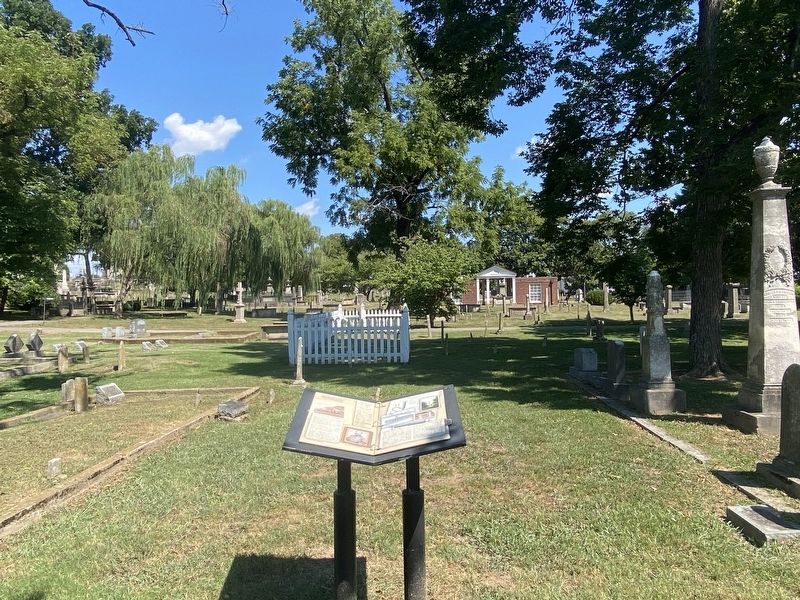
With the outbreak of the Civil War, Tennessee allied with the South in June 1861, making Nashville a Confederate capital. Unable to defend the city after the fall of Ft. Donelson, Nashville was surrendered to the Federal army in February 1862. Union occupation lasted till the end of the war, and Federal soldiers remained garrisoned at Ft. Nelly, just above the City Cemetery, until 1867.
The City Cemetery was used as a burial ground for both Federal and Confederate soldiers. W.R. Cornelius, who spent the first months of the war burying the Southern dead, was hired by the Federal army in March 1862 to serve as undertaker.
A native of Pennsylvania, Cornelius came to Nashville in 1847 where he worked as a foreman and cabinet maker for a local funeral company, McCombs and Carson. At the age of twenty-six he became a partner in the business after the death of Carson in 1849. Seven years later Cornelius delivered the first bronze casket to Nashville.
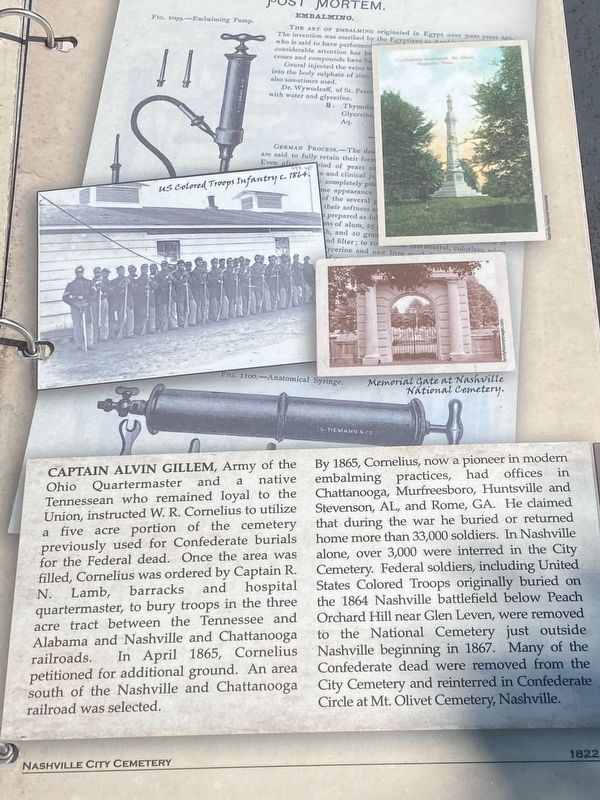
Captain Alvin Gillem, Army of the Ohio Quartermaster and a native Tennessean who remained loyal to the Union, instructed W.R. Cornelius to utilize a five acre portion of
this page online
By 1865, Cornelius, now a pioneer in modern embalming practices, had offices in Chattanooga, Murfreesboro, Huntsville, and Stevenson, AL, and Rome, GA. He claimed that during the war, he buried or returned home more than 33,000 soldiers. In Nashville alone, over 3,000 were interred in the City Cemetery. Federal soldiers, including United States Colored Troops originally buried on the 1864 Nashville battlefield below Peach Orchard Hill near Glen Leven, were removed to the National Cemetery just outside Nashville beginning in 1867. Many of the Confederate dead were removed from the City Cemetery and reinterred in Confederate Circle at Mt. Olivet Cemetery, Nashville.
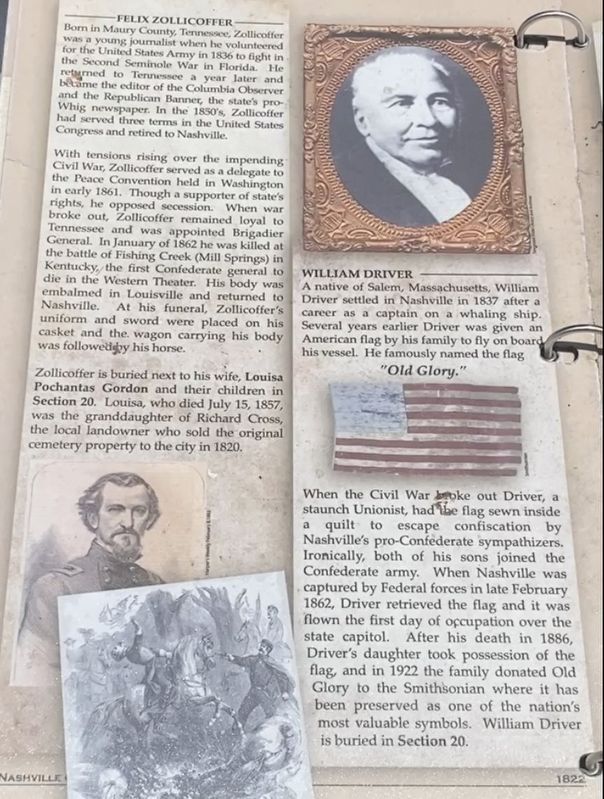
Felix Zollicoffer
Born in Maury County, Tennessee,
Photographed by Darren Jefferson Clay, August 25, 2022
2. The Civil War and Its Aftermath Marker
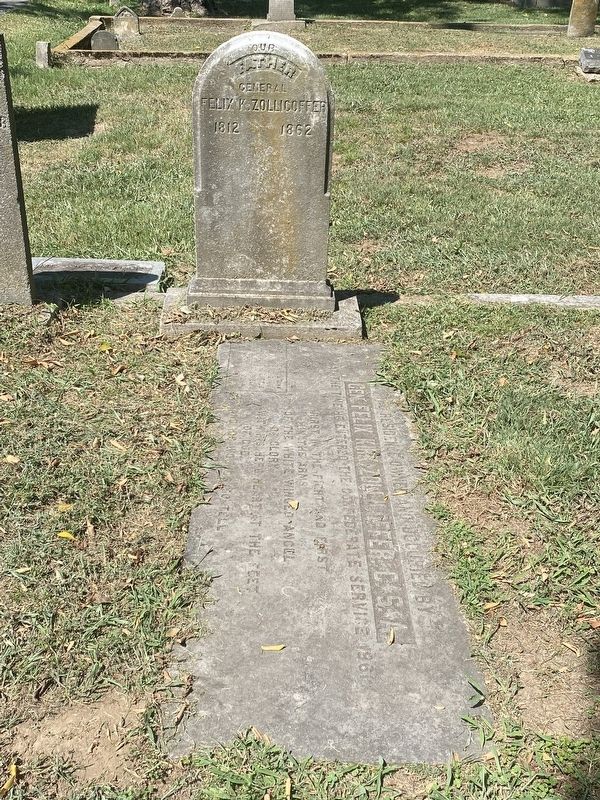
With tension rising over the impending Civil War, Zollicoffer served as a delegate to the Peace Convention held in Washington in early 1861. Though a supporter of state's rights, he opposed secession. When war broke out, Zollicoffer remained loyal to Tennessee and was appointed Brigadier General. In January of 1862 he was killed at the battle of Fishing Creek (Mill Springs) in Kentucky, the first Confederate general to die in the Western Theater. His body was embalmed in Louisville and returned to Nashville. At his funeral, Zollicoffer's uniform and sword were placed on his casket and the wagon carrying his body was followed by his horse.
Zollicoffer is buried next to his wife, Louisa Pochantas Gordon and their children in Section 20. Louisa, who
Photographed by Darren Jefferson Clay, August 25, 2022
3. The Civil War and Its Aftermath Marker
William Driver
A native of Salem, Massachusetts, William Driver settled in Nashville in 1837 after a career as a captain on a whaling ship. Several years earlier Driver was given an American flag by his family to fly onboard his vessel. He famously named the flag "Old Glory."
When the Civil War broke out Driver, a staunch Unionist, had the flag sewn inside a quilt to escape confiscation by Nashville's pro-Confederate sympathizers. Ironically, both of his sons joined the Confederate army. When Nashville was captured ivy Federal forces in late February 1862, Driver retrieved the flag and it was flown the first day of occupation over the state capitol. After his death in 1886, Driver's daughter took possession of the flag, and in 1922 the family donated Old Glory to the Smithsonian where it has been preserved as one of the nation's most valuable symbols. Willam Driver is buried in Section 20.
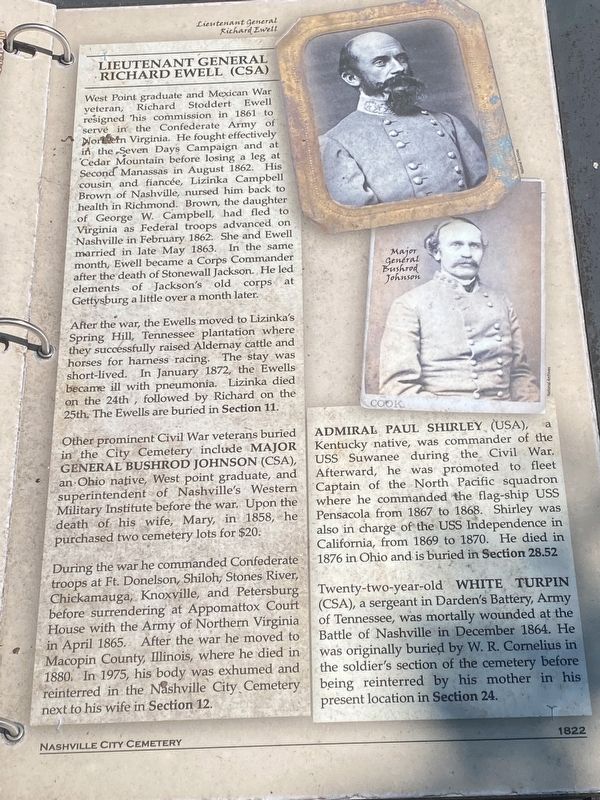
Lieutenant General Richard Ewell (CSA)
West Point graduate and Mexican War veteran, Richard Stoddert
Photographed by Darren Jefferson Clay, August 25, 2022
4. The Civil War and Its Aftermath Marker
After the war, the Ewells moved to Lizinka's Spring Hill, Tennessee plantation where they successfully raised Alderney cattle and horses for harness racing. The stay was short-lived. In January 1872, the Ewells became ill with pneumonia. Lizinka died on the 24th , followed by Richard on the 25th. The Ewells are buried in Section 11.
Other prominent Civil War veterans buried in the City Cemetery include Major General Bushrod Johnson (CSA), an Ohio native, West Point Graduate, and superintendent
Photographed by Darren Jefferson Clay, August 25, 2022
5. The Civil War and Its Aftermath Marker
During the war he commanded Confederate troops at Ft. Donelson, Shiloh, Stones River, Chickamauga, Knoxville, and Petersburg before surrendering at Appomattox Court House with the Army of Northern Virginia in April 1865. After the war he moved to Macon County, Illinois, where he died in 1880. In 1975, his body was exhumed and reinterred in the Nashville City Cemetery next to his wife in Section 12.
Admiral Paul Shirley (USA), a Kentucky native, was commander of the USS Suwanee during the Civil War. Afterward, he was promoted to fleet Captain of the North Pacific squadron where he commanded the flag-ship USS Pensacola from 1867 to 1868. Shirley was also in charge of the USS Independence in California, from 1869 to 1870. He died in 1876 in Ohio and is buried in Section 28.52.
Twenty-two-year-old White Turpin (CSA), a sergeant in Darden's Battery, Army of Tennessee, was mortally wounded at the Battle of Nashville in December 1864. He was originally buried by W.R. Cornelius in the soldier's
Photographed by Darren Jefferson Clay, August 25, 2022
6. Felix Zollicoffer’s grave and headstone.
Erected by Nashville City Cemetery.
Topics. This historical marker is listed in these topic lists: Cemeteries & Burial Sites • War, US Civil. A significant historical month for this entry is January 1862.
Location. 36° 8.805′ N, 86° 46.182′ W. Marker is in Nashville, Tennessee, in Davidson County. It is in South Nashville. It can be reached from the intersection of 4th Avenue South and Oak Street, on the right when traveling south. The marker stands within Nashville City Cemetery. Touch for map. Marker is at or near this postal address: 1001 4th Ave S, Nashville TN 37203, United States of America. Touch for directions.

Regionally, this marker is in Middle Tennessee. It is also in the American South and specifically in the Upper South. Globally, it is in North America, the Western Hemisphere, the Western World, and the Anglosphere. Historically, it finds itself in what was once the territory of the Mississippian Culture, one of the Confederate States of America, and the Antebellum South.
Other nearby markers. At least 8 other markers are within walking distance of this marker: Frontier Nashville / Athens of the West (within shouting distance of this marker); Nashville City Cemetery (within shouting distance of this marker); The Free and the Unfree (within shouting distance of this marker); From Frontier to Civilization (within shouting distance of this marker); A Community of Citizens and Soldiers (within shouting distance of this marker); John E. Hagey (about 300 feet away, measured in a direct line); From Burying Ground to Cemetery (about 300 feet away); William Carroll (about 400 feet away). Touch for a list and map of all markers in Nashville.
Other markers no longer nearby. Felix K. Zollicoffer (was here, next to this marker but has been permanently removed); William Driver (was a few steps from this marker but has been permanently removed); Major Henry M. Rutledge (was a few steps from this marker but has been permanently removed); Gen. Sam G. Smith (was within shouting distance of this marker but has been permanently removed); Richard S. Ewell (was about 400 feet away but has been permanently removed).
Credits. This page was last revised on September 11, 2024. It was originally submitted on September 4, 2022, by Darren Jefferson Clay of Duluth, Georgia. This page has been viewed 568 times since then and 36 times this year. Last updated on September 11, 2024, by Carl Gordon Moore Jr. of North East, Maryland. Photos: 1, 2, 3, 4, 5, 6. submitted on September 4, 2022, by Darren Jefferson Clay of Duluth, Georgia. • Devry Becker Jones was the editor who published this page.
