University of Virginia near Charlottesville in Albemarle County, Virginia — The American South (Mid-Atlantic)
Memorial to Enslaved Laborers

As it enters its third century, the University of Virginia remembers the enslaved people whose labor and talents made possible the construction and operation of the Academical Village. Forced labor, incalculable suffering, and the struggle to live with dignity were the daily experience of the enslaved African Americans who shaped the institution's first half-century. This memorial is erected as a permanent tribute to them.
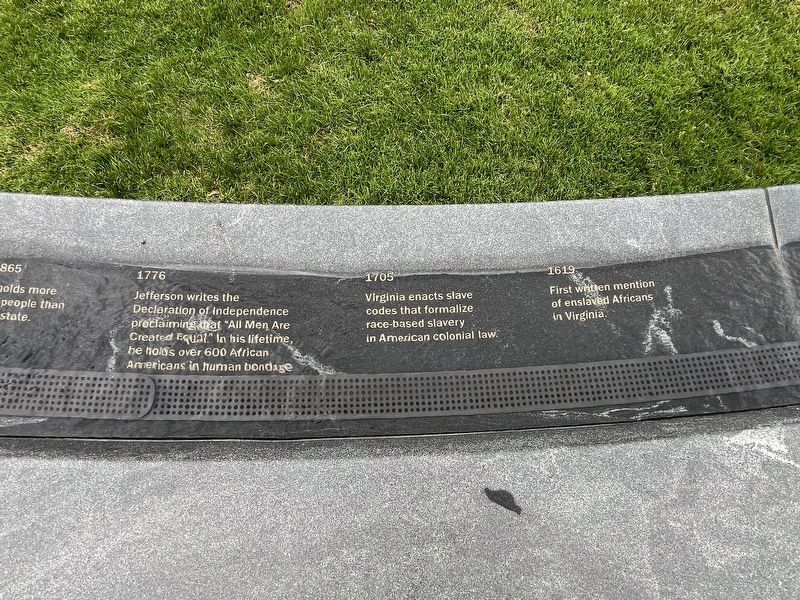
1619
First written mention of enslaved Africans in Virginia.
1705
Virginia enacts slave codes that formalize race-based slavery in American colonial law.
1776
Jefferson writes the Declaration of Independence proclaiming that "All Men Are Created Equal." In his lifetime, he holds over 600 African Americans in human bondage.
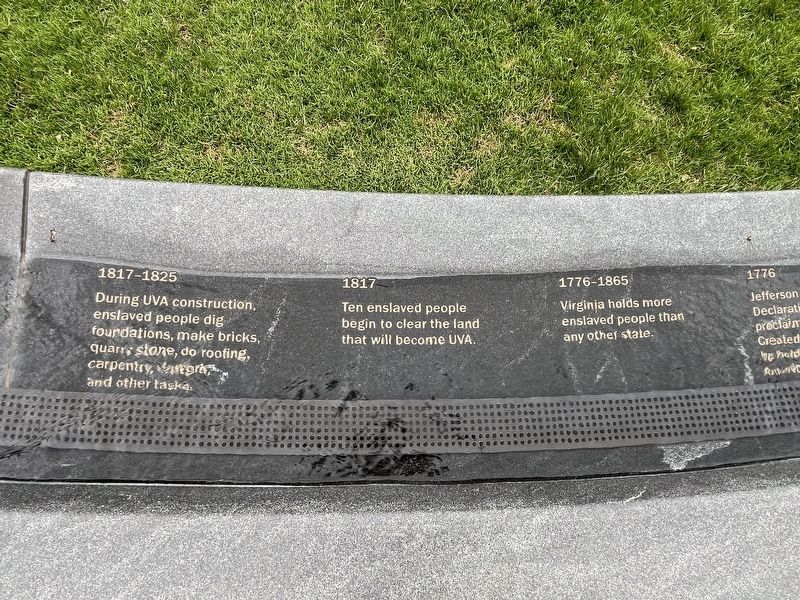
1776-1865
Virginia holds more enslaved people than any other state.
1817
Ten enslaved people begin to clear the land that will become UVA.
1817-1825
During UVA construction, enslaved people dig foundations, make bricks, quarry stone, do roofing, carpentry, and other tasks.
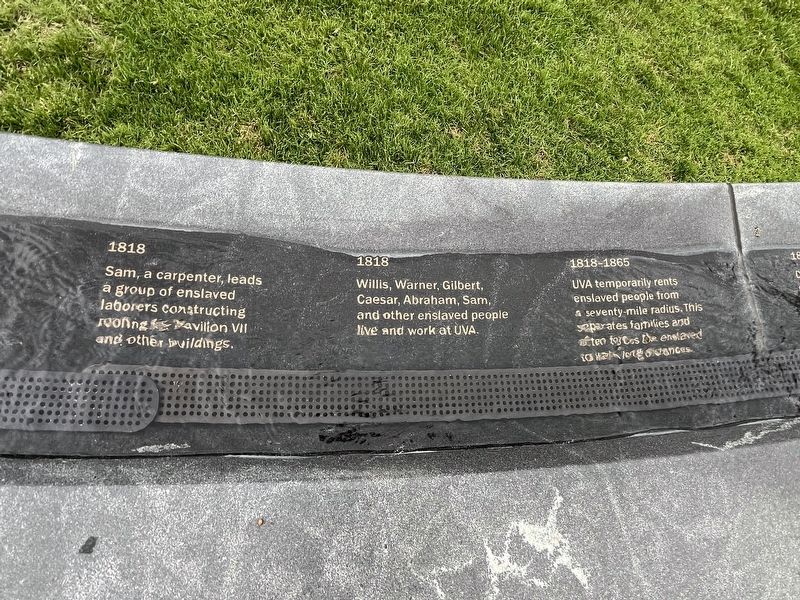
1818-1865
UVA temporarily rents enslaved people from a seventy-mile radius. This
this page online
1818
Willis, Warner, Gilbert, Caesar, Abraham, Sam, and other enslaved people live and work at UVA.
1818
Sam, a carpenter, leads a group of enslaved laborers constructing roofing for Pavilion VII and other buildings.
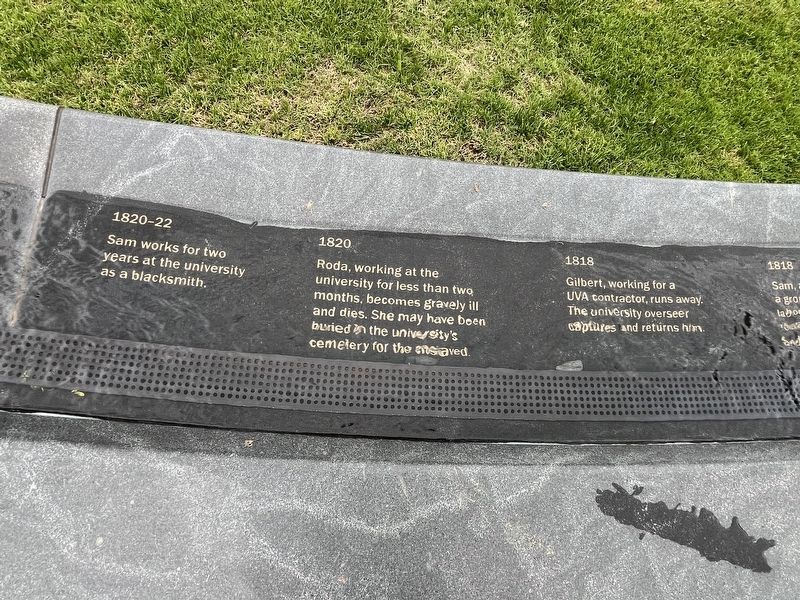
1818
Gilbert working for a UVA contractor, runs away. The university overseer captures and returns here.
1820
Roda, working at the university for less than two months, becomes gravely ill and dies. She may have been buried at the university's cemetery for the enslaved.
1820-22
Sam works for two years at the university as a blacksmith.
1821
William Green works as a blacksmith at the UVA construction site. Dick and Ned work as carpenters.
1821-24
Willis, Sam, John, Reubin, Nelson, Jefferson, Ben, Barrett, Lewis, Tom, Bob, Dick, Alfred, Moses, Randal, George, Sharper, and other enslaved men mold and fire bricks.
1822
Fleming runs away. He is captured a mile from the university and returns.
1822
Willis runs away. The UVA overseer pursued and captures him in Louisa County.
1822-23
Henry works as a blacksmith, Charles
1824
Carpenter Sam, an enslaved man, supervises the work of three other carpenters: Davey, William, and "young Sam," the last possibly his son.
1824
Tom runs away. He is captured fifty miles from Charlottesville and jailed in Louisa County before the UVA overseer returns him to work at the university.
1825
UVA opens for its first session with 123 white male students. 90-150 enslaved people also live on Grounds.
1825-65
An average of over one hundred enslaved people work annually as blacksmiths, bricklayers, cooks, carpenters, painters, seamstresses, janitors, and domestics.
1825
Jim and Moses cut stone at the UVA quarry, Primus works in the blacksmith's shop, and Zebray cuts stone for construction of the Anatomical Theatre.
1825
In October, rioting students beat a professor's enslaved servant.
1826
Faculty seek stricter control of the enslaved, calling for creation of a licensing system that requires African Americans waiting upon students on Grounds to carry badges.
1826-27
Nelson cares for horses
1826-29
Thrimston Hern, "a tolerable good stone cutter," does stone work at UVA, including completing the Rotunda steps.
1826-29
Several professors purchase enslaved people from Jefferson's estate after his death in 1826. Among the enslaved is Lucy Cottrell, who becomes a cook in Pavilion IV.
1827
Prudence cleans bloody linens from the Anatomical Theatre. Humphrey and Peyton Skipwith work as stonemasons.
1828
John Edwards chops wood at the university. Cato Cocke excavates bedrock at foundation sites.
1829
Disturbed in the night "by a noise made by negroes passing thro the University," a professor proposes that the school institute a regular slave patrol.
1829
Zebray trims and shapes quarry stone to enclose the University Cemetery. Alfred lays bricks and whitewashes buildings.
1830
147 enslaved African Americans live and work at the university. 66 people are held by professors 57 by hotelkeepers, the remaining 24 by UVA.
1831-32
In the wake of Nat Turner's slave uprising, the Virginia legislature debates the fate of slavery. They choose to
1832
Three professors purchase Lewis Commodore at public auction for the school's use. They are later reimbursed, and he becomes UVA property.
1837
Students fire pistols on the Lawn, then violently attack Lewis Commodore.
1838
Two students savagely beat an enslaved man named Fielding.
1839-57
Lewis, charged with maintaining the Anatomical Theatre, cleans up after cadaver dissections and is forced to rob graves.
1840
143 enslaved African Americans live and work at the university. 55 people are held by professors, 67 by hotelkeeprs, and 21 by UVA.
1843
Abraham, Shelton, and Kenny lay bricks at the university.
1846
Isaac and Nelson work as stonemasons. Washington, Absalom, and Ben lay bricks.
1848
Micahjah assists a stonemason in cutting and trimming rock while Kennedy repairs paved surfaces by laying new bricks.
1849
Falling ill during her pregnancy, Flora suffers a stillbirth and does not recover for months.
1849-1850
Abraham Lewis Commodore, Charles, Dick, Lewis, Margaret, Homer, James, Abraham, Johnson, Thad, Cassandra, and other enslaved people live and work at UVA.
1850
Three
1850
93 enslaved African Americans live and work at the university. 42 are held by professors, 37 by hotelkeepers, and 14 by UVA.
1852
A young man named Charles whitewashes dormitory rooms and cleans lecture rooms.
1853
Isabella Gibbons, a cook who works in a Pavilion kitchen, marries William Gibbons, a butler enslaved by another UVA professor. They teach themselves to read and write.
1853-54
Dick, Primus, Ryland, Jackson, John, Billy, and other enslaved people live and work at UVA.
1855
Lucy suffers from "rheumatism aggravated by her sleeping apartment… the brick floor being always liable to dampness."
1856
An enslaved eleven-year-old girl is beaten unconscious by a UVA student. Claiming his right to discipline any slave, he suffers no consequences.
1857-58
Nelson, Henry, Norman, George, Bob, William, Garland, and other enslaved people live and work at UVA.
1859
Abolitionist John Brown tries to seize a federal arsenal at Harpers Ferry, Virginia, as part of a plan to lead an armed slave uprising.
1859
UVA

1860
104 enslaved African Americans live and work at the university. 55 are held by professors, 36 by hotelkeepers, 11 by the Proctor, and 2 by UVA.
1860
Parnil, Willis, Ned and Albert work as carpenters at the university.
1861
Virginia secedes from the Union, invoking the federal government's "oppression of the slaveholding states."
1861
Approximately 14,000 enslaved African Americans, over half the population, live in Albemarle County when the Civil War starts. A half million enslaved people reside in Virginia.
1861
Enslaved people flee to Union-held Fort Monroe in eastern Virginia. Their wartime flight to Union forces across the South paves the way for Lincoln's emancipation policy.
1862
Joshua and Charlotte work as attendants in the university infirmary.
1862-64
Nearly 1,000 enslaved local African Americans are forced by Confederate authorities to do work such as building fortifications.
1863
Charlottesville Baptist Church's black congregants, including those enslaved at UVA, successfully petition white church leaders to establish separate services for African American members.
1863-1865
More than 250 African American men, born in Albemarle County, but dispersed by sale, flight, and migration across the South enlist in the Union army.
1864
Aaron chops wood at the university.
1865
On March 3, Charlottesville and UVA officials surrender the town to Union forces. On April 9, Confederate forces in Virginia surrender at Appomattox.
1865
Local African Americans celebrate both March 3 and April 9 as freedom days.
1865
With general emancipation underway and the Civil War over, UVA in September begins to pay wages to those formerly enslaved.
1866
Isabella Gibbons, formerly enslaved at UVA, teaches at a freedmen's school in Charlottesville with 42 students. One month later the school has grown to 69 students. It will become the Jefferson School.
1886
Baptist minister William Gibbons, formerly enslaved at UVA, dies in Washington, D.C. He is buried in Charlottesville.
1889
Isabella Gibbons dies in Charlottesville and is buried alongside William Gibbons.
Can we forget the crack of the whip, cowhide, whipping-post, the auction-block, the hand-cuffs, the spaniels, the iron collar, the negro-trader tearing the young child from its mother's breast as a whelp from the lioness? have we forgotten that by those horrible cruelties, hundreds of our race have been killed? No, we have not, nor ever will.
— Isabella Gibbons, 1867
Warner • Mother • Abraham • Billy
Laborer • Father • Willis • Sam • Milly King • Caesar • Jack
Jim Henderson • Gilbert • Billy • Brother • Tom • Ishmel • Sam • Husband • Stonecutter
Stonemason • Uncle • John Edwards • Lancelotte • Warner • Sister • Ben • Friend • Sandy • William Green • Brickmason
Bill • Lewis • Stonecutter • John • Willis • Ben Sowell • Grandmother • George • Billy • Laborer • Anthony • Aunt • Nelson • Sawyer • Squire
Wyatt • Father • Sally Cottrell Cole • Grandfather • Billy • George • Mother • Milly • Painter • Roda • Sam • Dick • Brickmason • Prior • Charles • John Meads • Servant • Carpenter
Mariah • Stonecutter • David Adams • Son • Harry • Charles • Niece • Henry • Madison • Jackson • Daughter • Sam • Nelson • Willis • Wilson • James • Burwell Colbert • Tinner • Jack • Domestic • Laundress • Brickmaker • Fleming
Willis • Brickmason • Woodcutter • Jim Price • Fleming • Ned • Wife • Nephew • Harry • Alfred • Stableman • Grandfather • Laborer • Cook • Wilson • Jenny • Glazier • Nelson • Edward Jackson • Armstrong • Jeff • Robert • Paul • Father
Billy • Brickmaker • Midwife • Janitor • Sam Johnson • Willis • Sally • Dick • Anthony • Lewis • Isham • Grandchild • Barnet • Alfred • Lindy • Tom • Zachariah • Cousin • Ned • Stonemason • Stonecutter • Mother • Jack • Wagoner • Daughter • Barrett • Robin
Sawyer • Christo • Charles • Brother • Father • Joiner • Grandmother • Blacksmith • Bristoe • John • Farmer • Sukey • Thrimston Hern • George • Frank • Laundress • Guy • Domestic • Nephew • Bob • Davey • Giles • Jefferson • Dick • Fleming • Ben • Simon • Sam • Humphrey
Fanny Gillette Hern • Stableman • Davy Hern • Willis • Cousin • Gilbert • Bonny Castle Hern • Gardener • Grandfather • Ben Snowden • Lily Hern • Thomas P. Wells • George • Charles • Carpenter • Charlotte • Mike • Brother • Jane • Mat • Son • Peyton Skipwith • Randal • Primus • Painter • Prince • Charles • Sharper • Mike • Franklin • Ben • James
Seamstress • Tom • William • Mother • Ned • Stonecutter • Simon • Ben • Brother • Husband • John • Barrett • Sally • Booker • Wilson • Booker • Tepney • Woodcutter • Armistead • Nelson • Joseph Fossett • Cook • Grandchild • Moses • Stonemason • Peter • Cato Cocke • Isaiah • Prince • Sister • William • Butler • Servant • Dinston
Gardener • Wyatt • Midwife • Nephew • Father • Laborer • Nelson • Charles Perry • Brickmason • John • Frederick • Jacob • Wyatt • Janitor • Wilson • Aunt • Tom • Araminte • Wagoner • Sam • Sister • Reubin • Ben • Aaron • Humphrey • John • Zebray • Carter • Aaron
Dorothea Dolly Cottrell • Phil • Violete • Brother • Hicman • Booker • Stonemason • Bob • Davey • Alfred • Stephen • Tom • Grandchild • Edmond Monroe • Elijah • Stonecutter • Simon • Nelson • John • Cousin • Joiner • Tinner • Sam • Ben • Brickmaker • Maid • Sarah • Mielide • Friend • Seamstress • German • Jim • Lucy Gottress • Albert • Husband • Humphrey • Moses • James • Lewis Commodore • Laundress • William
William • Humphrey • Isaiah • Spencer • Stableman • Waiter • Simpson • Daniel • Primus • Anthony • Domestic • Isaac • Aaron • Moses • Jack Davis • Albert • Alfred • Butler • Davey • James Monroe • Dick • Woodcutter • Painter • Prudence • Henry • Zura • Peter • Friend • Sawyer • Jackson • John • Aunt
Sam • George • Zachariah • Alfred • Reuben • Moses • Grandmother • Nelson • Eston Hemings • Albert • Thornton • Carpenter • Netsy • Aunt • Friend • Jack Kennedy • Stonecutter • Judy • Henry • Niecy • Nicholas • James • James • Horace • Janitor • Joy • Jack • Joiner • Wagoner • Son • John
Trinson • Farmer • Thornton • Daniel • Midwife • Wilson • Woodcutter • Jack • Tom • Ned • Domestic • Painter • Brickmason • Henry • Joe • John Taylor • Abraham • John Twine • Fielding • Davey • Sarah Ann • Aaron • Thrinston • Grandfather • Cook • Ben • Father • Daughter • Uncle • Blacksmith • Matilda • Ned • Brazeel • Husband • Gardener • Wife • Phil
Thomas • Betsy • Stonemason • Mother • Sister • Middlesex • Senior • Stonecutter • Priscilla • James Smith • Jack • Butler • Charles • Wagoner • Laundress • Sam • Henry • Joe • Flora Preston • Bentley • Leni • Nelson • Lavinia • Jack Wilson • Granddaughter • Washington • Lucy • Sally
Woodcutter • Barnett • Daniel • Father • Betsy • Daphne • Johnson • Gardener • Fleming • Nephew • Moses • Aunt • Mary Jane • Brickmason • Tulip • Washington • Charles • Edy Fossett • Charles • Charles • Daughter • Grandfather • Peter Briggs • Joe • Aaron • Servant • Seamstress • James • John Smith • Uncle • Sam • George • Janitor • Anna • Nancy • Jay
Husband • Butler • Stonecutter • Beluringer • Waiter • Primus • Cousin • Painter • Sam • John • Tamer • Charles • Uncle • Dolly • Dick • Lawrence Vines • Ambrose • Laborer • Margaret • Ben • Joe • Abraham • Jenny Vine • Mother • Daniel • Daisy • Niece • Brother • Laundress • Anson • Peter Willis • Jackson • Becky • Jim • Frank
Charles • Abraham • Glazier • Midwife • Niece • Ryland • Primus • Charlotte • Stableman • Wife • Anthony Buckner • George • Reuben • Aaron • James Monroe • William • Peyton • Brickmason • Wilson • Randle Jones • Lewis • Julia • Kenny • Sister • Nicholas • Blacksmith • Seamstress • Frank • Mary • Sam • Limos • Maid • Gardener • Ben • Ann • Milly • Sister • Grandmother
Waiter • Charlotte • Janitor • Woodcutter • Garland • Thornton • Father • George • Jim Scott • Rosalie • Susan • Homer • Grandfather • Cassandra • Lucy • James • Ryland • Scott Wood • Henry • Caroline • Aaron • Britt • Laborer • Joiner • Uncle • Aunt • Frank • Ben
Niece • Farmer • Ryland • Domestic • Wagoner • Harden • Jack • Grandchild • William • Uncle • Nathan • G.W. Kennedy • Sy Gillett • John • Ben • Brickmason • Aaron • Pleasant • Laundress • Betsy • Claiborne • Brickmaker • Son • Beverly • Lewis • Maid • Flora • Hannah • Joy
Sawyer • Gardener • Charles • Seamstress • Emily • Cross • Aaron • Billy • Charlott • Kitty Jones • Stableman • Servant • William Weston • Garland • • Woodcutter • Becky • Dick • Kennedy • Cousin • Cook • Jim James • Wife • Grandchild • Jack • Barbara • Beverly
Brother • Charles • Jarratt • Jerry • John • Wife • Skitt • Jack • Stonemason • Butler • Carpenter • Dick • Clarke • Agnes • Jane Casey • Janitor • Midwife • Billy • Henry
Laundress • Farmer • Wagoner • Cook • Charles • Charlotte • Nelson • Jack • Charles Smith • Tom • Cousin • Dick • Henry • Friend • Zack • Blacksmith • Ben • Painter • Amy • Brickmason • Charles • Husband • Billy • Ryland Rives • Tom • Norman • Zack • Blacksmith • Lucy • Pa • Painter
Waiter • Bellringer • Larcker • John Johnson • Roberty • John • Jim • Stableman • Woodcutter • Henry • Maria • Jane • John • Servant • Bob • Billy • Isabella Gibbons • Sister • Henry • Joshua • Grandmother • Janitor • Jack • Randall • Dick • Son
Stonemason • Charles • Ellen • Nelson Prick • Dick • Elizabeth • John • Joshua • Carpenter • Martha • Joe • Edward • Albert • Grandfather • John • Aunt • Walker Brown • Seamstress • Elsy • Daughter • Maid • Charles • Henry
Sally • Brickmaker • Dick • Jenny • Joshua Jackson • Grandchild • Henry • Farmer • Mother • Ella • Midwife • Wagoner • Lewis • Isaiah • William Gibbons • John • Pianist • Charles • Adelaide • Tom
George • Domestic • Peggy • Servant • William Preston • Jackson • John • Mary • Sam • Andrew • Woodcutter • Nephew • Maid • Servant • Berkeley Bullock • Wife • Rachel • Jackson • Andrew • John
Cook • Husband • Midwife • Butler • Seamstress • Stableman • John • Milly • Nelson • Joshua • Fontaine Gregory • Stableman • Burr • Mary • Kitty
Farmer • Domestic • Brooks • Nancy • Servant • George Braxton • Parnil • Mary • Patsy • Friend
Gardener • Henry Holland • Nimrod • Aaron • Maid • Son • Julia Ann
Simon • Joshua • Butler • Daughter • William • Sophy
Nelson • Fiddler • Aaron • Lewis
Erected 2021 by University of Virginia.
Topics. This historical marker is listed in these topic lists: Abolition & Underground RR • African Americans • Education • Industry & Commerce. A significant historical date for this entry is March 3, 1865.
Location. 38° 2.113′ N, 78° 30.087′ W. Marker is near Charlottesville, Virginia, in Albemarle County. It is in University of Virginia. It is on Rotunda Drive west of Hospital Drive, on the right when traveling west. Touch for map. Marker is at or near this postal address: 11 E Range, Charlottesville VA 22903, United States of America. Touch for directions.

Regionally, this marker is in the Piedmont and in Central Virginia. It is also in the American South and specifically in the Upper South. Globally, it is in North America, the Western Hemisphere, the Western World, and the Anglosphere. Historically, it finds itself in what was once the territory of the Mississippian Culture, one of the original Thirteen Colonies, one of the Confederate States of America, and the Antebellum South.
Other nearby markers. At least 8 other markers are within walking distance of this marker: The University “Corner” (about 400 feet away, measured in a direct line); World War I Memorial (about 600 feet away); Woodrow Wilson (about 600 feet away); Thomas Jefferson Monument (about 600 feet away); 'Coat and Tie Rebellion' Marker (about 700 feet away); William Holding Echols (about 800 feet away); University of Virginia (about 800 feet away); Kappa Sigma Fraternity (approx. 0.2 miles away). Touch for a list and map of all markers in Charlottesville.
Also see . . . Additional photos of the memorial (CC0). Overall there were over 60 photos taken of the memorial. They may be accessed from this Google Drive folder. (Submitted on May 19, 2024, by Devry Becker Jones of Washington, District of Columbia.)
Additional commentary.
1. Editorial Note
I tried my best to transcribe all names, jobs and roles named on the walls of the memorial. Some of the photos become blurry at the bottom of the page. That noted, the artist's symbolism is not lost on me. Not all, or even most, names are known. These human beings were only mentioned in passing. They're only mentioned as notes in the margins. They weren't considered important enough to note. In their time, they were considered chattel to be bought and sold. If I missed a name in transcription, please feel welcome to add it to the transcription. I hope to honor their stories.
— Submitted May 19, 2024, by Devry Becker Jones of Washington, District of Columbia.
Credits. This page was last revised on September 16, 2024. It was originally submitted on May 18, 2024, by Devry Becker Jones of Washington, District of Columbia. This page has been viewed 719 times since then and 69 times this year. Last updated on September 15, 2024, by Carl Gordon Moore Jr. of North East, Maryland. Photos: 1. submitted on May 18, 2024, by Devry Becker Jones of Washington, District of Columbia. 2, 3, 4, 5, 6. submitted on May 19, 2024, by Devry Becker Jones of Washington, District of Columbia. • Bernard Fisher was the editor who published this page.
