Slaterville in Fairbanks in Fairbanks North Star Borough, Alaska — Northwest (North America)
The 1913 Pioneer Ascent of Denali
Photographed by William Fischer, Jr., August 17, 2024
1. The 1913 Pioneer Ascent of Denali Marker
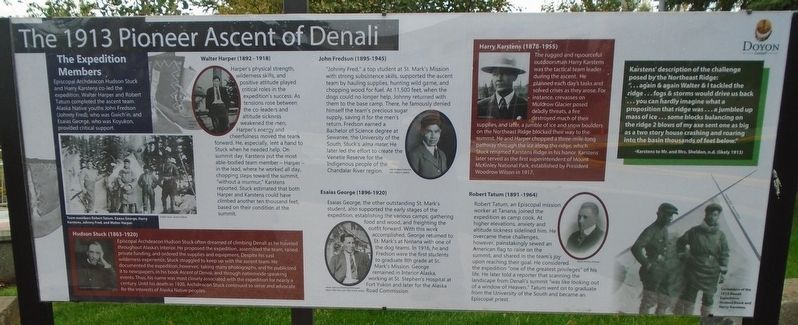
The Expedition Members
Episcopal Archdeacon Hudson Stuck and Harry Karstens co-led the expedition. Walter Harper and Robert Tatum completed the ascent team. Alaska Native youths John Fredson (Johnny Fred), who was Gwich'in, and Esaias George, who was Koyukon, provided critical support.
Walter Harper (1892-1918)
Harper's physical strength, wilderness skills, and positive attitude played critical roles in the expedition's success. As tensions rose between the co-leaders and altitude sickness weakened the men, Harper's energy and cheerfulness moved the team forward. He, especially, lent a hand to Stuck when he needed help. On summit day, Karstens put the most able-bodied team member - Harper - in the lead, where he worked all day, chopping steps toward the summit, "without a murmur," Karstens reported. Stack estimated that both Harper and Karstens could have climbed another ten thousand feet, based on their condition at the summit.
Hudson Shack (1863-1920)
Episcopal Archdeacon Hudson Stuck often dreamed of climbing Denali as he traveled throughout Alaska's Interior. He proposed the expedition, assembled the team,
this page online
John Fredson (1895-1945)
"Johnny Fred," a top student at St Mark's Mission with strong subsistence skills, supported the ascent team by hauling supplies, hunting wild game, and chopping wood for fuel. At 11,500 feet, when the dogs could no longer help, Johnny returned with them to the base camp. There he famously denied himself the team's precious sugar supply, saving it for the men's return. Fredson earned a Bachelor of Science degree at Sewanee, the University of the South, Stuck's alma mater. He later led the effort to create the Venetie Reserve for the Indigenous people of the Chandalar River region.
Esaias George (1896-1920)
Esaias
Photographed by William Fischer, Jr., August 17, 2024
2. The 1913 Pioneer Ascent of Denali Marker
Harry Karstens (1878-1955)
The rugged and resourceful outdoorsman Harry Karstens was the tactical team leader during the ascent. He planned each day's task and solved crises as they arose. For instance, crevasses on Muldrow Glacier posed deadly threats, a fire destroyed much of their supplies, and later, a jumble of ice and snow boulders on the Northeast Ridge blocked their way to the summit. He and Harper chopped a three-mile-long pathway through the ice along the ridge, which Stuck renamed Karstens Ridge in his honor. Karstens later served as the first superintendent of Mount McKinley National Park, established by President Woodrow Wilson in 1917.
Robert Tatum (1891-1964)
Robert Tatum, an Episcopal mission worker at Tanana, joined the expedition as camp cook. At higher elevations, anxiety and altitude sickness sidelined him. He overcame the challenges, however, painstakingly sewed an American flag to raise on the summit, and shared in the team's joy upon reaching their goal. He considered the expedition "one of the greatest privileges" of his life. He later told a reporter that scanning the landscape of Denali's summit "was like looking out of a window of Heaven." Tatum went on to graduate from the University of the South and became an Episcopal priest.
Karstens' description of the challenge posed by the Northeast Ridge: "...again & again Walter & I tackled the ridge...fogs & storms would drive us back...you can hardly imagine what a proposition that ridge was...a jumbled up mass of ice...some blocks balancing on the ridge 2 blows of my axe sent one as big as a two story house crashing and roaring into the basin thousands of feet below."
-Karstens to Mr. and Mrs. Sheldon, n.d. (likely 1913)
[Left center group photo caption reads]
Team members Robert Tatum, Esaias George, Harry Karstens, Johnny Fred, and Walter Harper.
[Bottom right photo caption reads]
Co-leaders of the 1913 Denali Expedition Hudson Stuck and Harry Karstens.
Erected 2022 by Doyon, Limited.
Topics. This historical marker is listed in these topic lists: Environment • Exploration • Indigenous Peoples and Communities. A significant historical year for this entry is 1913.
Location. 64° 50.73′ N, 147° 43.201′ W. Marker is in Fairbanks, Alaska, in Fairbanks North Star Borough. It is in Slaterville. It is on Doyon Place. Touch for map. Marker is at or near this postal address: 1 Doyon Place, Fairbanks AK 99701, United States of America. Touch for directions.

Regionally, this marker is in the Alaska Railroad Corridor, in the Athabascan Region, and in Interior Alaska. It is also on the American Pacific Coast. Globally, it is in North America, on the Pacific Rim, in the Western Hemisphere, in the Western World, and in the Anglosphere. Historically, it finds itself in what was once the Russian Empire.
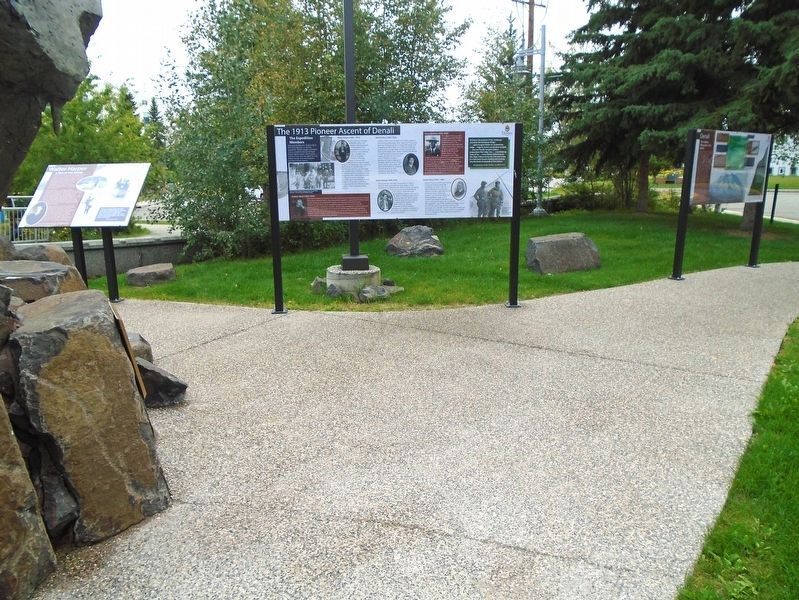
Other nearby markers. At least 8 other markers are within walking distance of this marker: Walter Harper (here, next to this marker); Denali (here, next to this marker); Sled Dogs (a few steps from this marker); The Artist (a few steps from this marker); Fairbanks Riverfront (about 300 feet away, measured in a direct line); 1967 Chena River Flood (about 300 feet away); Community Volunteers (about 300 feet away); Gordon and Doris Wear (about 300 feet away). Touch for a list and map of all markers in Fairbanks.
More about this marker. Marker is part of the Walter Harper Memorial Project.
Credits. This page was last revised on September 20, 2024. It was originally submitted on September 19, 2024, by William Fischer, Jr. of Reynoldsburg, Ohio. This page has been viewed 211 times since then and 25 times this year. Photos: 1, 2. submitted on September 19, 2024, by William Fischer, Jr. of Reynoldsburg, Ohio.
