Downtown in Fairbanks in Fairbanks North Star Borough, Alaska — Northwest (North America)
Fairbanks
Incorporated November 10, 1903
| — | Vignettes of History • Proud to be Alaskan | — |
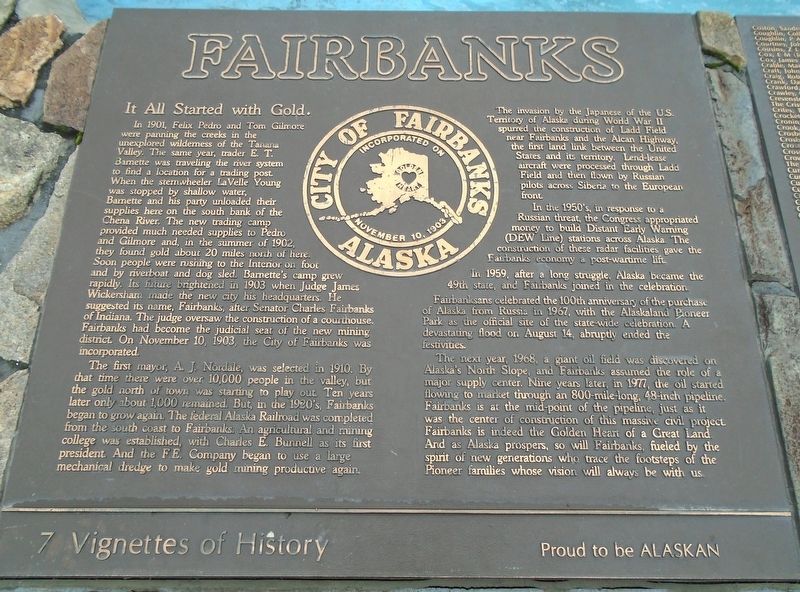
Photographed by William Fischer, Jr., August 17, 2024
1. Fairbanks Marker
It All Started with Gold
In 1901, Felix Pedro and Tom Gilmore were panning the creeks in the unexplored wilderness of the Tanana Valley. The same year, trader E. T. Barnette was traveling the river system to find a location for a trading post. When the sternwheeler LaVelle Young was stopped by shallow water, Barnette and his party unloaded their supplies here on the south bank of the Chena River. The new trading camp provided much needed supplies to Pedro and Gilmore and, in the summer of 1902, they found gold about 20 miles north of here. Soon people were rushing to the Interior on foot and by riverboat and dog sled. Barnette's camp grew rapidly. Its future brightened in 1903 when Judge James Wickersham made the new city his headquarters. He suggested its name, Fairbanks, after Senator Charles Fairbanks of Indiana. The judge oversaw the construction of a courthouse. Fairbanks had become the judicial seat of the new mining district. On November 10, 1903, the City of Fairbanks was incorporated.
The first mayor, A. J. Nordale, was selected in 1910. By that time there were over 10,000 people in the valley, but the gold
this page online
The invasion by the Japanese of the U.S. Territory of Alaska during World War II spurred the construction of Ladd Field near Fairbanks and the Alcan Highway, the first land link between the United States and its territory. Lend-lease aircraft were processed through Ladd Field and then flown by Russian pilots across Siberia to the European front.
In the 1950's, in response to a Russian threat, the Congress appropriated money to build Distant Early Warning (DEW Line) stations across Alaska. The construction of these radar facilities gave the Fairbanks economy a post-wartime lift.
In 1959, after a long struggle, Alaska became the 49th state, and Fairbanks joined in the celebration.
Fairbanksans celebrated the 100th anniversary of

Photographed by William Fischer, Jr., August 17, 2024
2. Fairbanks Marker
The next year, 1968, a giant oil field was discovered on Alaska's North Slope, and Fairbanks assumed the role of a major supply center. Nine years later, in 1977, the oil started flowing to market through an 800-mile-long, 48-inch pipeline. Fairbanks is at the mid-point of the pipeline, just as it was the center of construction of this massive civil project. Fairbanks is indeed the Golden Heart of a Great Land. And as Alaska prospers, so will Fairbanks, fueled by the spirit of new generations who trace the footsteps of the Pioneer families whose vision will always be with us.
Erected 1984 by Festival Fairbanks '84.
Topics. This historical marker is listed in these topic lists: Environment • Industry & Commerce • Settlements & Settlers • Waterways & Vessels. A significant historical date for this entry is November 10, 1903.
Location. 64° 50.657′ N, 147° 43.168′ W. Marker is in Fairbanks, Alaska, in Fairbanks North Star Borough. It is in Downtown. It is on 1st Avenue east of Cushman Street, on the left when traveling east. Marker is in Golden Heart Plaza, along the fountain wall. Touch for map. Marker is at or near this postal address: 516 1st Avenue, Fairbanks AK 99701, United States of America. Touch for directions.

Regionally, this marker is in the Alaska Railroad Corridor, in the Athabascan Region, and in Interior Alaska. It is also on the American Pacific Coast. Globally, it is in North America, on the Pacific Rim, in the Western Hemisphere, in the Western World, and in the Anglosphere. Historically, it finds itself in what was once the Russian Empire.
Other nearby markers. At least 8 other markers are within walking distance of this marker: Athabascan Circle (here, next to this marker); Fairbanks North Star Borough (here, next to this marker); Annus Mirabilis (here, next to this marker); Coal: Limitless Energy (here, next to this marker); Pioneers of Alaska Igloo No. 4 and Auxiliary No. 8 (here, next to this marker); University of Alaska—Fairbanks (a few steps from this marker); Dr. William Ranson Wood (a few steps from this marker); Alaska's Rich Mineral Resources (a few steps from this marker). Touch for a list and map of all markers in Fairbanks.
Also see . . . City of Fairbanks Local History. (Submitted on September 21, 2024, by William Fischer, Jr. of Reynoldsburg, Ohio.)
Credits. This page was last revised on December 7, 2025. It was originally submitted on September 21, 2024, by William Fischer, Jr. of Reynoldsburg, Ohio. This page has been viewed 248 times since then and 26 times this year. Photos: 1, 2. submitted on September 21, 2024, by William Fischer, Jr. of Reynoldsburg, Ohio.
