Charlevoix in Charlevoix County, Michigan — The American Midwest (Great Lakes)
History of Indigenous People in the Region
⎯⎯⎯
History of Indigenous People in the Area

Photographed by J. J. Prats, September 12, 2024
1. History of Indigenous People in the Region side of marker
Origins, ca. 12,000 Years Ago. Indigenous people have been in nearly continuous residence in this area for the last 12,000 years. Although these are various origin stories, it is commonly held that the Odawa and their close kin the Ojibwa and Potawatomi migrated here from the North Atlantic coast. They formed an alliance known as the Three Fires and called themselves the Anishnabek (The Real People).
Life on or near the Water. The Anishnabek have a deep connection to the environment and interact in harmonious balance with trees, plants, sky, earth and any living species. Of utmost importance is the relationship to water. Especially in the Great Lakes region, water plays a vital role in their culture, beliefs and economy, and as a food source. For this reason, villages were built near lakeshores or rivers. There was a large village above this site starting over 3,500 years ago. For the Odawa, as expert traders, having vast networks and knowledge of the waterways was a distinct advantage.
Moving with the Seasons and Stopping at Big Rock. The Anishnabek thrived for centuries fishing, hunting, trapping, gathering,
this page online
Impact of the Arrival of the Europeans (starting 1615). The first Europeans the Odawa encountered were the French in 1615, in Ontario. The course of history in the region was changed from that point on. Tribal populations would decline dramatically due to war loss of land and foreign diseases. The Odawa had to navigate many turbulent situations, for many generations, to remain on their native lands.
Many Wars Fought to Stay in the Region from 1650-1815. The Odawa were major players in wars, starting with the Iroquois in 1650, and with other tribes who challenged them for resources. They met colonists and settlers in the Great Lakes region, starting during the Revolutionary War era through the War of 1812. The Odawa fought to defend their lands and way of life, and after
Photographed by J. J. Prats, September 12, 2024
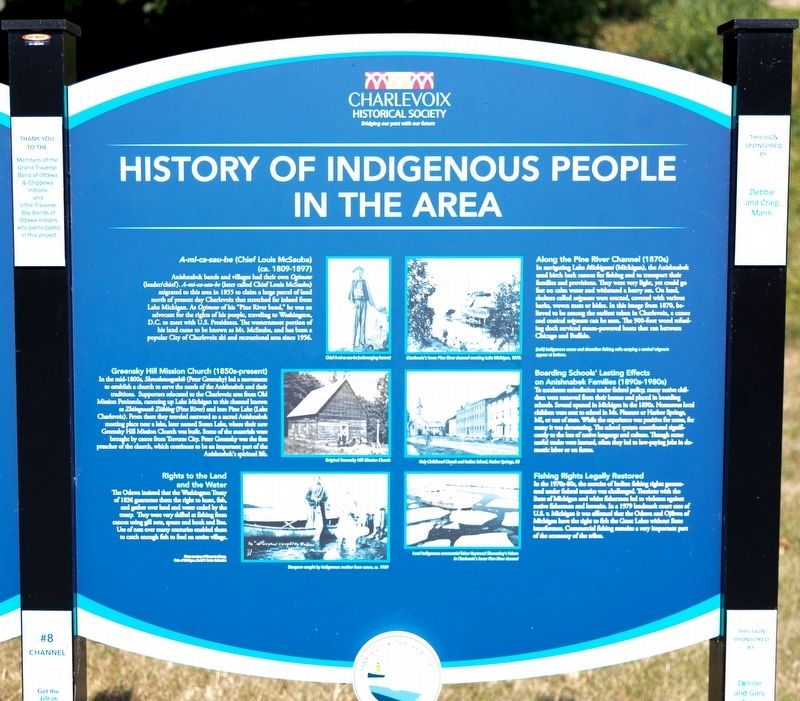
2. History of Indigenous People in the Area side of marker
The Treaty Era 1795-1855: Taking the Land. Anishnabek bands entered into several treaties with the United States between 1795-1855. The key issues were cession of lands, retaining rights to natural resources, creating reservations and compensation for lands ceded. The Washington Treaty of 1836 ceded 14 million acres to the U.S. The Odawa fought against forced removal and assimilation. With the Detroit Treaty of 1855, even though they were able to stay home, their lands were still being when through fraud, theft and corruption. Despite American settlement and becoming minorities in their own lands, the Anishnabek continue to live in their ancestral homeland throughout Northern Michigan.
(side two)
A-mi-ca-sau-be (Chief Louis McSauba), (ca. 1809-1897). Anisnabek bands and village had their own Ogimaw(leader/chief). A-mi-ca-sau-be (later called Chief Louis McSauba) migrated to this area in 1855 to claim a large parcel of land north of present-day Charlevoix that stretched far inland from Lake Michigan. As Ogimaw of his “Pine River band,” he was an advocate for the rights

Courtesy Michigan History Center
3. Michigan Treaty Map
Click on image to enlarge.
Greensky Hill Mission Church (1850s-present). In the mid-1900s, Showskawageshik (Peter Greensky) led a movement to establish a church to serve the needs of the Anishnabek and their traditions. Supporters relocated to the Charlevoix area from Old Mission Peninsula, canoeing up Lake Michigan to this channel known as Zhiingwaak Ziibiing (Pine River) and into Pine Lake (Lake Charlevoix). From there they traveled eastward to a sacred Anishnabek meeting place near the lake, later named Susan Lake, where their new Greensky Hill Mission Church was built. Some of the materials were brought by canoe from Traverse City. Peter Greensky was the first preacher of the church, which continues to be an important part of the Anishnabek’s spiritual life.
Rights to the Land and the Water. The Odawa insisted that the Washington Treaty of 1836 guarantee them the right to hunt, fish, and gather over the land and water ceded by

(Public Domain)
4. A-mi-ca-sau-be (Chief Louis McSauba)
Along the Pine River Channel (1870s). In navigating Lake Michigami (Michigan), the anishnabek used birch bark canoes for fishing and to transport their families and provisions. They were very light, yet could go fast on calm water and withstand a heavy sea. On land, shelters called wigwam were erected, covered with various barks, woven mats or hides. In this image from 1870, believed to be among the earliest taken in Charlevoix, a canoe and conical wigwam can be seen. The 900-foot wood refueling dock serviced steam-powered boats that ran between Chicago and Buffalo.
Boarding Schools’ Lasting Effects on Anishnabek Families (1890s-1980s). To accelerate assimilation under federal policy, many native children were removed from their homes and placed in boarding schools. Several opened in Michigan in the 1890s. Numerous local children were sent to school in Mt. Pleasant or Harbor Springs, or out of state. While the experience was positive

Photographed by J. J. Prats, September 12, 2024
5. The Two Faces of Marker No. 8
Fishing Rights Legally Restored. In the 1970-80s, the exercise of Indian fishing rights guaranteed under federal treaties was challenged. Tensions with the State of Michigan and white fishermen led to violence against native fishermen and lawsuits. In an 1979 landmark court case of U.S. v. Michigan it was affirmed that the Odawa and Ojibwa of Michigan have the right to fish the Great Lakes without State interference. Commercial fishing remains a very important part of the economy of the tribes.
Erected by Charlevoix Historical Society. This sign was sponsored by the Charlevoix Public Library and by Denise and Gary Fate. (Marker Number 8.)
Topics. This historical marker is listed in these topic lists: Anthropology & Archaeology • Indigenous Peoples and Communities • Religion & Religious Structures • Settlements & Settlers. A significant historical year for this entry is 1615.
Location. 45° 19.151′ N, 85° 15.586′ W.

1846 oil by Paul Kane. Gift of the Thomas Gilcrease Foundation, 1964
6. “Sault Saint Marie”
This is the painting depicted on the first side of the marker.

Regionally, this marker is in Northern Michigan Lower Peninsula, in the Grand Traverse Bay Region, and in one of the Lake Michigan Shore counties. It is also in the American Midwest. Globally, it is in North America, on the Great Lakes, in the Western Hemisphere, in the Western World, and in the Anglosphere. Historically, it finds itself in what was once the Northwest Territory.
Other nearby markers. At least 8 other markers are within walking distance of this marker: The Lower Channel / Bridges, Boats, and the Weathervane Inn (within shouting distance of this marker); The Last Swing Bridge (within shouting distance of this marker); 103 Main Street (now Park Avenue) (about 300 feet away, measured in a direct line); Robert Bridge Memorial Park

Photographed by J. J. Prats, September 12, 2024
7. History of Indigenous People Marker
The architecturally unique Mushroom-House style Weathervane Restaurant is in the background. as is the Bridge Street drawbridge.
Also see . . . Greensky Hill Mission. Historical marker at the location where Peter Greensky established his mission. (Submitted on September 22, 2024.)
Credits. This page was last revised on July 9, 2025. It was originally submitted on September 22, 2024, by J. J. Prats of Powell, Ohio. This page has been viewed 677 times since then and 127 times this year. Photos: 1, 2, 3, 4, 5, 6, 7. submitted on September 22, 2024, by J. J. Prats of Powell, Ohio.
