Manteo in Dare County, North Carolina — The American South (South Atlantic)
Richard Etheridge, 1842-1900
“In Behalf of Humanity”
Photographed by Brandon D Cross, September 14, 2024
1. Richard Etheridge, 1842-1900 Marker
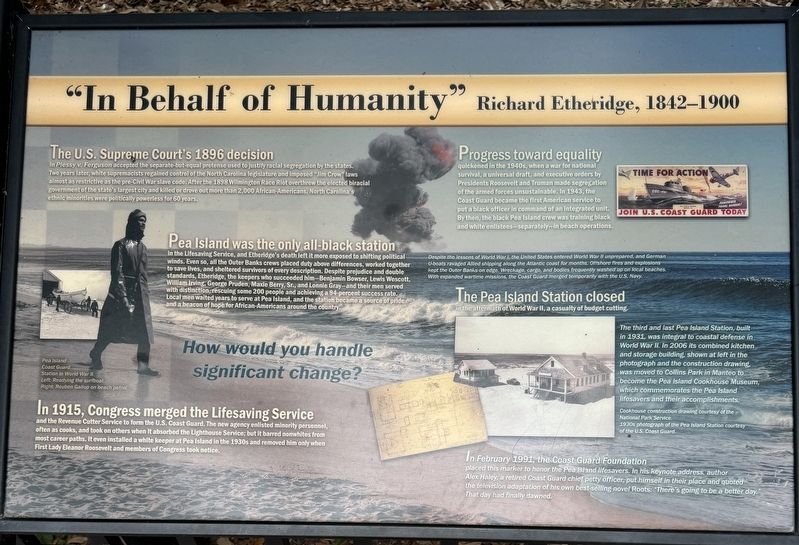
The U.S. Supreme Court's 1896 decision in Plessy v. Ferguson accepted the separate-but equal pretense used to justify racial segregation by the states. Two years later, white supremacists regained control of the North Carolina legislature and imposed "Jim Crow" laws almost as restrictive as the pre-Civil War slave code. After the 1898 Wilmington Race Riot overthrew the elected biracial government of the state's largest city and killed or drove out more than 2,000 African-Americans, North Carolina's ethnic minorities were politically powerless for 60 years.
Pea Island was the only all-black station in the Lifesaving Service, and Etheridge's death left it more exposed to shifting political winds. Even so, all the Outer Banks crews placed duty above differences, worked together to save lives, and sheltered survivors of every description. Despite prejudice and double standards, Etheridge, the keepers who succeeded him—Benjamin Bowser, Lewis Wescott, William Irving, George Pruden, Maxie Berry, Sr., and Lonnie Gray—and their men served with distinction, rescuing some 200 people and achieving a 94-percent success rate. Local
this page online
How would you handle significant change?
In 1915, Congress merged the Lifesaving Service and the Revenue Cutter Service to form the U.S. Coast Guard. The new agency enlisted minority personnel, often as cooks, and took on others when it absorbed the Lighthouse Service; but it barred nonwhites from most career paths. It even installed a white keeper at Pea Island in the 1930s and removed him only when First Lady Eleanor Roosevelt and members of Congress took notice.
Progress toward equality quickened in the 1940s, when a war for national survival, a universal draft, and executive orders by Presidents Roosevelt and Truman made segregation of the armed forces unsustainable. In 1943, the Coast Guard became the first American service to put a black officer in command of an integrated unit. By then, the black Pea Island crew was training black and white enlistees—separately—in beach operations.
Despite the lessons of World War I, the United States entered World War II unprepared, and German U-boats ravaged Allied shipping along the Atlantic coast for months. Offshore fires and explosions kept the Outer Banks on edge. Wreckage, cargo, and bodies frequently washed up on local beaches. With expanded wartime missions, the Coast Guard merged temporarily with the U.S. Navy.
The Pea Island Station closed

Photographed by Brandon D Cross
2. Richard Etheridge, 1842-1900 Marker
The third and last Pea Island Station, built in 1931, was integral to coastal defense in World War II. In 2006 its combined kitchen and storage building, shown at left in the photograph and the construction drawing, was moved to Collins Park in Manteo to become the Pea Island Cookhouse Museum, which commemorates the Pea Island lifesavers and their accomplishments.
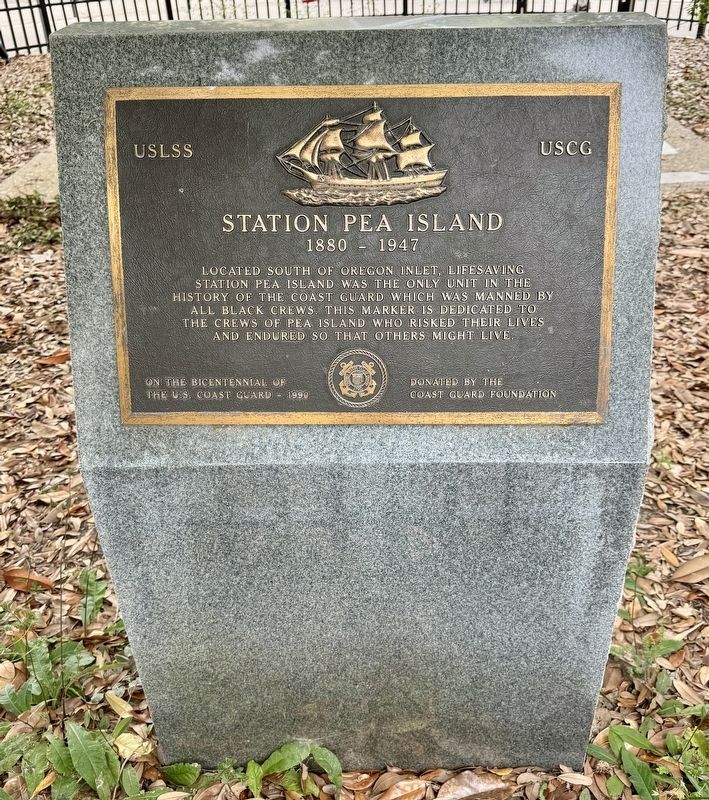
In February 1991, the Coast Guard Foundation placed this marker to honor the Pea Island lifesavers. In his keynote address, author Alex Haley, a retired Coast Guard chief petty officer, put himself in their place and quoted the television adaptation of his own best-selling novel Roots: "There's going to be a better day." That day had finally dawned.
(captions)
Pea Island Coast Guard Station in World War II.
Left: Readying the surfboat.
Right: Reuben Gallop on beach patrol.
Cookhouse construction drawing courtesy of the National Park Service.
1930s photograph of the Pea Island Station courtesy of the U.S. Coast Guard.
Topics. This historical marker is listed in these topic lists: African Americans
Photographed by Brandon D Cross
3. Pea Island Marker
Location. 35° 55.084′ N, 75° 42.245′ W. Marker is in Manteo, North Carolina, in Dare County. It is on Airport Road 0.1 miles east of Old County Road, on the right when traveling east. The marker is located near the entrance to North Carolina Aquariums within the Etheridge Family Cemetery. Touch for map. Marker is at or near this postal address: 374 Airport Rd, Manteo NC 27954, United States of America. Touch for directions.

Regionally, this marker is in the Coastal Plain and on the Outer Banks. It is also in the American South, specifically in the Upper South, in the Tidewater, and on the Eastern Seaboard. Globally, it is in the North Atlantic Region, North America, the Western Hemisphere, the Western World, and the Anglosphere. Historically, it finds itself in what was once the territory of the Mississippian Culture, one of the original Thirteen Colonies, one of the Confederate States of America, and the Antebellum South.
Other nearby markers. At least 8 other markers are within walking distance of this marker: A different marker also named Richard Etheridge, 1842-1900 (here, next to this marker); a different marker also named Richard Etheridge, 1842-1900 (here, next to this marker); a different marker also named Richard Etheridge, 1842-1900 (here, next to this marker); Give These Men a Medal! (within shouting distance of this marker); A Moveable Feast (within shouting distance of this marker); A Big Deal (about 300 feet away, measured in a direct line); The Lower Lights (about 300 feet away); A Show Boat (about 400 feet away). Touch for a list and map of all markers in Manteo.
Also see . . .
1. Richard Etheridge. Cape Hatteras National Seashore, National Park Service (Submitted on September 23, 2024, by Brandon D Cross of Flagler Beach, Florida.)
2. Captain Richard Etheridge, Keeper, USLSS. United States Coast Guard (Submitted on September 24, 2024.)
3. North Carolina Aquarium on Roanoke Island/Richard Etheridge Family Cemetery. (Submitted on September 24, 2024.)
Credits. This page was last revised on September 24, 2024. It was originally submitted on September 23, 2024, by Brandon D Cross of Flagler Beach, Florida. This page has been viewed 228 times since then and 22 times this year. Photos: 1, 2. submitted on September 23, 2024, by Brandon D Cross of Flagler Beach, Florida. 3. submitted on September 24, 2024, by Brandon D Cross of Flagler Beach, Florida. • Bernard Fisher was the editor who published this page.
