Pike's Landing in College in Fairbanks North Star Borough, Alaska — Northwest (North America)
Reindeer & Caribou
Photographed by William Fischer, Jr., August 18, 2024
1. Reindeer & Caribou Marker
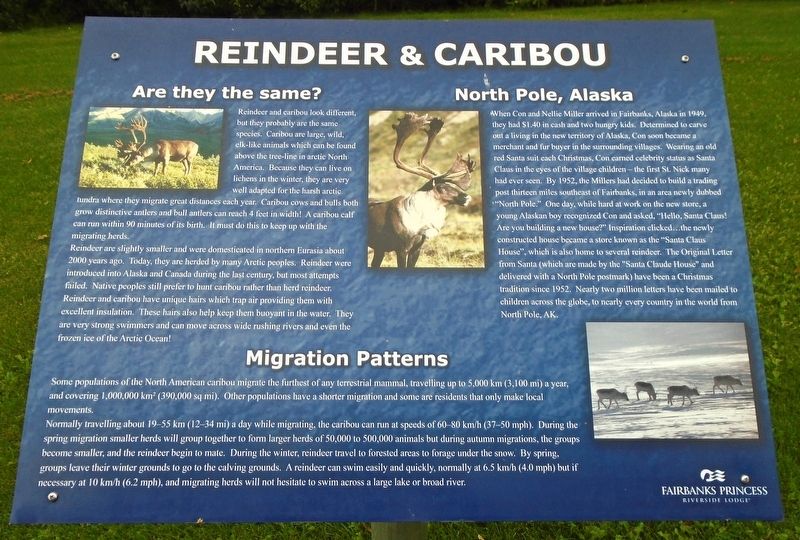
Reindeer and caribou look different, but they probably are the same species. Caribou are large, wild. elk-like animals which can be found above the tree-line in arctic North America. Because they can live on lichens in the winter, they are very well adapted for the harsh arctic tundra where they migrate great distances each year. Caribou cows and bulls both grow distinctive antlers and bull antlers can reach 4 feet in width! A caribou calf can run within 90 minutes of its birth. It must do this to keep up with the migrating herds.
Reindeer are slightly smaller and were domesticated in northern Eurasia about 2000 years ago. Today, they are herded by many Arctic peoples. Reindeer were introduced into Alaska and Canada during the last century, but most attempts failed. Native peoples still prefer to hunt caribou rather than herd reindeer. Reindeer and caribou have unique hairs which trap air providing them with excellent insulation. These hairs also help keep them buoyant in the water. They are very strong swimmers and can move across wide rushing rivers and even the frozen ice of the Arctic Ocean!
Some
this page online
Normally travelling about 19-55 km (12-34 mi) a day while migrating, the caribou can run at speeds of 60-80 km/h (37-50 mph). During the spring migration smaller herds will group together to form larger herds of 50,000 to 500,000 animals but during autumn migrations, the groups become smaller, and the reindeer begin to mate. During the winter, reindeer travel to forested areas to forage under the snow. By spring, groups leave their winter grounds to go to the calving grounds. A reindeer can swim easily and quickly, normally at 6.5 km/h (4.0 mph) but if necessary at 10 km/h (6.2 mph), and migrating herds will not hesitate to swim across a large lake or broad river.
When Con and Nellie Miller arrived in Fairbanks, Alaska in 1949, they had $1.40 in cash and two hungry kids. Determined to carve out a living in the new territory of Alaska, Con
Photographed by William Fischer, Jr., August 18, 2024
2. Reindeer & Caribou Marker
Erected by Fairbanks Princess Riverside Lodge.
Topics. This historical marker is listed in these topic lists: Animals • Environment • Indigenous Peoples and Communities • Settlements & Settlers. A significant historical year for this entry is 2000.
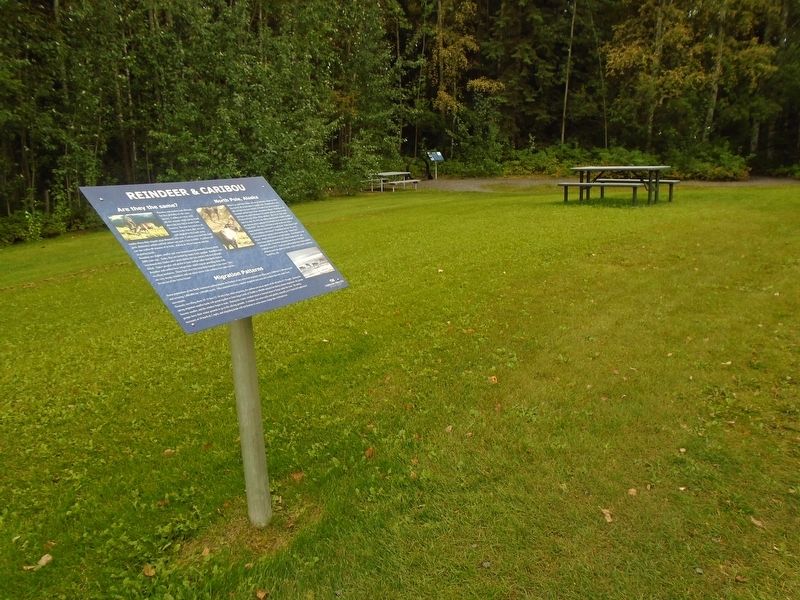
Location. 64° 50.025′ N, 147° 50.746′ W. Marker is in College, Alaska, in Fairbanks North Star Borough. It is in Pike's Landing. It can be reached from Pikes Landing Road. Marker is along the walking trail on the Fairbanks Princess Riverside Lodge grounds. Touch for map. Marker is at or near this postal address: 4477 Pikes Landing Road, Fairbanks AK 99709, United States of America. Touch for directions.

Regionally, this marker is in the Alaska Railroad Corridor, in the Athabascan Region, and in Interior Alaska. It is also on the American Pacific Coast. Globally, it is in North America, on the Pacific Rim, in the Western Hemisphere, in the Western World, and in the Anglosphere. Historically, it finds itself in what was once the Russian Empire.
Other nearby markers. At least 8 other markers are within walking distance of this marker: Pipeline (a few steps from this marker); Bear Cache & Alaskan Cabins (within shouting distance of this marker); Alaska vs the "Lower 48" (within shouting distance of this marker); Welcome to Fairbanks (about 300 feet away, measured in a direct line); Historic Fairbanks (about 300 feet away); Sluice Box (about 400 feet away); Felix, Joy, & Dandy Pedro (about 500 feet away); William Salmon & August Conradt (about 500 feet away). Touch for a list and map of all markers in College.
Also see . . . Santa Claus House, North Pole, Alaska. (Submitted on September 24, 2024, by William Fischer, Jr. of Reynoldsburg, Ohio.)
Credits. This page was last revised on January 3, 2025. It was originally submitted on September 24, 2024, by William Fischer, Jr. of Reynoldsburg, Ohio. This page has been viewed 187 times since then and 24 times this year. Photos: 1, 2. submitted on September 24, 2024, by William Fischer, Jr. of Reynoldsburg, Ohio.
