Downtown West in Minneapolis in Hennepin County, Minnesota — The American Midwest (Upper Plains)
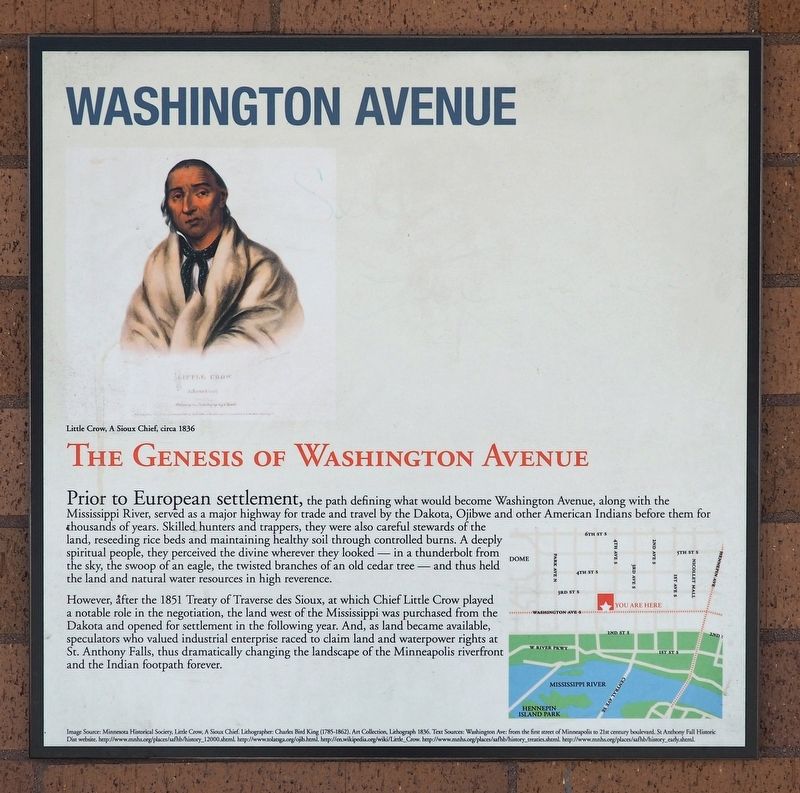
The Genesis of Washington Avenue
| — | Washington Avenue | — |
Photographed by McGhiever, May 12, 2024
1. The Genesis of Washington Avenue Marker
[Caption:] Little Crow, A Sioux Chief, circa 1836
Prior to European settlement, the path defining what would become Washington Avenue, along with the Mississippi River, served as a major highway for trade and travel by the Dakota, Ojibwe and other American Indians before them for thousands of years. Skilled hunters and trappers, they were also careful stewards of the land, reseeding rice beds and maintaining healthy soil through controlled burns. A deeply spiritual people, they perceived the divine wherever they looked — in a thunderbolt from the sky, the swoop of an eagle, the twisted branches of an old cedar tree — and thus held the land and natural water resources in high reverence.
However, after the 1851 Treaty of Traverse des Sioux, at which Chief Little Crow played a notable role in the negotiation, the land west of the Mississippi was purchased from the Dakota and opened for settlement in the following year. And, as land became available, speculators who valued industrial enterprise raced to claim land and waterpower rights at St. Anthony Falls, thus dramatically changing the landscape of the Minneapolis
this page online
Image Source: Minnesota Historical Society, Little Crow, A Sioux Chief. Lithographer: Charles Bird King (1785-1862). Art Collection, Lithograph 1836. Text Sources: Washington Ave: from the first street of Minneapolis to 21st century boulevard. St. Anthony Fall Historic Dist website. http://www.mnhs.org/places/safhb/history_12000.shtml. http://www.tolatsga.org/ojib.html. http://en.wikipedia.org/wiki/Little_Crow. http://www.mnhs.org/places/safhb/history_treaties.shtml. http:www.mnhs.org/places/safhb/history_early.shtml.
Topics. This historical marker is listed in these topic lists: Indigenous Peoples and Communities • Industry & Commerce • Religion & Religious Structures • Roads & Vehicles.
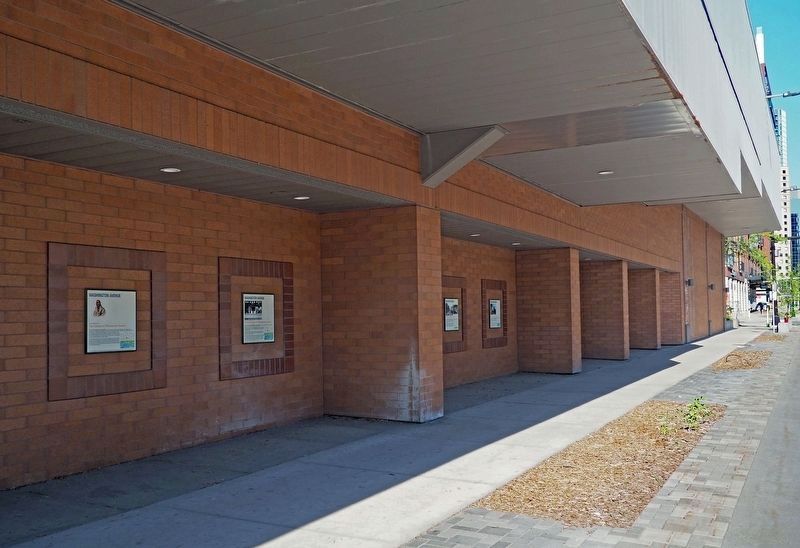
Location. 44° 58.741′ N, 93° 15.727′ W. Marker is in Minneapolis, Minnesota, in Hennepin County. It is in Downtown West. It is on Washington Avenue S. east of 4th Avenue S., on the right when traveling east. The marker is in an alcove on the north side of the Gateway Parking Ramp. Touch for map. Marker is at or near this postal address:
Photographed by McGhiever, May 12, 2024
2. Marker (second from left) on the north side of the Gateway Parking Ramp

Regionally, this marker is in the Twin Cities Metropolitan Area. It is also in the American Midwest, in the Corn Belt, and in the Great River Road Region. Globally, it is in North America, the Western Hemisphere, the Western World, and the Anglosphere. Historically, it finds itself in what was once Rupert’s Land, the territory of the Mississippian Culture, and the Louisiana Purchase.
Other nearby markers. At least 8 other markers are within walking distance of this marker: Industry's Impact on Washington Avenue (here, next to this marker); Transportation on Washington Avenue (here, next to this marker); The Decline of Washington Avenue (here, next to this marker); The Resurrection of Washington Avenue (a few steps from this marker); Changing Times (about 500 feet away, measured in a direct line); Welcome to the Rail Maze (about 500 feet away); Trains Can't Swim (about 700 feet away); Cataract House / 607 Washington (about 700 feet away). Touch for a list and map of all markers in Minneapolis.
Credits. This page was last revised on September 24, 2024. It was originally submitted on September 24, 2024, by McGhiever of Minneapolis, Minnesota. This page has been viewed 118 times since then and 10 times this year. Photos: 1. submitted on September 24, 2024, by McGhiever of Minneapolis, Minnesota. 2. submitted on September 23, 2024, by McGhiever of Minneapolis, Minnesota.
