
Chena Native Village in Chena Ridge in Fairbanks North Star Borough, Alaska — Northwest (North America)
The Heyday of Snowmobiling
Early 1970's
Photographed by William Fischer, Jr., August 19, 2024
1. The Heyday of Snowmobiling Marker
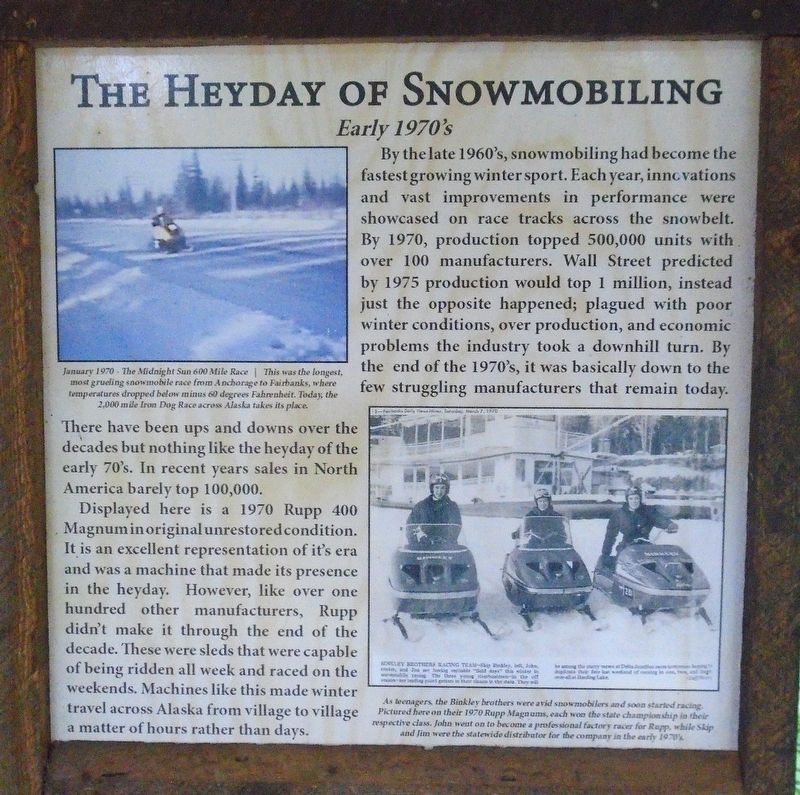
By the late 1960's, snowmobiling had become the fastest growing winter sport. Each year, innovations and vast improvements in performance were showcased on race tracks across the snowbelt. By 1970, production topped 500,000 units with over 100 manufacturers. Wall Street predicted by 1975 production would top 1 million, instead just the opposite happened; plagued with poor winter conditions, over production, and economic problems the industry took a downhill turn. By the end of the 1970's, it was basically down to the few struggling manufacturers that remain today.
There have been ups and downs over the decades but nothing like the heyday of the early 70's. In recent years sales in North America barely top 100,000.
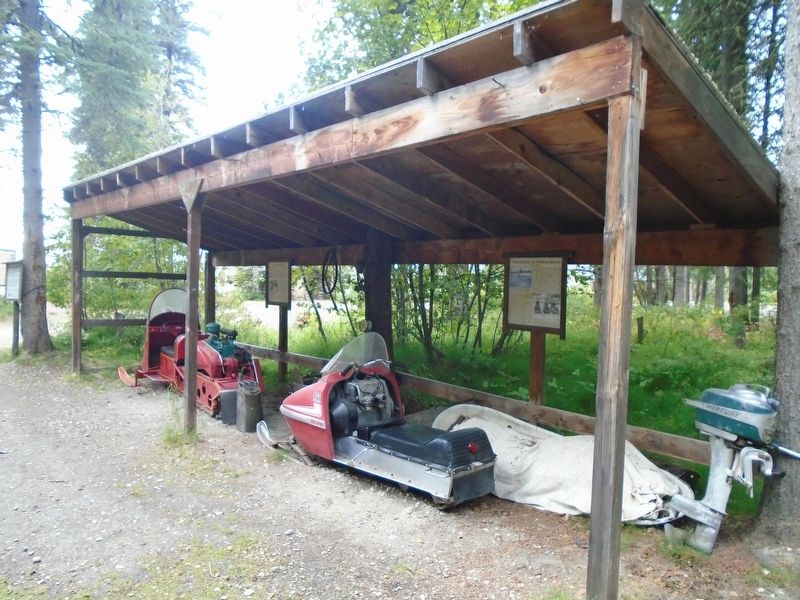
Displayed here is a 1970 Rupp 400 Magnum in original unrestored condition. It is an excellent representation of it's era and was a machine that made its presence in the heyday. However, like over one hundred other manufacturers, Rupp didn't make it through the end of the decade. These were sleds that were capable of being ridden all week and raced on the weekends. Machines like this made winter travel across
this page online
[Top photo caption reads]
January 1970 — The Midnight Sun 600 Mile Race | This was the longest, most grueling snowmobile race from Anchorage to Fairbanks, where temperatures dropped below minus 60 degrees Fahrenheit. Today, the 2,000 mile Iron Dog Race across Alaska takes its place.
[Bottom photo caption reads]
As teenagers, the Binkley brothers were avid snowmobilers and soon started racing. Pictured here on their 1970 Rupp Magnums, each won the state championship in their respective class. John went on to become a professional factory racer for Rupp, while Skip and Jim were the statewide distributor for the company in the early 1970's.
Erected by Riverboat Discovery.
Topics. This historical marker is listed in these topic lists: Environment • Roads & Vehicles • Settlements & Settlers • Sports. A significant historical month for this entry is January 1970.
Location. 64° 48′ N, 147° 55.018′ W. Marker is in Chena Ridge, Alaska, in Fairbanks North Star Borough. It is in Chena Native Village. It can be reached from Tall Spruce Road. Touch for map. Marker
Photographed by William Fischer, Jr., August 19, 2024
2. The Heyday of Snowmobiling Marker

Regionally, this marker is in the Alaska Railroad Corridor, in the Athabascan Region, and in Interior Alaska. It is also on the American Pacific Coast. Globally, it is in North America, the Pacific Rim, the Western Hemisphere, the Western World, and the Anglosphere. Historically, it finds itself in what was once the Russian Empire.
Other nearby markers. At least 8 other markers are within walking distance of this marker: The Iron Dog (here, next to this marker); Early Alaskan Riverboats (here, next to this marker); Chief John Silas' Cabin (within shouting distance of this marker); Trapper's Log Cabin (within shouting distance of this marker); Piper Super Cub (within shouting distance of this marker); Sod Roof Construction (within shouting distance of this marker); Trapper's Line Cabin (within shouting distance of this marker); Locked to the End (within shouting distance of this marker). Touch for a list and map of all markers in Chena Ridge.
More about this marker. Although a modern construction, the Chena Native Village is a living history open air museum highlighting historic Athabascan culture, and is reached by Riverboat Discovery tours.
Credits. This page was last revised on September 25, 2024. It was originally submitted on September 25, 2024, by William Fischer, Jr. of Reynoldsburg, Ohio. This page has been viewed 397 times since then and 78 times this year. Photos: 1, 2. submitted on September 25, 2024, by William Fischer, Jr. of Reynoldsburg, Ohio.
