Chena Native Village in Chena Ridge in Fairbanks North Star Borough, Alaska — Northwest (North America)
Steamboat Wood
Early Steamboats Relied on Wood for Fuel
Photographed by William Fischer, Jr., August 19, 2024
1. Steamboat Wood Marker
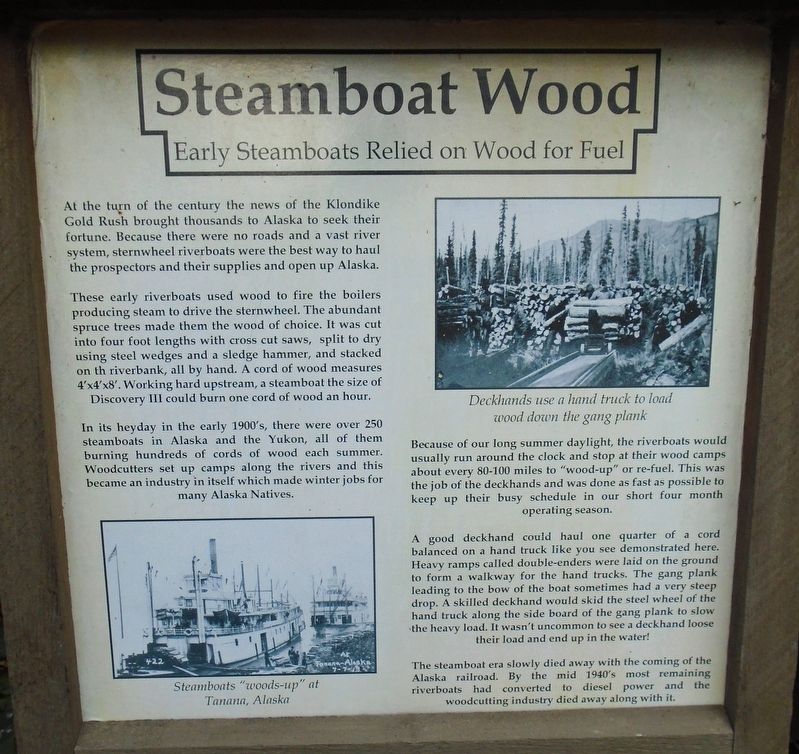
At the turn of the century the news of the Klondike Gold Rush brought thousands to Alaska to seek their fortune. Because there were no roads and a vast river system, sternwheel riverboats were the best way to haul the prospectors and their supplies and open up Alaska.
These early riverboats used wood to fire the boilers producing steam to drive the sternwheel. The abundant spruce trees made them the wood of choice. It was cut into four foot lengths with cross cut saws, split to dry using steel wedges and a sledge hammer, and stacked on th[e] riverbank, all by hand. A cord of wood measures 4'x4'x8'. Working hard upstream, a steamboat the size of Discovery III could burn one cord of wood an hour.
In its heyday in the early 1900's, there were over 250 steamboats in Alaska and the Yukon, all of them burning hundreds of cords of wood each summer. Woodcutters set up camps along the rivers and this became an industry in itself which made winter jobs for many Alaska Natives.
Because of our long summer daylight, the riverboats would usually run around the clock and stop at their wood camps about every 80-100 miles to "wood-up"
this page online
A good deckhand could haul one quarter of a cord balanced on a hand truck like you see demonstrated here [see top right photo]. Heavy ramps called double-enders were laid on the ground to form a walkway for the hand trucks. The gang plank leading to the bow of the boat sometimes had a very steep drop. A skilled deckhand would skid the steel wheel of the hand truck along the side board of the gang plank to slow the heavy load. It wasn't uncommon to see a deckhand loose their load and end up in the water!
The steamboat era slowly died away with the coming of the Alaska railroad. By the mid 1940's most remaining riverboats had converted to diesel power and the woodcutting industry died away along with it.
[Top right photo caption reads]
Deckhands use a hand truck to load wood down the gang plank
[Bottom left photo caption reads]
Steamboats "woods-up" at Tanana, Alaska
Erected by Riverboat Discovery.
Topics. This historical marker is listed in these topic lists: Environment
Photographed by William Fischer, Jr., August 19, 2024
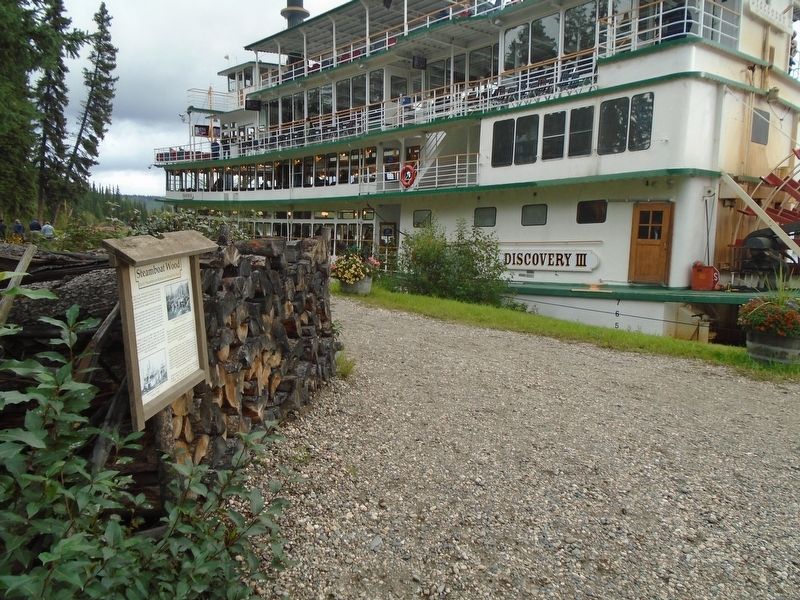
2. Steamboat Wood Marker and Discovery III
Location. 64° 48.026′ N, 147° 54.847′ W. Marker is in Chena Ridge, Alaska, in Fairbanks North Star Borough. It is in Chena Native Village. It can be reached from Tall Spruce Road. Touch for map. Marker is at or near this postal address: 2633 Tall Spruce Rd, Fairbanks AK 99709, United States of America. Touch for directions.

Regionally, this marker is in the Alaska Railroad Corridor, in the Athabascan Region, and in Interior Alaska. It is also on the American Pacific Coast. Globally, it is in North America, the Pacific Rim, the Western Hemisphere, the Western World, and the Anglosphere. Historically, it finds itself in what was once the Russian Empire.
Other nearby markers. At least 8 other markers are within walking distance of this marker: Smokehouse (a few steps from this marker); Fish Camp (a few steps from this marker); Post Office (a few steps from this marker); Pieper Super Cub (within shouting distance of this marker); Caribou and Reindeer (within shouting distance of this marker); Susan Butcher: A Lifetime of Inspiration (within shouting
Photographed by William Fischer, Jr., August 19, 2024
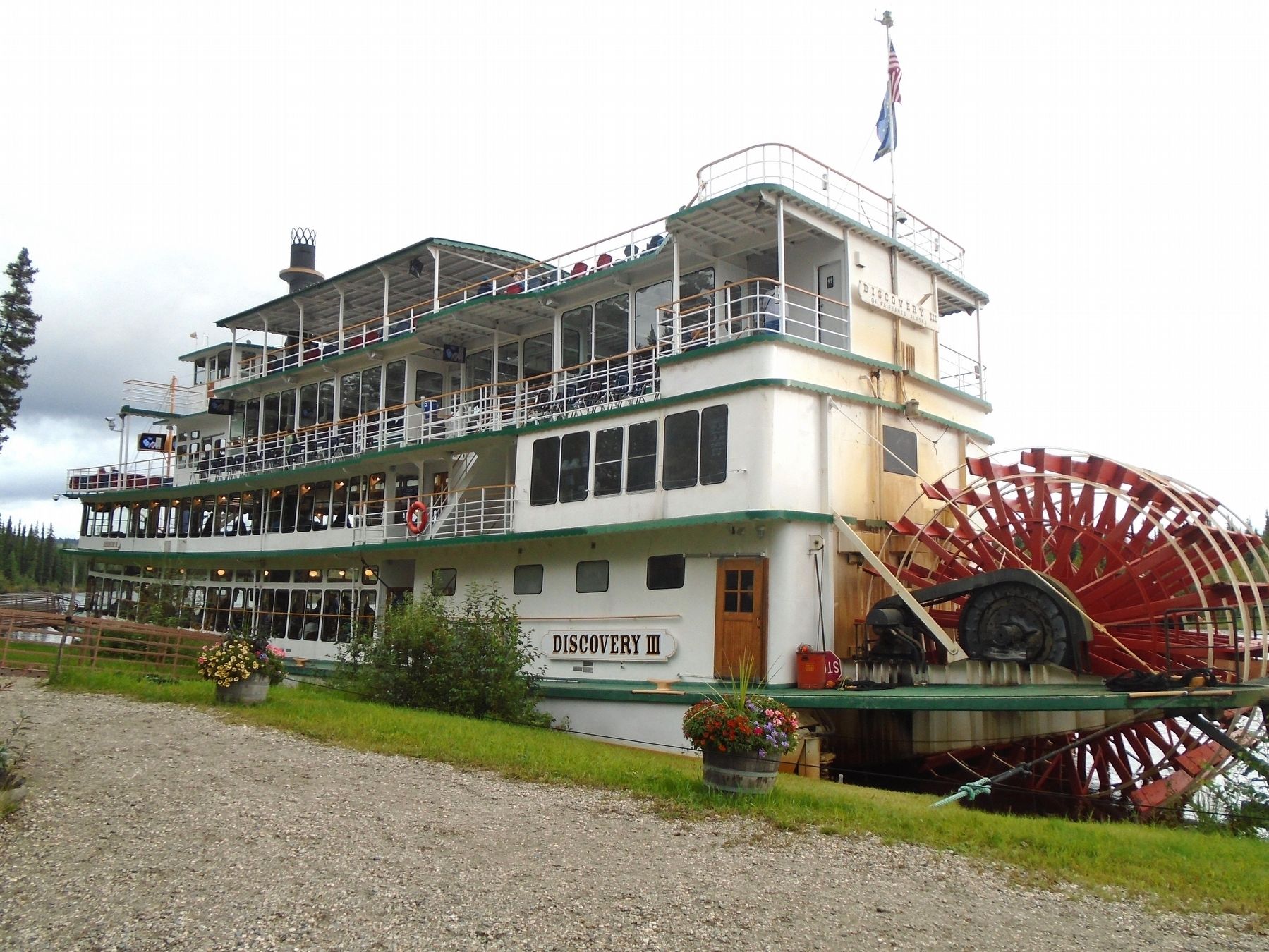
3. Discovery III
More about this marker. Although a modern construction, the Chena Native Village is a living history open air museum highlighting historic Athabascan culture, and is reached by Riverboat Discovery tours.
Credits. This page was last revised on September 26, 2024. It was originally submitted on September 26, 2024, by William Fischer, Jr. of Reynoldsburg, Ohio. This page has been viewed 294 times since then and 66 times this year. Photos: 1, 2, 3. submitted on September 26, 2024, by William Fischer, Jr. of Reynoldsburg, Ohio.
