
Chena Native Village in Chena Ridge in Fairbanks North Star Borough, Alaska — Northwest (North America)
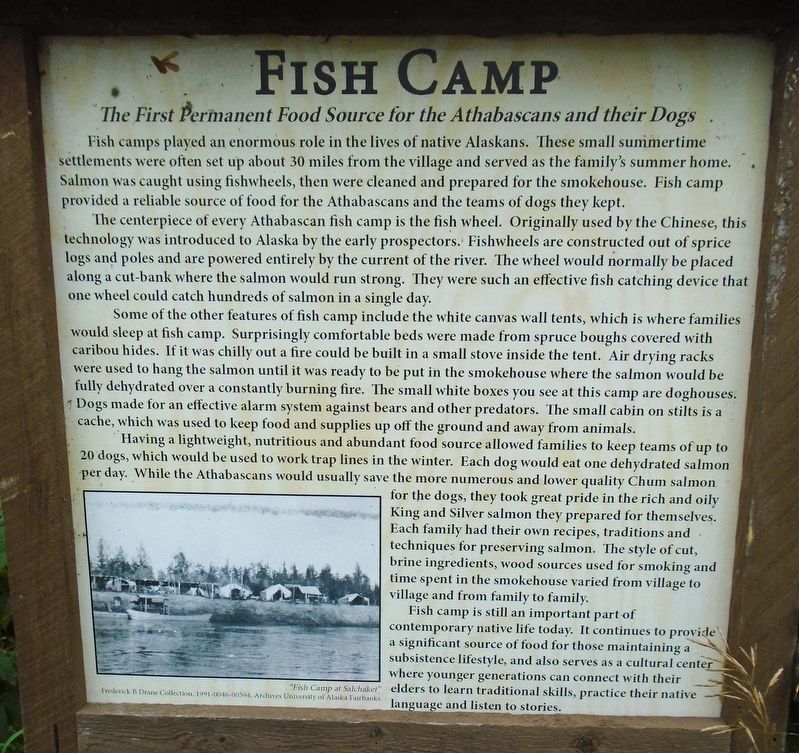
Fish Camp
The First Permanent Food Source for the Athabascans and their Dogs
Photographed by William Fischer, Jr., August 19, 2024
1. Fish Camp Marker
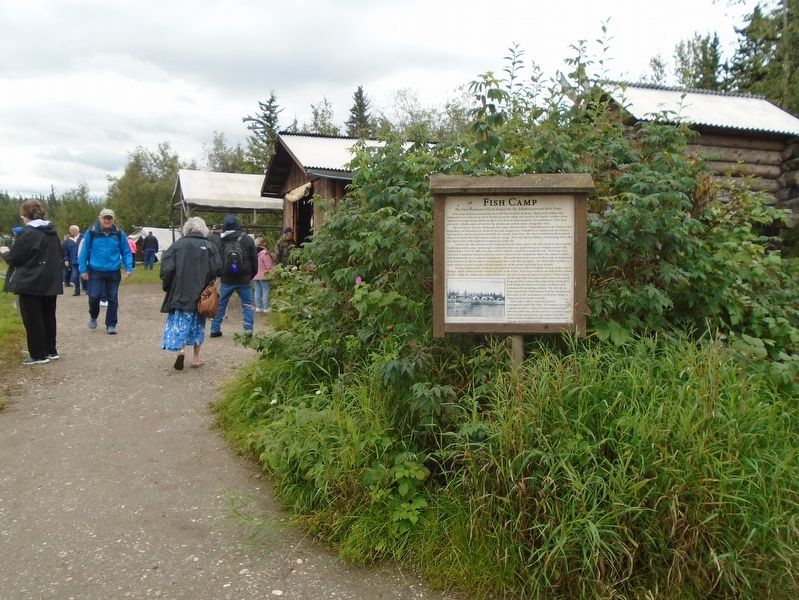
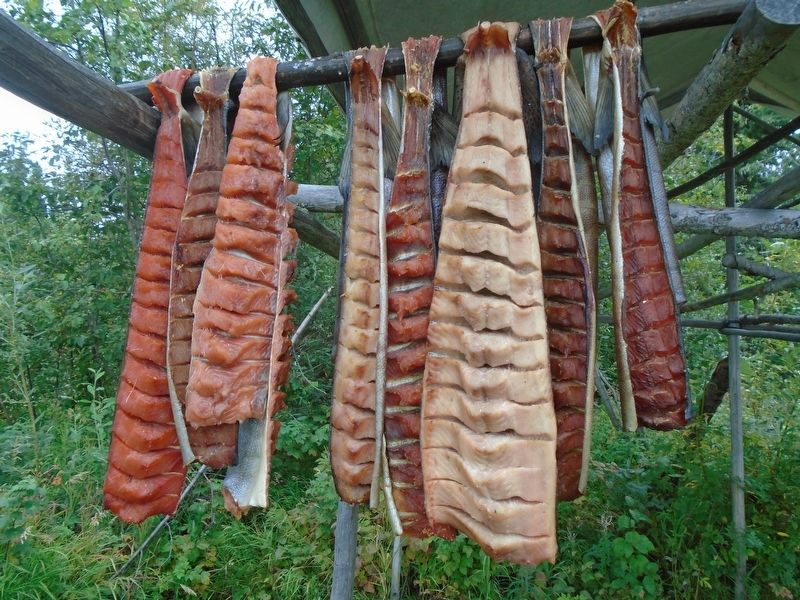
Fish camps played an enormous role in the lives of native Alaskans. These small summertime settlements were often set up about 30 miles from the village and served as the family's summer home. Salmon was caught using fishwheels, then were cleaned and prepared for the smokehouse. Fish camp provided a reliable source of food for the Athabascans and the teams of dogs they kept.
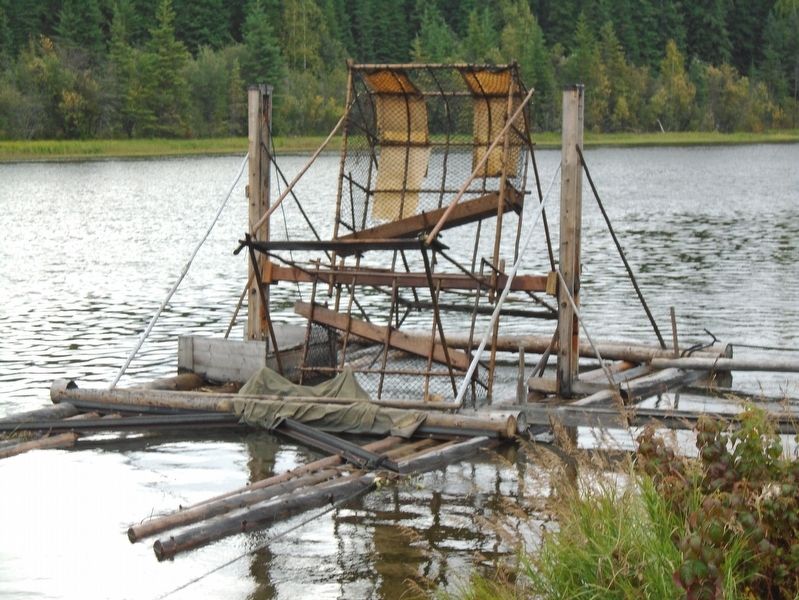
The centerpiece of every Athabascan fish camp is the fish wheel. Originally used by the Chinese, this technology was introduced to Alaska by the early prospectors. Fishwheels are constructed out of spr[u]ce logs and poles and are powered entirely by the current of the river. The wheel would normally be placed along a cut-bank where the salmon would run strong. They were such an effective fish catching device that one wheel could catch hundreds of salmon in a single day.
Some of the other features of fish camp include the white canvas wall tents, which is where families would sleep at fish camp. Surprisingly comfortable beds were made from spruce boughs covered with caribou hides. If it was chilly out a fire could be built in a small stove inside
this page online
Having a lightweight, nutritious and abundant food source allowed families to keep teams of up to 20 dogs, which would be used to work trap lines in the winter. Each dog would eat one dehydrated salmon per day. While the Athabascans would usually save the more numerous and lower quality Chum salmon for the dogs, they took great pride in the rich and oily King and Silver salmon they prepared for themselves. Each family had their own recipes, traditions and techniques for preserving salmon. The style of cut, brine ingredients, wood sources used for smoking and time spent in the smokehouse varied from village to village and from family to family.
Fish camp is still an important part of contemporary native life
Photographed by William Fischer, Jr., August 19, 2024
2. Fish Camp Marker
[Photo caption reads] "Fish Camp at Salchaket"
Erected by Riverboat Discovery.
Topics. This historical marker is listed in these topic lists: Animals • Indigenous Peoples and Communities • Settlements & Settlers • Waterways & Vessels.
Location. 64° 48.021′ N, 147° 54.837′ W. Marker is in Chena Ridge, Alaska, in Fairbanks North Star Borough. It is in Chena Native Village. It can be reached from Tall Spruce Road. Touch for map. Marker is at or near this postal address: 2633 Tall Spruce Rd, Fairbanks AK 99709, United States of America. Touch for directions.

Regionally, this marker is in the Alaska Railroad Corridor, in the Athabascan Region, and in Interior Alaska. It is also on the American Pacific Coast. Globally, it is in North America, the Pacific Rim, the Western Hemisphere,
Photographed by William Fischer, Jr., August 19, 2024
3. Fish Camp Operating Fish Wheel
Other nearby markers. At least 8 other markers are within walking distance of this marker: Smokehouse (here, next to this marker); Steamboat Wood (a few steps from this marker); Pieper Super Cub (within shouting distance of this marker); Caribou and Reindeer (within shouting distance of this marker); Post Office (within shouting distance of this marker); Susan Butcher: A Lifetime of Inspiration (within shouting distance of this marker); Locked to the End (within shouting distance of this marker); a different marker also named Locked to the End (within shouting distance of this marker). Touch for a list and map of all markers in Chena Ridge.
More about this marker. Although a modern construction, the Chena Native Village is a living history open air museum highlighting historic Athabascan culture, and is reached by Riverboat Discovery tours.
Also see . . . Chena Native Village. (Submitted on September 26, 2024, by William Fischer, Jr. of Reynoldsburg, Ohio.)
Photographed by William Fischer, Jr., August 19, 2024
4. Fish Camp Salmon Drying
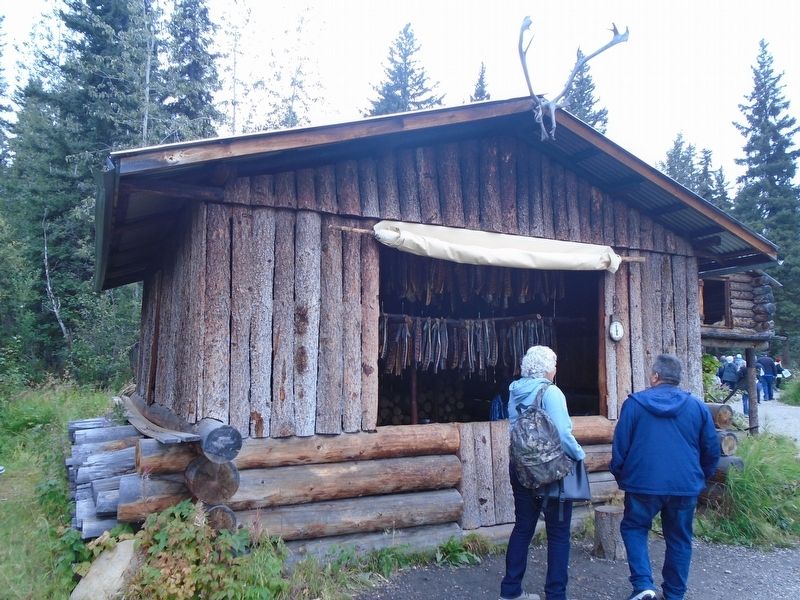
Photographed by William Fischer, Jr., August 19, 2024
5. Fish Camp Smokehouse
Credits. This page was last revised on September 26, 2024. It was originally submitted on September 26, 2024, by William Fischer, Jr. of Reynoldsburg, Ohio. This page has been viewed 384 times since then and 77 times this year. Photos: 1, 2, 3, 4, 5. submitted on September 26, 2024, by William Fischer, Jr. of Reynoldsburg, Ohio.
